AI for Roofing Contractors technology are closing 2-3x more jobs from the same lead volume—not by spending more on advertising, but by responding faster, estimating more accurately, and following up more consistently than competitors still using manual processes. In an industry where the first quote often wins and customer expectations demand instant responses, AI has become the competitive differentiator separating growing roofing companies from those struggling to maintain market share.
The roofing industry faces brutal economics in 2026. Google Ads for roofing keywords often exceed $40-80 per click, with cost per lead ranging from $100-300. When half those leads go cold because of slow response times or fall through the cracks without proper follow-up, marketing ROI becomes unsustainable. AI addresses this directly by ensuring every lead gets immediate attention, accurate estimates, and systematic nurturing.
This guide explains how roofing contractors are deploying AI across their operations—from the moment a lead calls to the final invoice—and the specific results they’re achieving.
Key Takeaway: AI helps roofing contractors close more jobs through three mechanisms: instant lead response (capturing leads before competitors), accurate AI-powered estimates (impressing customers and eliminating over/under-quoting), and automated follow-up (converting leads that would otherwise go cold). The combined effect typically doubles or triples close rates.
Why Do Roofing Contractors Struggle to Convert Leads?
Understanding the conversion problem reveals why AI makes such a dramatic difference. Roofing businesses face unique challenges that manual processes simply cannot solve:
Response time kills deals: When a homeowner discovers storm damage or decides it’s time for a new roof, they typically call 3-5 contractors. Research shows the first contractor to respond captures the job 50% of the time. If you’re on a roof when that call comes in—and you miss it—you’ve likely lost to a competitor who answered.
Estimating delays compound the problem: Traditional roof estimates require scheduling an inspection, visiting the property, measuring manually, calculating materials, and preparing the quote. This process takes 2-5 days during busy seasons. Meanwhile, a competitor with AI-powered estimating delivers a professional quote the same day.
Follow-up falls through the cracks: Roofing sales require nurturing. Homeowners often get multiple quotes and take days or weeks to decide. Without systematic follow-up, leads go cold. Most roofing contractors, overwhelmed with daily operations, follow up inconsistently or not at all.
High lead costs amplify losses: At $100-300 per lead, a 20% close rate means spending $500-1,500 in marketing to acquire each customer. Improving close rate to 40% cuts customer acquisition cost in half—without spending an additional dollar on advertising.
How Does AI Speed Up Roofing Lead Response?
AI answers the fundamental challenge of roofing sales: being available when customers call, even when you’re physically working jobs. Modern AI systems provide several capabilities:
AI Virtual Receptionists
AI phone systems answer every call instantly, 24/7. They conduct natural conversations, qualify the lead (storm damage vs. planned replacement, urgency level, property type), capture contact information, and can even schedule inspection appointments directly into your calendar.
The AI distinguishes between different call types: a homeowner with an active leak needs different handling than someone casually exploring roof replacement costs. It can prioritize urgent leads for immediate callback while scheduling routine inquiries for your next available inspection slot.
Website Chatbots and Lead Capture
AI chatbots on roofing websites engage visitors immediately, answering common questions about services, financing, and timelines. They capture lead information from visitors who might otherwise browse and leave without converting.
Sophisticated chatbots can provide preliminary quotes by asking about roof size and material preferences, schedule inspections, and even pre-qualify leads for financing. Every website visitor becomes an engagement opportunity rather than anonymous traffic.
How Does AI-Powered Estimating Work for Roofing?
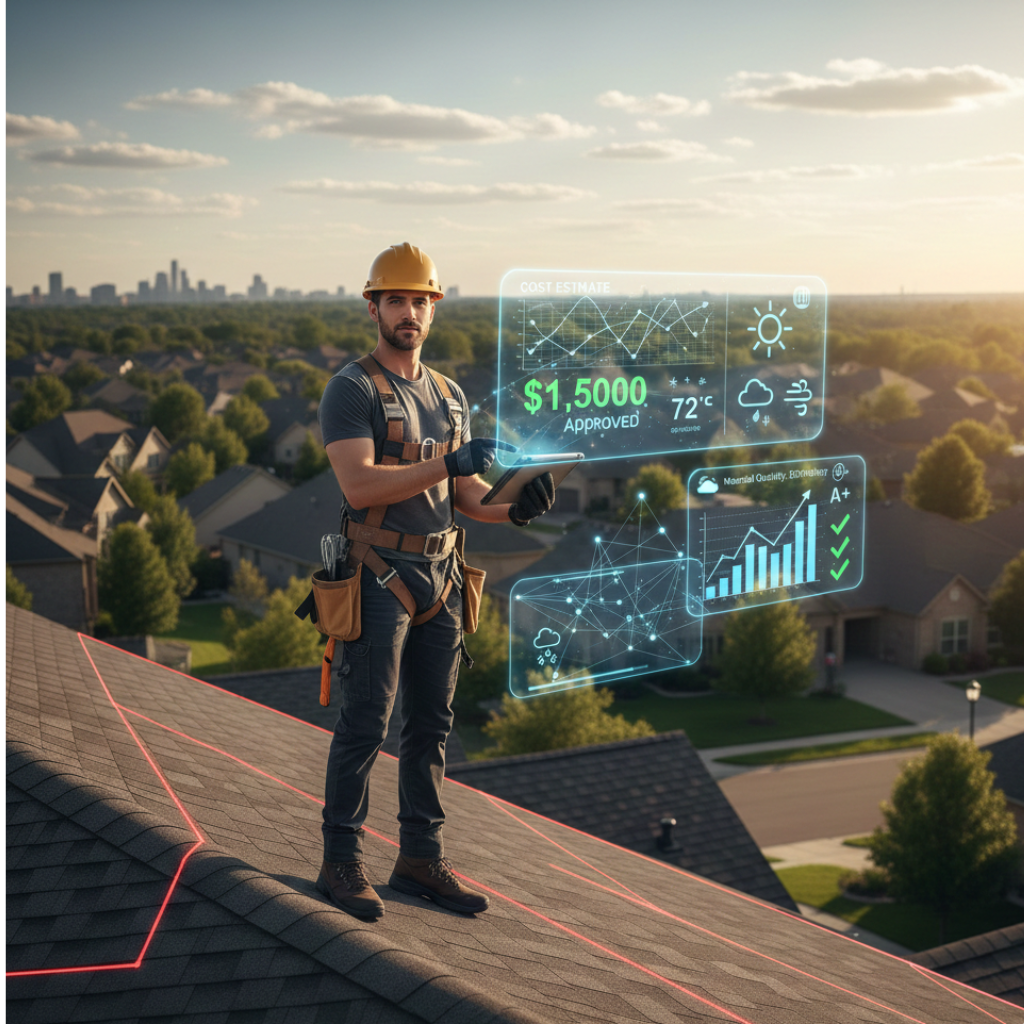
AI estimating represents one of the most transformative technologies in roofing. These systems combine satellite/aerial imagery, property data, and machine learning to generate accurate roof measurements and estimates in minutes rather than days.
The technology process:
- Enter the property address into the AI platform
- AI accesses high-resolution aerial imagery and 3D mapping data
- Machine learning algorithms identify roof planes, calculate pitch, measure area, and detect features (chimneys, skylights, vents)
- System generates detailed measurements including total square footage, waste factor, and material quantities
- Integration with material pricing databases produces itemized cost estimates
- Professional proposal documents are generated automatically
The accuracy is remarkable: leading AI measurement platforms achieve 95-98% accuracy compared to manual measurements. Some roofing contractors report that AI measurements are actually more accurate than their manual measuring because they eliminate human error in complex roof geometries.
| Traditional Estimating | AI-Powered Estimating |
| 2-5 days from inquiry to quote | Same-day quote (often within hours) |
| Requires on-site visit for measurements | Remote measurement via satellite imagery |
| Manual calculation prone to errors | 95-98% accuracy, consistent results |
| Limited to estimator’s daily capacity | Unlimited estimate capacity |
| Inconsistent pricing across estimators | Standardized, optimized pricing |
How Does AI Improve Roofing Sales Follow-Up?
The sales cycle for roofing jobs often spans weeks. Homeowners get multiple quotes, discuss with family, check reviews, and wait for the “right time.” Without systematic follow-up, many qualified leads simply forget about you.
AI CRM systems automate the entire follow-up process:
Immediate post-estimate follow-up: Within hours of delivering an estimate, AI sends personalized follow-up messages thanking the homeowner, highlighting key benefits, and answering common objections.
Timed sequence nurturing: Over the following days and weeks, the AI sends a series of messages: financing information, customer testimonials, urgency reminders (before storm season, while materials are in stock), and gentle check-ins.
Behavioral triggers: When a lead revisits your website, opens an email, or engages with content, the AI adjusts follow-up accordingly. Hot leads get more attention; dormant leads receive periodic reactivation attempts.
Multi-channel coordination: AI coordinates follow-up across email, text, and phone, using the channels each lead responds to best while avoiding over-communication.
What Results Are Roofing Contractors Seeing with AI?
The improvements from AI adoption in roofing are substantial and measurable:
Lead response time: From hours or days to instant. AI ensures every lead gets immediate attention, dramatically reducing the number lost to faster competitors.
Estimate volume: Contractors report preparing 3-5x more estimates per day when using AI measurement tools. One estimator’s daily capacity expands from 3-4 quotes to 10-15 quotes.
Close rates: The combination of faster response, professional instant estimates, and systematic follow-up typically increases close rates by 50-200%. A contractor closing 20% of leads might see that rise to 40-50%.
Cost per acquisition: With the same marketing budget producing more closed jobs, cost per acquisition drops proportionally. A $200 cost per lead with 20% close rate ($1,000 per customer) becomes $500 per customer at 40% close rate.
Real Impact Example: A roofing contractor generating 100 leads/month at $200/lead ($20,000 marketing spend) with 20% close rate completes 20 jobs. Implementing AI increases close rate to 40%, producing 40 jobs from the same $20,000—effectively doubling revenue without additional marketing spend.
What AI Tools Do Roofing Contractors Use?
The roofing AI ecosystem includes several specialized categories:
Roof measurement and takeoff platforms: Tools like EagleView, RoofSnap, and HOVER use aerial imagery and AI to generate detailed roof measurements. They integrate with estimating software to produce complete quotes automatically.
AI-powered CRM systems: Roofing-specific CRMs like JobNimbus, AccuLynx, and Roofr incorporate AI for lead scoring, automated follow-up, and sales pipeline optimization.
Virtual receptionist and chatbot services: AI phone answering systems ensure 24/7 lead capture, while website chatbots engage visitors and schedule appointments automatically.
Drone and inspection AI: AI analyzes drone footage to identify damage, assess roof condition, and generate inspection reports. This speeds up the inspection process and provides documentation for insurance claims.
Scheduling and dispatch optimization: AI scheduling systems optimize crew assignments and job sequencing, reducing windshield time and increasing daily productivity.
How Do You Implement AI for Roofing Contractors Business?
Successful AI implementation follows a logical progression:
Phase 1 – Lead capture and response (Week 1-2): Implement AI answering and website chatbots to ensure no lead goes unanswered. This delivers immediate ROI by capturing leads that would otherwise be lost.
Phase 2 – Estimating acceleration (Week 2-4): Deploy AI roof measurement tools to speed quote delivery. Train your team on the system and establish workflows for rapid estimate turnaround.
Phase 3 – Sales automation (Week 4-6): Configure AI-powered CRM with automated follow-up sequences. Build email/text templates for different lead stages and set up behavioral triggers.
Phase 4 – Optimization (Ongoing): Monitor results, refine AI configurations, and expand capabilities. Add drone inspection, scheduling optimization, and other tools as your team builds AI proficiency.
Frequently Asked Questions
Are AI roof measurements accurate enough to quote from?
Leading AI measurement platforms achieve 95-98% accuracy. Many contractors use AI measurements for initial quotes, then verify during inspection. Some contractors find AI measurements more accurate than manual measuring because they eliminate human error on complex roofs.
Will AI estimating eliminate the need for site inspections?
For most residential jobs, you’ll still want an in-person inspection to assess deck condition, identify hidden damage, and build customer rapport. However, AI allows you to provide same-day preliminary quotes and reserve site visits for serious prospects rather than every inquiry.
How do customers react to AI-generated estimates?
Customers are generally impressed by the professionalism and speed of AI-generated estimates. The detailed measurements, material breakdowns, and professional formatting often exceed what competitors provide with manual processes.
What’s the ROI timeline for roofing AI tools?
Most roofing contractors see positive ROI within 30-60 days. AI answering systems pay for themselves with the first captured lead that would have been missed. AI estimating pays off when you close one additional job that the speed advantage helped win.
Can AI help with insurance claim documentation?
Yes. AI-powered drone inspection and damage assessment tools generate detailed documentation that supports insurance claims. The objective, data-driven reports often help secure better claim outcomes for homeowners.
How much does roofing AI software cost?
Costs vary widely. AI answering services run $100-400/month. Roof measurement platforms charge $20-100 per report or offer monthly subscriptions. Full CRM platforms with AI features cost $100-500/month. Most contractors spend $300-800 monthly total on AI tools.
Close More Roofing Jobs Without Spending More on Marketing
The roofing contractors dominating their markets in 2026 aren’t necessarily the ones with the biggest advertising budgets—they’re the ones converting a higher percentage of leads into paying customers. AI technology makes this possible by eliminating the response delays, estimated bottlenecks, and follow-up failures that kill conversion rates.
The math is straightforward: if you’re paying $200 per lead and closing 20%, your customer acquisition cost is $1,000. Doubling your close rate with AI cuts that to $500—without spending another dollar on marketing. That efficiency improvement flows directly to your bottom line.
Your competitors are already adopting these tools. Every day you wait is a day they’re capturing leads faster, quoting more accurately, and following up more consistently. The technology is proven, the ROI is documented, and the competitive advantage goes to early adopters.
Next Step: Calculate your current close rate and cost per customer. Then model what happens to your revenue if AI tools increase close rate by 50-100%. That projection shows the business case for implementation—and the cost of waiting.