Over half of B2B buyers now ask ChatGPT, Perplexity, or other AI assistants for vendor shortlists before they ever open Google. Gartner’s 2025 research reveals that 70% of enterprise queries have shifted to generative AI engines. If your B2B business isn’t appearing when prospects ask “What’s the best accounting software for manufacturing companies?” or “Who provides IT support for law firms?”, you’re being eliminated from consideration before the traditional sales process even begins.
This isn’t a gradual shift—it’s a fundamental change in how B2B buyers research vendors. McKinsey estimates that 42% of potential deals never reach consideration when product or service data is missing from AI-generated responses. AI-powered platforms have become the second largest source of qualified B2B leads at 34%, behind only social media at 46%. Traditional search has dropped to third place.
For small B2B businesses—consulting firms, software vendors, professional services, agencies, and specialized contractors—Answer Engine Optimization (AEO) determines whether AI includes you in vendor recommendations or leaves you invisible to decision-makers who increasingly rely on AI research.
Key Takeaway: AI traffic to B2B websites converts at 14.2% compared to Google’s 2.8%—a 5x advantage. B2B buyers using AI have clearer intent and higher qualification. The businesses that appear in AI research recommendations receive dramatically more qualified leads than those relying solely on traditional search.
How Has B2B Buyer Research Actually Changed?
Understanding the shift in B2B buying behavior explains why AEO has become critical:
The Old Process (Pre-AI)
B2B buyers would Google solution categories, visit multiple vendor websites, download whitepapers, attend demos, and build shortlists through research-intensive processes. Marketing focused on SEO, content marketing, and paid advertising to capture attention during this extended journey.
The New Process (AI-Powered)
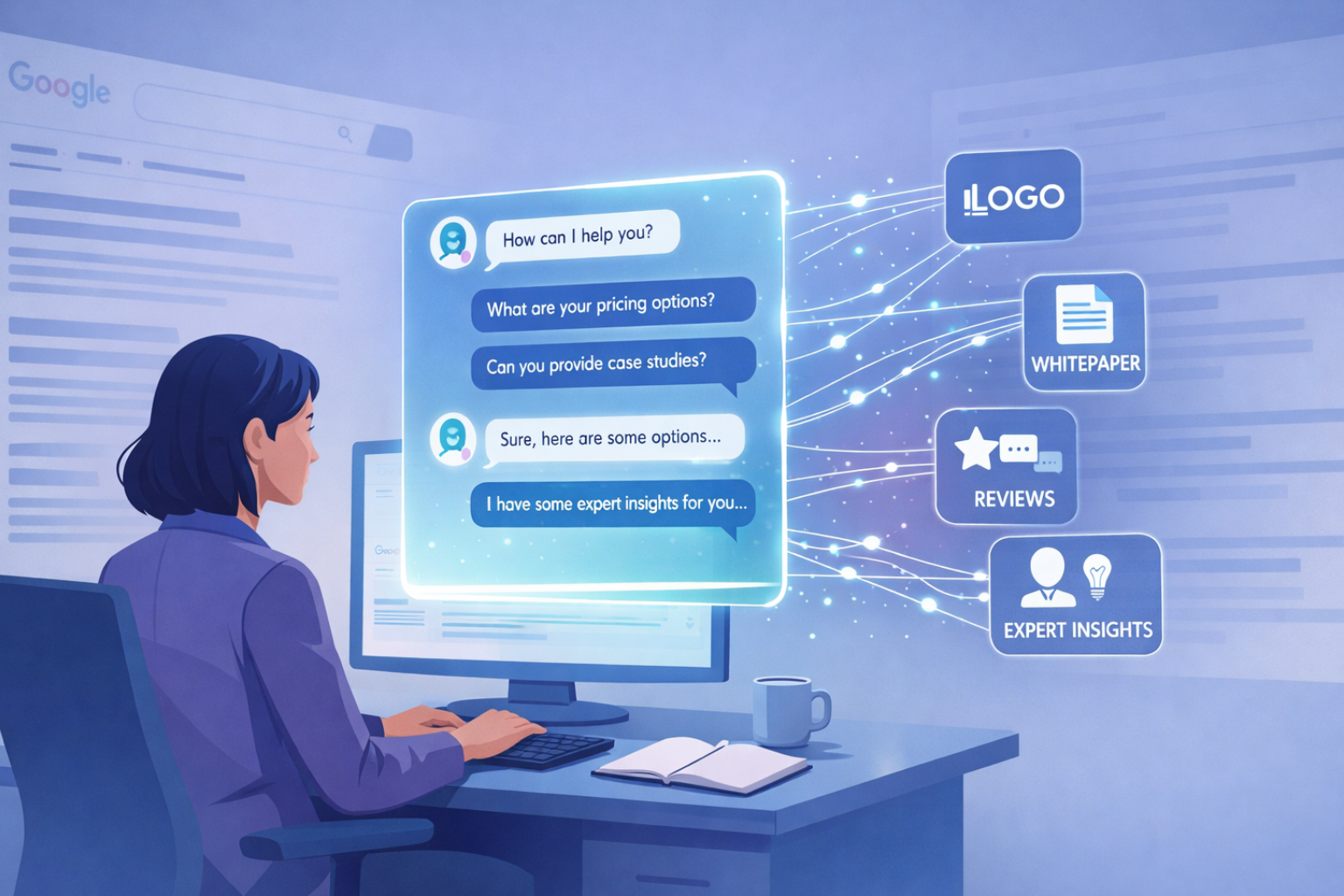
Today’s B2B buyer asks ChatGPT: “What are the best CRM systems for a 50-person professional services firm with Salesforce integration needs?” The AI provides a shortlist with explanations. The buyer then researches only those specific vendors. Businesses not in the AI’s recommendation never enter consideration—regardless of their Google ranking or content marketing investment.
| Traditional B2B Research | AI-Powered B2B Research |
| Google search for solution categories | Ask AI for curated vendor shortlist |
| Visit 10-20 vendor websites | Research only AI-recommended vendors |
| Download whitepapers to understand solutions | AI explains solutions in context of specific needs |
| Extended research timeline (weeks/months) | Compressed research (hours/days) |
| Broad consideration set | Narrow, AI-curated consideration set |
Why Does AI Research Convert Better for B2B?
The 5x conversion advantage of AI traffic (14.2% vs 2.8%) isn’t accidental. It reflects fundamental differences in how buyers arrive:
Higher intent: When a buyer asks AI “What project management tools work best for remote marketing agencies?”, they’re already committed to solving a problem. They’re not browsing—they’re buying.
Better qualification: AI queries often include qualifying information: company size, industry, specific requirements, budget range. Visitors arriving through AI recommendations are pre-qualified matches for your solution.
Trust transfer: When ChatGPT or Copilot recommends your business, it carries implicit endorsement. The buyer approaches your site with positive predisposition rather than skepticism.
Shorter sales cycles: Buyers who’ve had AI explain why your solution fits their needs arrive educated. They understand the value proposition before the first call.
Revenue Impact: If AI research traffic converts at 5x the rate of traditional search, and AI is becoming the primary research channel, the revenue impact compounds. A small B2B firm capturing AI visibility early gains disproportionate market share as buyer behavior continues shifting.
What Makes AI Recommend One B2B Vendor Over Another?
AI systems evaluate B2B vendors differently than consumer businesses. Understanding these criteria shapes effective AEO strategy:
Clarity of offering: AI must understand what you do, who you serve, and what makes you different. Vague positioning (“We help businesses grow”) provides nothing AI can work with. Specific positioning (“NetSuite implementation for mid-market manufacturers”) gives AI clear matching criteria.
Industry and use-case specificity: When a buyer asks for solutions in their specific industry, AI looks for vendors with relevant expertise. Content that addresses specific industries, use cases, and challenges helps AI match you to relevant queries.
Third-party validation: Case studies, testimonials, industry awards, analyst coverage, and media mentions all signal credibility. AI systems weight third-party validation heavily because it indicates verified expertise.
Thought leadership content: Original research, expert commentary, and educational content help AI understand your expertise areas. When AI needs to explain a concept, it cites authoritative sources—positioning your business as one increases recommendation likelihood.
Structured data: Schema markup (Organization, Service, FAQ, Review) helps AI systems parse your offerings accurately. Without structured data, AI may misunderstand or overlook your business entirely.
How Do Small B2B Businesses Implement AEO?
B2B AEO differs from consumer AEO in emphasis but shares core principles. Here’s the implementation framework:
-
Define Your AI-Discoverable Positioning
AI needs to match your business to specific queries. Create clear, structured positioning:
- What specific problems do you solve?
- What industries/company sizes do you serve?
- What makes your approach different?
- What outcomes do clients achieve?
Document these clearly on your website and ensure consistency across all platforms.
-
Build Industry-Specific Content
When a manufacturing COO asks AI for IT consultants who understand manufacturing, AI looks for industry-specific signals. Create content demonstrating expertise:
- Industry-specific case studies with quantified results
- Guides addressing industry-specific challenges
- Comparison content (“ERP systems for manufacturing: Oracle vs SAP vs NetSuite”)
- FAQ content answering industry-specific questions
-
Implement B2B-Relevant Schema Markup
Schema types particularly relevant for B2B:
- Organization (with details about expertise areas)
- Service (for each service offering)
- FAQ (addressing prospect questions)
- Review (client testimonials with structured data)
- Article (for thought leadership content)
-
Develop Citable Thought Leadership
AI systems cite authoritative sources. Position your business as one:
- Publish original research and data
- Create definitive guides on topics in your expertise
- Offer expert commentary on industry trends
- Contribute to industry publications and podcasts
-
Collect and Structure Social Proof
Testimonials, case studies, and client logos provide trust signals AI systems weight:
- Collect detailed testimonials with specific outcomes
- Structure case studies with clear problem-solution-result format
- Mark up reviews with schema
- Display industry certifications and partnerships
Which B2B Categories Need AEO Most Urgently?
While all B2B businesses benefit from AEO, certain categories face particular urgency:
Professional services: Consulting firms, agencies, and advisors—where trust and expertise drive selection. AI research often includes “best marketing agency for SaaS startups” queries where recommendations determine consideration sets.
Software and technology vendors: The software selection process increasingly starts with AI queries like “What CRM works best for real estate teams?” Vendors not appearing in these responses lose deals they never knew existed.
Specialized contractors and service providers: IT services, manufacturing partners, logistics providers—any specialized B2B service where buyers research options before reaching out.
Financial and legal services: Accountants, attorneys, and financial advisors serving business clients. Trust signals are paramount; AI recommendations carry significant weight.
Frequently Asked Questions
How do I check if AI systems recommend my B2B business?
Ask ChatGPT, Perplexity, and Copilot questions your prospects would ask. “What are the best [your category] for [your target market]?” “Who provides [your service] for [your industry]?” Note whether you appear, how you’re described, and what competitors are mentioned.
Does B2B AEO require different tactics than B2C?
The principles are similar but emphasis differs. B2B places more weight on thought leadership, industry expertise, case studies, and professional credentials. B2C emphasizes local presence, reviews, and immediate availability. Both require structured data and clear positioning.
How long before B2B AEO shows results?
Timeline varies with existing content assets. Businesses with strong case studies and thought leadership may see results within weeks of implementing schema and restructuring content. Building new thought leadership content takes months but provides lasting competitive advantage.
Can a small B2B firm compete with larger competitors in AI recommendations?
Absolutely. AI systems evaluate relevance and expertise, not company size. A 10-person consulting firm with deep expertise in healthcare IT may appear ahead of a generic Big Four practice for healthcare-specific queries. Specialization and clear positioning help smaller firms compete.
Should B2B companies use AI tools in their own sales process?
Yes—and doing so provides insights into how AI views your market. Use AI tools for competitive research, content ideation, and understanding how your category is being discussed. This informs both AEO strategy and broader go-to-market approach.
Get in Front of AI-Powered Buyer Research
The B2B buyer’s journey has fundamentally changed. When decision-makers ask AI assistants to shortlist vendors, the businesses that appear in those recommendations capture consideration. The businesses that don’t—regardless of their Google ranking, content library, or sales team excellence—are eliminated before the game begins.
For small B2B businesses, this represents both threat and opportunity. The threat: invisible elimination from consideration sets. The opportunity: AI research levels the playing field. A specialized firm with clear positioning, demonstrated expertise, and structured data can outcompete larger generalist competitors in AI recommendations.
The businesses that implement B2B AEO now—positioning clearly, building citable thought leadership, collecting structured social proof—will capture disproportionate market share as AI becomes the default starting point for vendor research.
Next Step: Ask ChatGPT and Perplexity three questions your ideal prospects would ask when researching vendors in your category. Note who appears, how they’re described, and what differentiators AI highlights. That’s your competitive landscape—and your AEO roadmap.