
Most advice about AEO for small business gets one thing badly wrong: it treats the four big answer engines as if they want the same thing. They don’t. Google has published guidance that contradicts half of what AEO blogs recommend. Perplexity rewards a page you published on Tuesday. Copilot won’t cite you at all if you’ve never verified your site in Bing. Four gatekeepers, four rulebooks.
Below: a separate checklist for each, honest cost ranges, and how to tell whether you should be doing this yourself.
What AEO for small business actually means
Answer engine optimization is the work of getting your business named and linked as a source inside AI-generated answers, rather than only appearing as a blue link below them.
The practical difference from classic SEO is narrower than most people assume. Google’s own guide to optimizing for generative AI features states that its AI features run on the same core Search ranking systems, and that optimizing for them is still SEO. A page has to be indexed and eligible for a snippet before it can appear in an AI Overview at all.
So the foundation is unchanged. What’s new sits in four places: which bots you allow, whether you exist in Bing, how the first 60 words of each section read, and where else your business gets talked about.
Everything else is either standard SEO in a new costume or a tactic that only matters on one platform. Knowing which is which saves you a lot of wasted weekends. Our breakdown of how AI engines choose which sources to cite goes deeper on the mechanics.
The mistake almost every AEO guide makes
Read five AEO articles and four will tell you to create an llms.txt file first.
Google says it ignores them. Not “deprioritizes,” ignores. The same guidance page lists llms.txt under things you don’t need to do, alongside chunking your content into tiny pieces and rewriting pages specifically for AI systems. Google also states that structured data isn’t required for its generative AI features, though it still recommends schema for rich results in normal search.
That’s a fairly loud statement from the platform that handles most of your customers’ searches, and it’s mostly absent from the AEO advice circulating right now.
The read isn’t “ignore llms.txt forever.” Some non-Google systems do consume those files, and building one costs an afternoon. The read is that it’s a low-priority item promoted to step one because it’s easy to write blog posts about. Meanwhile the thing that actually gates Copilot visibility, verifying your site in Bing Webmaster Tools, takes 15 minutes and almost nobody mentions it.
Four platforms, four checklists
Work these in order. Google first, because volume. Bing second, because it’s cheap and it gets you measurement.
Google AI Overviews and AI Mode
- Confirm the page is indexed and eligible for a snippet in Search Console. Nothing else matters until it is.
- Check your site is included in Search generative AI features in Search Console settings.
- Write what Google calls non-commodity content. Their example of the bad version is a generic listicle of tips; the good version is a first-hand account with detail only you have. For a service business: real job specifics, real pricing, real photos of your own work.
- Claim and finish your Google Business Profile, because AI responses can pull local business details straight from it.
- Add LocalBusiness or Organization schema. Not because Google requires it for AI answers, but because it earns rich results elsewhere.
- Skip: llms.txt, content chunking, buying mentions.
ChatGPT
- Allow
OAI-SearchBotin robots.txt. This is the one that governs whether you can show up in ChatGPT’s search results, and per OpenAI’s crawler documentation it’s controlled independently fromGPTBot, which handles training data. - That independence matters. Plenty of sites blocked
GPTBotin 2023 to stay out of training, never touchedOAI-SearchBot, and now assume they’re invisible in ChatGPT when they aren’t. Others blocked everything with a wildcard. - Check your firewall too. Allowing a bot in robots.txt means nothing if Cloudflare or your WAF returns rate-limit errors to it.
- Make sure content renders in raw HTML. If a paragraph only appears after JavaScript runs, assume it won’t be read.
- Expect a slower ramp than Perplexity. ChatGPT leans toward established, frequently referenced domains.
Perplexity
- Allow
PerplexityBot. - Answer the question in the first sentence under each heading. Perplexity is unusually literal about matching a query to a heading and lifting the text directly beneath it.
- Publish and update often. Perplexity crawls in near real time, so a page updated this week can beat a page that has held a Google ranking for six years.
- Be present where discussions happen. Community platforms and niche forums show up in Perplexity’s cited sources more than on any other engine. Answering real questions in your industry’s subreddit is AEO work, even though it doesn’t feel like it.
- This is where a small business has the best short-term shot. Fewer competitors have figured it out.
Microsoft Copilot
- Verify your site in Bing Webmaster Tools. Copilot retrieves from Bing’s index, so if you’re not in it, you’re not eligible. Most small business sites have never been submitted.
- Submit your sitemap to Bing separately from Google.
- Turn on Bing’s IndexNow so updates get picked up quickly.
- Then open the AI Performance report, covered below.
- Copilot is the least contested of the four. Most content teams optimize exclusively for Google, which leaves the Bing side of the fence noticeably lower.
Where the four platforms disagree
This is the table nobody publishes, and it’s the reason generic AEO checklists underperform.
| Tactic | Google AI | ChatGPT | Perplexity | Copilot |
|---|---|---|---|---|
| llms.txt file | Ignored, stated officially | Not a documented signal | Not a documented signal | Not a documented signal |
| Freshness of the page | Moderate weight | Slower to reflect changes | Very high weight | Ties to Bing crawl rate |
| Separate crawler permission needed | Google-Extended | OAI-SearchBot | PerplexityBot | Bingbot |
| Forum and community presence | Indirect | Indirect | Direct and heavy | Indirect |
| First-party citation dashboard | Yes, in Search Console | No | No | Yes, in Bing Webmaster Tools |
| Typical lag for a new page | 4 to 8 weeks | 1 to 3 weeks | Days | 1 to 3 weeks |
Read across a row and the strategy writes itself. Freshness is close to free, so quarterly refreshes of your top ten pages buy Perplexity visibility that costs a competitor nothing to match, and that most never bother with.
Do Gemini, Grok, and Meta AI Matter Yet?
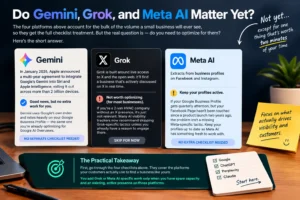
The four platforms above account for the bulk of the volume a small business will ever see, so they get the full checklist treatment. They’re in all three of the AEO tool roundups published this year, with one more on the way and owners keep asking if they’re missing out by ignoring them. TLDR: mostly not yet, except for one thing that’s worth two minutes of your time.
Gemini. In January 2026, Apple announced a multi-year agreement to integrate Google’s Gemini into Siri and Apple Intelligence, rolling it out across more than two billion active devices. That sounds like a reason to build a checklist for Gemini. It isn’t. Gemini uses Google’s own index and on local searches it heavily depends on Google Business Profile data. Which is the same profile you’re already claiming and completing in the Google section above. There is no separate work here. A complete and accurate Google Business Profile is doing double duty, for Google AI Overviews and Gemini at the same time.
Grok. Grok is built around live access to X and the open web. It’ll find a business that’s actively discussed on X in real time. For a 2-van HVAC company without an X presence, it’s just not worth optimizing, and a lot of 2026 AI visibility trackers now explicitly recommend skipping Grok-specific tactics unless you already have a reason to engage there. “Some brands are deliberately staying away from Grok because of the platform’s history of moderation controversies. That’s a judgment call on your part, not a technical checklist item.
Meta AI. Extracts from business profiles on Facebook and Instagram. If your Google Business Profile gets quarterly attention, but your Facebook Page hasn’t been touched since a product launch two years ago, the problem isn’t a missing Meta-specific tactic. Keep the profile up to date so Meta AI has something fresh to work with.
Practical takeaway: First, go through the four checklists above. They cover the platforms your customers actually use to find a business like yours. You don’t add Grok or Meta AI specific work until you have spare capacity and an existing, active presence on those platforms.
The two free dashboards that tell you if it’s working
Until this year, measuring AI visibility meant paying for a tracking tool or typing prompts into ChatGPT by hand. Two things changed.
Google added a Generative AI performance report inside Search Console, which shows how people are reaching your content through its AI features.
Microsoft went further. In February 2026 it shipped an AI Performance report inside Bing Webmaster Tools showing which of your URLs get cited in Copilot and Bing AI answers, which queries triggered those citations, and how the numbers move over time. It’s free with any verified site.
The grounding queries are the interesting part. Those are the searches Copilot generates internally to find sources, not the phrasing your customer typed. Reading them tells you the question shape the engine is trying to satisfy, which beats most paid keyword tools. We cover reading both dashboards in our post on the new AI visibility reports.
Set up both before you spend a dollar on a third-party tool. And be careful with tools claiming access to internal Google ranking metrics. Google says outright that none have it.
The AEO Tools Worth Paying For (and the Free Ones First)
You can pay for no checks until after you’ve run two free. HubSpot’s AEO Grader will audit your structured data, FAQ schema, and clarity of content in a few minutes with no account required. ProductRank.ai queries the major engines with your brand name and topic keywords and hands back a visibility score, which is a quick way to confirm whether you’re being cited at all before you spend time diagnosing why.
If those two find gaps that the free dashboards above can’t explain, or you want citations tracked on a schedule rather than checked by hand, paid tools start cheap and scale fast. Cost: Entry-tier platforms are about $59 a month for a limited prompt count across three engines. Near $250 a month for roughly 125 prompts across the four engines that matter most to a service business are mid-tier options: ChatGPT, Perplexity, Google AI Overviews, Copilot.
This price point is all about three things. Multi-engine coverage, not just a tool to monitor ChatGPT Citation source discovery tells you which specific pages got cited, not just that your brand was mentioned. And a prompt list created from your real buyer questions, not some generic industry keyword list written by someone else.
Forget the $499 a month and up for one of the enterprise suites. Those are for agencies and multi-brand teams tracking share of voice across ten platforms at once. A single-location business confirming it shows up for “emergency plumber” + its city doesn’t need that depth, and won’t use most of it. This is the line item for the “$50 to $500” tracking tool tier in the cost table below. Budget for it there, not as a surprise separate out.
What AEO costs a small business in 2026
Here is what you’ll see quoted. Ranges are wide because scope varies, and any agency giving a firm number before looking at your site is guessing.
| Approach | Monthly cost | Your time | Realistic fit |
|---|---|---|---|
| Fully DIY, free tools | $0 to $50 | 10 to 15 hours | One location, owner has patience for technical setup |
| DIY plus a tracking tool | $50 to $500 | 8 to 12 hours | You have someone in-house who already does the website |
| One-time audit, you implement | $250 to $3,000 once | 15 to 30 hours over a quarter | You want the roadmap but have cheap labor internally |
| Audit plus implementation retainer | $1,500 to $5,000 | 2 to 4 hours | Service business, multiple cities, no dev resource |
| Full program with content volume | $5,000 to $15,000 | 2 hours | Multi-location, competitive category, revenue depends on search |
| In-house AEO specialist | $7,000 to $11,000 in salary | Hiring and managing | Rarely worth it below roughly $10M revenue |
The number people forget is the middle column. A $200 tool subscription with 12 hours a month against it isn’t a $200 program. At any reasonable value on your own time, that’s the most expensive tier on the table.
DIY or hire someone
Three questions decide it.
Can you edit robots.txt, add JSON-LD, and verify a site in two webmaster consoles without breaking anything? If yes, the technical foundation is a weekend. If that sentence makes you want to close the tab, the foundation is where the money goes, and it’s a one-time spend rather than a retainer.
Do you have 10 hours a month you’d otherwise spend on something lower-value? Not 10 hours in theory. Ten hours in the week you’re short a technician and quoting three jobs.
Does search actually drive your revenue? A two-van HVAC company in Tampa where 70% of calls come from Google is a different case from a referral-driven consultancy. As an example: 30 leads a month, a 25% close rate, a $600 average ticket, and a 10% visibility lift is worth about $450 a month. That caps what a retainer can rationally cost.
Our breakdown of in-house versus agency costs runs the same math across the whole marketing function.
The hybrid most small businesses land on: pay once for an audit and the technical fixes, keep content and reviews in-house. If you want a starting point, our SEO, GEO and AEO audit covers exactly the technical layer that’s hard to do yourself, and our AEO optimization service picks up if you’d rather hand off the whole thing.
Your first 30 days, in order
Week 1. Verify in Google Search Console and Bing Webmaster Tools. Submit sitemaps to both. Read your robots.txt and confirm OAI-SearchBot, PerplexityBot, ClaudeBot and Google-Extended aren’t blocked. Check your WAF isn’t blocking them either. Finish your Google Business Profile.
Week 2. Add LocalBusiness or Organization schema sitewide. Write down the 10 questions customers ask you most, including the awkward pricing ones. Build one FAQ page from those answers and mark it up with FAQPage schema.
Week 3. Rewrite the opening of every section on your five most important pages so the first 40 to 60 words answer the heading directly. Turn vague headings into the question a customer would type. This one change moves more than anything else here.
Week 4. Run your top 15 service-plus-city queries manually through Google AI Mode, ChatGPT, Perplexity and Copilot. Write down who gets cited. That list, not Google page one, is your real competitive set. Then start a review request habit, because consistent Google reviews feed the trust signals every one of these engines reads.
Check results at 90 days. Our small business AEO playbook has the longer version of this sequence, and local service businesses should also read the plumbing and HVAC specific version.
Six Mistakes that quietly kill results
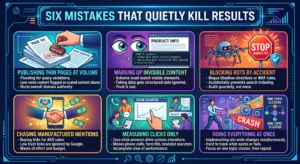
Publishing thin pages at volume. Google’s spam policy on scaled content abuse covers spinning up pages for every query variation. Fastest way to make things worse.
Marking up content that isn’t visible on the page. Schema has to reflect what a human sees. Faking it gets structured data ignored.
Blocking bots by accident. A wildcard disallow, a plugin default, a WAF rule. Check quarterly, not once.
Chasing mentions. Manufactured mentions don’t work the way AEO pitch decks suggest, and Google has said as much.
Measuring clicks only. If an answer engine names your business and the customer calls you directly, no click was recorded. Watch calls, form fills, and branded search volume alongside traffic. That shift is the subject of why a number one ranking now leaks most of your clicks.
Doing everything at once. Pick one topic cluster, fix it, measure it, repeat. One cluster done well teaches more than a site-wide rollout done badly.
Measuring the Channel That Doesn’t Click
And the above mistake of “measuring clicks only” needs two specific fixes, not just a warning.
First, build the channel in GA4 that most sites don’t have. Build a custom channel group called something like “AI Search” and include referrers from chatgpt.com, chat.openai.com, perplexity.ai, gemini.google.com, claude.ai and copilot.microsoft.com. Report it alongside Organic Search, Paid Search and Direct and let it run for a couple of months before you draw your conclusions. Our post on how to enable GA4’s AI assistant traffic channel has the exact setup.
Second, watch what the industry now calls Share of Model. Run a fixed list of 15 to 20 buyer prompts through the engines your customers use once a month. Count how often you’re named against your named competitors, and log the result somewhere you’ll actually check again. This is the #1 indicator. Citations often take weeks to actually show referral traffic in GA4 so a flat AI Search channel in month 1 is normal and doesn’t mean the work isn’t landing.
When a citation drops out from one check to the next, it’s almost always for a specific, fixable reason: a page went down, a competitor published something fresher, or a technical block crept in. Once you look, it’s almost never a mystery. This exact scenario is covered step by step in our recovery playbook for a lost AI citation.
FAQs
Is AEO for small business different from SEO?
Mostly it is the same work pointed at a different outcome. Google itself says optimizing for its generative AI features is still SEO. The parts that are genuinely additional are crawler permissions for non-Google bots, Bing verification, answer-first formatting, and off-site presence in the places specific engines pull from. If your SEO foundation is broken, no amount of AEO tactics will rescue it.
How much does AEO cost for a small business in 2026?
Doing it yourself costs roughly zero to 500 dollars a month in tools plus 8 to 15 hours a month of your time. One-time audits are commonly quoted between 250 and 3,000 dollars depending on site size. Ongoing agency retainers most often start around 1,500 to 3,000 dollars a month for a small business, and rise from there with content volume and the number of locations.
Do I need an llms.txt file?
Not for Google. Google states plainly that its Search systems ignore llms.txt and similar files, and that having one will neither help nor hurt your visibility there. Some other tools and non-Google systems do read these files, so it is not a waste, but it belongs near the bottom of a small business priority list, not at the top where most guides put it.
How long before AEO shows results?
Perplexity can pick up new or updated pages within days because it crawls in near real time. ChatGPT search usually takes a few weeks. Google AI Overviews follow normal Google indexing, so expect four to eight weeks for a new page and sometimes longer for a competitive query. Judge the program at 90 days, not at 3 weeks.
Can I pay to appear in AI answers?
Not for the citation itself. There is no paid placement that buys you a source slot inside a Google AI Overview, a ChatGPT answer, or a Perplexity response. Ad formats are appearing next to and inside some AI surfaces, but those are ads, and users read them as ads. The cited source position has to be earned.
Which platform should a small business optimize for first?
Google, then Bing. Google still handles the overwhelming majority of searches your customers run, and Bing verification is a 15 minute job that gets you both Copilot eligibility and the only free citation dashboard any engine currently publishes. Chase ChatGPT-specific tactics after those two are done.
Where to start this week
Open your robots.txt and read it. Then verify your site in Bing Webmaster Tools. Under an hour together, no cost, and between them they decide whether the rest of your AEO work has anywhere to land.