The uncomfortable truth is that AI engines do not read your site like a loyal customer. They slice it into claims, compare those claims against other sources, decide whether your brand looks trustworthy, and then either use you or ignore you. Your clever headline matters less than your clean answer. Your ranking matters less than whether the engine can understand who you are and what you know.
That means the job is not to “write for robots.” The job is to make your best human expertise easy for a machine to verify and repeat.
| Old SEO habit | AEO habit | Why it wins in answers |
| Warm up slowly | Answer first, then explain | Engines extract the opening claim |
| Optimize one page | Build a topic cluster | Engines trust depth |
| Hide dates | Show publish and updated dates | Freshness reduces uncertainty |
| Use broad claims | Add numbers, sources, and examples | Specific claims are easier to cite |
| Measure only clicks | Measure mentions and citations | AI answers may not send a click |
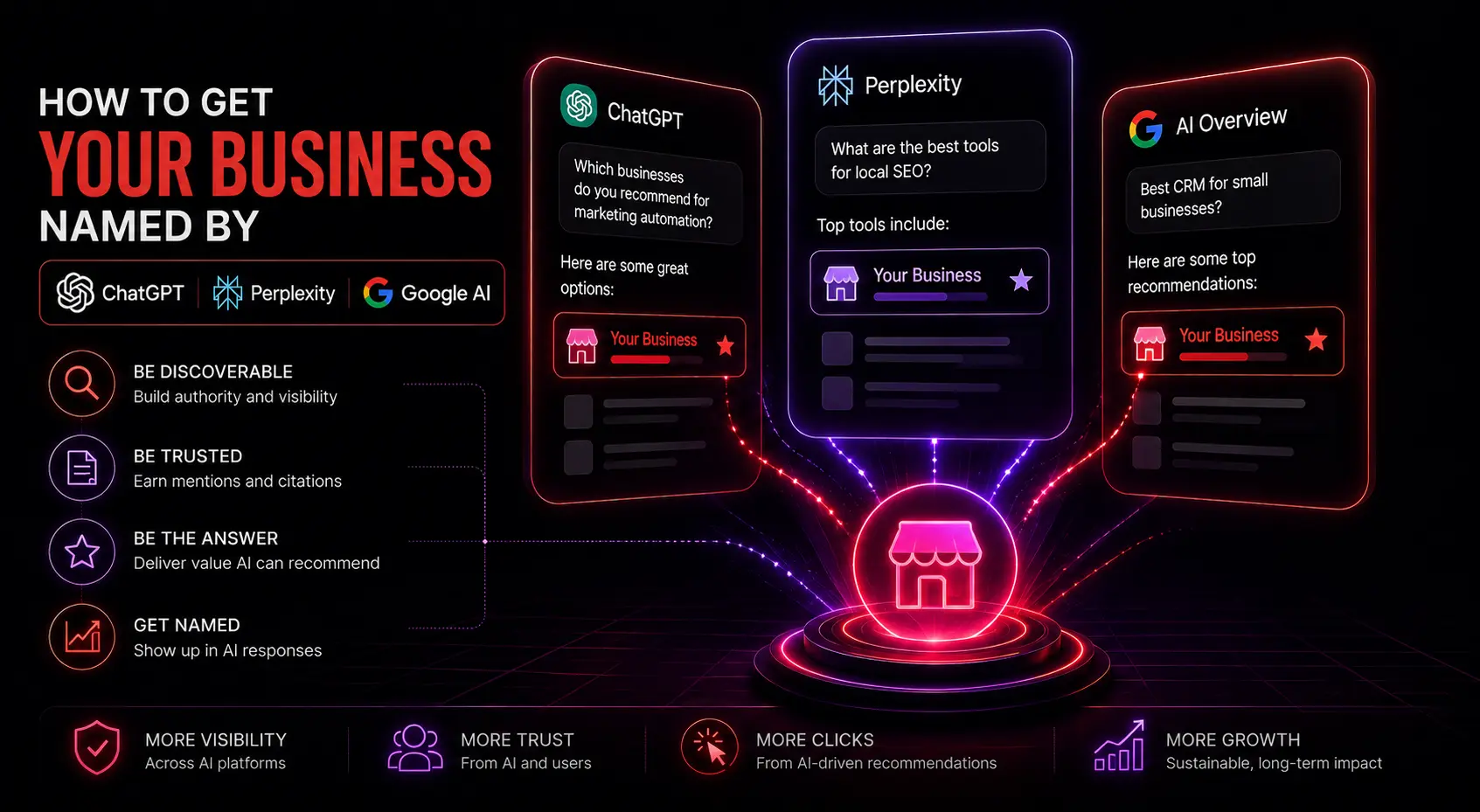
Your next customer is not scrolling page one of Google. They are typing “best [your service] near me” into ChatGPT, reading the three names it recommends, and choosing from that list. If your business is not one of the three, you do not exist in that conversation, no matter how well you rank in traditional search.
This is the shift behind Answer Engine Optimization. AEO is the practice of structuring your content and your brand so AI engines like ChatGPT, Perplexity, Claude, and Google AI Overviews cite you, quote you, and recommend you in their answers. It is not the same game as ranking for clicks, and the businesses winning it are not necessarily the ones at the top of Google. They are the ones who made their content easy for an AI to extract, trust, and repeat.
This is a do-it guide. Below: what AEO is, how each engine sources differently, the tactics in priority order, a copy-and-paste answer-block template, an AEO audit checklist, a 30-day rollout plan, the platform-by-platform playbook, how to measure it, and the mistakes that keep businesses invisible.
The New Search Result Is a Sentence With Your Name In It
Answer Engine Optimization is the work of making your content the source an AI engine pulls from when it answers a question. Instead of optimizing a page to rank and earn a click, you optimize it to be extracted and cited inside an AI-generated answer, where the user often never visits your site but sees your brand named as the authority.
It rests on six pillars: content structure, answer formatting, citation quality, schema markup, entity recognition, and topical authority. Get those right and you become a source the engines reach for. Ignore them and you stay invisible in the answer layer even while you rank in the blue links.
One clarification, because the terms blur: AEO and Generative Engine Optimization (GEO) overlap heavily. Think of AEO as the tactical craft of getting cited in answers, and GEO as the broader strategy of being recommended across generative engines. This guide is the tactical half.
ChatGPT, Perplexity, and Google Do Not Trust Sources the Same Way
Before the tactics, one fact that should shape all of them: these engines do not cite the same way, so “optimize for AI” is too vague to act on. The differences are large.
An analysis of 680 million citations found that only about 11% of domains are cited by both ChatGPT and Perplexity. Each runs on fundamentally different citation logic. A 2026 study measured a 46-fold gap in brand citation rates between platforms: ChatGPT cited brands roughly 0.59% of the time while Perplexity cited them around 13.05%. Perplexity is citation-hungry and fast; ChatGPT is far more selective.
Perplexity also heavily favors fresh content. It cites material published in the last 30 days at roughly an 82% rate and can pick up new content within hours of indexing. ChatGPT and Claude lean more on established authority and move slower. This is why fresh, well-structured content is your fastest route to a citation on Perplexity while authority compounds your standing on ChatGPT.
The Work That Makes You Easier to Cite
These are the changes that actually move citation rates, ordered by impact.
Put the answer in the first breath
This is the single highest-leverage change. AI engines extract the first one to two sentences of a section to decide whether it answers the query. So open every section with a direct, self-contained answer, ideally with a specific number or named source, before you elaborate. Do not warm up. The first sentence is the one that gets quoted, so make it the answer.
Give the engine clean pieces to lift
Engines extract structured, scannable content far more readily than walls of prose. Build in the formats they reach for: a short TL;DR or summary near the top, clear claims backed by supporting evidence, a Q&A or FAQ section that mirrors how people actually ask, and data tables wherever a comparison or set of numbers belongs. Each is a clean, liftable unit an engine can drop into an answer.
Make freshness and authorship impossible to miss
Engines weigh freshness and credibility, and they look for explicit signals. Show a named author, a publish date, and a last-updated date on every piece. And use visible year signals, putting “2026” in titles and headings improves citation rates by roughly 30%, because it tells the engine the content is current. Stale-looking content gets passed over even when it is correct.
Show depth, not one lucky article
Citations cluster around sites that demonstrate depth on a topic, not one-off posts. Sites with dense internal linking networks get cited more often. So link every new piece to two to four existing authoritative posts on related subjects, building a web that signals you are a genuine authority, not a single page that happened to match.
Make the business entity unambiguous
Structured data helps engines parse and trust your content. Implement schema (Article, FAQ, and where relevant Organization and breadcrumbs) so the machine reads your pages cleanly. Then strengthen your entity, the way the AI understands who you are, by keeping your business name, description, and core facts consistent across your site and the wider web. Entity strength is what lets an engine confidently name you.
The Answer Block That Machines Can Quote
The format engines love is consistent. Build every key section like this:
*Heading as a question or clear topic.* For example, “How much does X cost?”
*First sentence: the direct answer with a specific.* “X costs $200 to $500 a month for most small businesses.” State it plainly, with a number or named source, in one sentence.
*Next one or two sentences: the supporting detail.* Briefly back the answer with the why or the context.
*Then elaborate.* Add the nuance, examples, and depth below, where it helps the reader but is no longer competing to be the extracted snippet.
Here is the before and after. Weak: “There are a lot of factors that go into pricing, and it really depends on your needs, but let’s explore them.” Strong: “An AI receptionist costs $200 to $500 a month for 24/7 coverage. That is roughly 90% less than a full-time hire once you include benefits and taxes.” The strong version is liftable as-is into an AI answer. The weak version gives the engine nothing to quote.
The Page Audit: Fix These Before Publishing
Score the page quickly before you publish:
| Check | Pass/fail question | Fix if weak |
| Direct answer | Does the first sentence answer the heading? | Rewrite the opener |
| Specificity | Is there a number, source, or concrete example? | Add evidence |
| Extractability | Could one paragraph stand alone in an AI answer? | Split long prose |
| Trust | Are author, date, and updated date visible? | Add page-level signals |
| Entity | Is the business name/category consistent? | Standardize facts |
| Internal depth | Does it link to related authority pages? | Add 2-4 relevant links |
| Schema | Does structured data match the page? | Add Article/FAQ/Breadcrumb schema |
Run any important page against this list and fix what is missing:
Does every section open with a direct, specific answer in the first sentence? Is there a TL;DR near the top and an FAQ at the bottom that matches real questions? Are author, publish date, and updated date visible? Is the current year in the title and key headings? Are there data tables or clear claim-plus-evidence blocks where relevant? Is Article and FAQ schema implemented? Does the page link to two to four related authoritative pages on your site? Are your business name and core facts identical here and across the web? Each “no” is a citation you are leaving on the table.
A 30-Day Plan That Does Not Turn Into Theory
Do not boil the ocean. Sequence it.
*Week 1: Pick and fix your flagship.* Choose your single most important commercial page or post. Rewrite every section opening to lead with a direct answer, add a TL;DR and FAQ, make author and dates visible, and put the year in the title.
*Week 2: Add structure and schema.* Add Article and FAQ schema to that page, insert data tables or claim-plus-evidence blocks, and link it to two to four related strong pages.
*Week 3: Expand to your next three pages.* Apply the same checklist to your next most important pages, and publish one fresh, current-year piece targeting a question your customers actually ask, to win fast Perplexity citations.
*Week 4: Strengthen your entity and measure.* Make your business name, description, and facts consistent across your site, profiles, and listings, then begin tracking whether you appear in AI answers for your target questions.
Play Each Engine on Its Own Terms
Here is the practical version in table form:
| Engine | What it tends to reward | Best move this month | What to watch |
| Perplexity | Fresh, well-cited, current content | Publish updated answer blocks and tables | Fast citation tests |
| ChatGPT | Entity clarity and authority | Standardize brand facts across the web | Brand mention consistency |
| Google AI Overviews | Search authority plus source fit | Keep SEO strong and add structured answers | AIO presence by query type |
| Claude | Substantive, careful explanation | Publish deeper guides with clear sourcing | Slower authority compounding |
Each engine rewards slightly different moves, so play to each:
*Perplexity:* Your fast feedback loop. Publish fresh, current-year content with clean answer blocks; it can cite you within days and favors content under 30 days old.
*ChatGPT:* The selective one. Win it with entity strength and topical authority over time, consistent brand facts everywhere and deep, interlinked coverage of your topics.
*Google AI Overviews:* Leans on your existing search authority plus structured data, so keep strong SEO foundations and clean schema, and expect changes to land over weeks.
*Claude:* Rewards genuine authority and well-structured, substantive content; moves slowest, so treat it as a compounding payoff of the same work.
When You Should Expect Signals
Set expectations correctly. After structural fixes, changes tend to appear in Perplexity within about 2 to 7 days, in ChatGPT within roughly 7 to 21 days, and in Claude and Google AI Overviews within about 14 to 45 days. Perplexity is your fast feedback loop; the others reward patience. Do not judge the whole effort by week one.
Track Share of Answers, Not Just Traffic
A simple tracking sheet is enough at the start:
| Query | ChatGPT | Perplexity | Google AI Overview | Claude | Notes |
| Best [service] near me | Named / not named | Named / not named | Cited / not cited | Named / not named | Record competitors |
| How much does [service] cost? | Quoted / not quoted | Linked / not linked | Cited / not cited | Quoted / not quoted | Track answer wording |
| Is [brand] good for [use case]? | Accurate / inaccurate | Accurate / inaccurate | Accurate / inaccurate | Accurate / inaccurate | Fix entity gaps |
The goal is not to obsess over one prompt. The goal is to watch your share of answers rise across a stable set of buyer questions.
Stop checking only Google rankings. Build a simple tracking habit: list the 10 to 20 questions your customers actually ask, then regularly run them through ChatGPT, Perplexity, Google AI Overviews, and Claude and record whether your brand is named, quoted, or linked. Track your “share of answers”, how often you appear across those queries and engines, over time. That is the real AEO scoreboard, and it shows whether your work is landing per platform.
The Mistakes That Keep Good Content Invisible
Burying the answer in paragraph three, so the engine has nothing to extract. Writing vague, hedge-heavy openers instead of specific, quotable claims. Optimizing one page and stopping, when topical depth and interlinking are what build citation authority. Letting content look stale with no visible dates or current year. Inconsistent business facts across the web, which weakens the entity the engine relies on. And measuring success by clicks alone, when the citation, not the click, is now the win.
The Citation Goes to the Clearest Source
Getting cited by AI is not a mystery, and it is not the same as ranking on Google. It is a craft with clear rules: lead with the answer, format for extraction, show your freshness and credibility, build topical depth, and structure your data. Use the answer-block template on every page, run the audit checklist, follow the 30-day plan, and play each engine to its strengths, with Perplexity as your fast proving ground while authority compounds on ChatGPT and Google AI Overviews. The businesses that get named in AI answers are the ones who made themselves the easiest, most trustworthy source for a machine to quote.
Questions Teams Ask When Search Starts Answering Back
What is Answer Engine Optimization (AEO)?
AEO is the practice of structuring your content and brand so AI engines like ChatGPT, Perplexity, Claude, and Google AI Overviews cite, quote, and recommend you in their answers. Rather than optimizing a page to rank and earn a click, you optimize it to be extracted and named inside an AI-generated answer.
How do I get my business cited by ChatGPT and Perplexity?
Lead every section with a direct, specific answer, since engines extract the first one to two sentences. Add TL;DR summaries, FAQ sections, and data tables; show a visible author, publish date, and updated date; build topical authority with dense internal linking; and add schema markup. Publish fresh, current-year content to win Perplexity citations fastest.
Why do ChatGPT and Perplexity cite different sources?
They run on fundamentally different citation logic. An analysis of 680 million citations found only about 11% of domains are cited by both, and a 2026 study found a 46-fold gap in brand citation rates, with ChatGPT around 0.59% and Perplexity around 13.05%. Perplexity favors fresh content heavily, while ChatGPT leans on established authority.
How long does it take to get cited by AI engines?
After structural fixes, citations tend to appear in Perplexity within about 2 to 7 days, ChatGPT within 7 to 21 days, and Claude and Google AI Overviews within 14 to 45 days. Perplexity gives the fastest feedback; the others reward patience as your authority builds.
Does putting the year in my titles help AI citations?
Yes. Visible year signals such as “2026” in titles and headings improve citation rates by roughly 30%, because they tell the engine the content is current. Freshness is a strong factor, especially on Perplexity, which cites content from the last 30 days at around an 82% rate.
How do I measure whether AEO is working?
List the 10 to 20 questions your customers ask, then regularly run them through ChatGPT, Perplexity, Google AI Overviews, and Claude and record whether your brand is named, quoted, or linked. Track this “share of answers” over time per engine. It is the real AEO scoreboard, since the citation, not the click, is the win.
Is AEO the same as SEO?
No. SEO optimizes pages to rank and earn clicks, while AEO optimizes content to be cited inside AI-generated answers where the user may never click through. They share authority and relevance signals, so AEO builds on SEO rather than replacing it, but the formatting and goals differ.