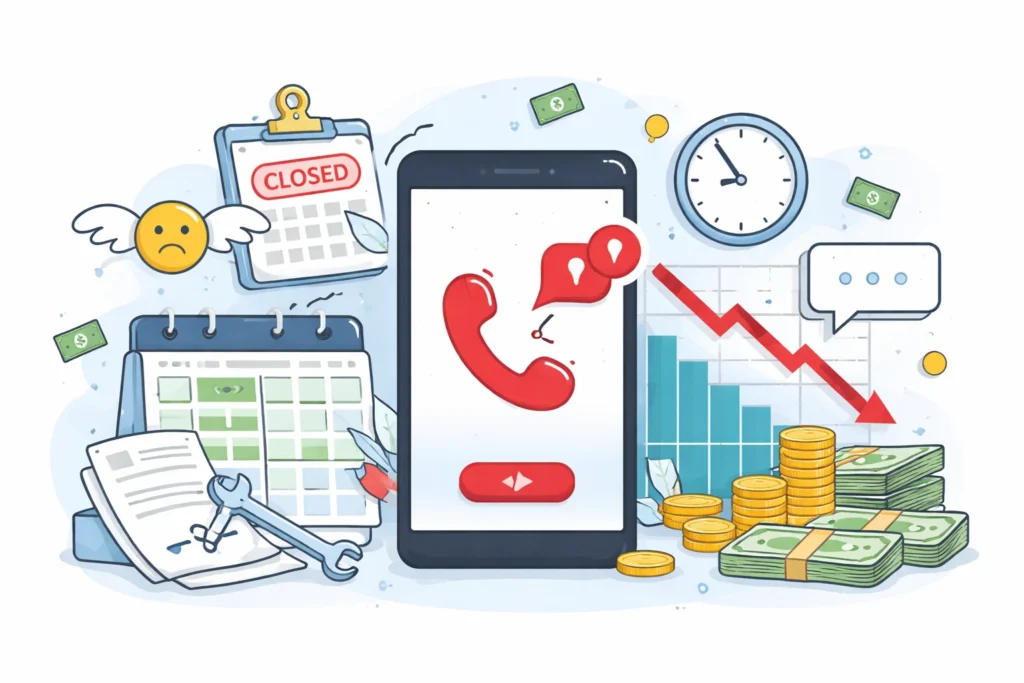
Key Takeaway: Every missed call costs home service companies an average of $1,200 in immediate revenue and up to $15,000 in lifetime value. AI answering systems can cut missed calls by 90% or more for less than $500/month.
Want results like this for your business?
NuroSparx builds AI-powered growth engines for brands doing $1M to $100M. Let’s talk.
Get a Free Growth AuditService businesses in the United States lose an average of $126,000 per year to missed phone calls, and many owners don’t see it happening. Research shows that 62% of inbound calls to home service companies go unanswered, and 85% of those callers never try again. For a lawn care company, roofing contractor or auto glass repair shop, each missed call loses more than a $200 job. It can cost $5,000 to $15,000 in lifetime customer value, plus the referrals that customer would have sent you.
You don’t have to hire more staff or stay glued to your phone 18 hours a day. AI-powered virtual receptionists and answering systems now capture leads 24/7, qualify customers, book appointments and even give quotes while you’re on a roof, mowing a lawn or finally getting some sleep.
How many calls does the average service business miss?
According to data from Invoca, home services businesses miss about 27% of inbound calls. Other industry analyses paint a grimmer picture: home service companies miss up to 62% of inbound calls during peak periods.
The cause is the typical day of a service business owner. You’re working jobs, driving between appointments, managing crews, ordering supplies and handling emergencies. Your phone rings constantly, but you can’t answer on a ladder, under a car or while you run equipment.
What happens to incoming calls
Roughly two-thirds of potential customers never reach a live person. For service businesses that get 60-80% of their new business from inbound calls, that’s a catastrophic leak in the sales funnel.
What does each missed call cost your business?
Every missed call costs home service companies an average of $1,200 in lost revenue right away. The damage goes much deeper.
The full financial impact
Immediate job loss: A homeowner calling for emergency plumbing, storm roof repair or windshield replacement brings $200 to $3,000 in immediate revenue, depending on the service.
Lost lifetime value: A satisfied lawn care customer might spend $3,000-$5,000 a year for 5-10 years. A roofing customer becomes a referral source and, later, a repeat customer for re-roofing. That single missed call could be worth $5,000 to $15,000 in lifetime value.
Referral loss: Happy customers refer 2-3 new customers on average. Each missed call can cost you the original customer plus everyone they would have referred.
Marketing waste: You’re likely spending $1,000-$10,000 a month on Google Ads, SEO, truck wraps and other marketing. When 62% of the leads from that marketing go unanswered, you burn more than half your marketing budget.
Why don’t customers leave voicemails or call back?
Platform data shows that fewer than 3% of callers who reach voicemail leave a message. And 85% of people whose calls go unanswered never call back.
Why callers move on
Immediate need: Most service calls come from people with urgent problems. The pipe is leaking now. The windshield cracked this morning. The lawn needs mowing before the weekend party. These callers need help right away.
Easy alternatives: One Google search shows 10+ competitors. If you don’t answer, the next company on the list will. The customer needs someone who answers, and that doesn’t have to be you.
Voicemail frustration: Voicemail feels like a dead end to modern consumers. They don’t know when (or if) you’ll call back, and they can’t get their question answered. The uncertainty is uncomfortable, so they move on.
Response time expectations: Studies show that if you return a missed call four hours later (the average response time), you’re calling someone who has already hired your competitor. The window for winning that customer closed hours ago.
When do service businesses miss the most calls?
Missed calls follow predictable patterns
During active jobs: When you’re working, you can’t answer the phone. A roofer on a steep pitch, an auto glass technician mid-installation or a lawn care operator on a commercial mower can’t take calls safely or practically.
After hours and weekends: Homeowners often research and call service providers in the evening after work or on weekends, when they’re home and can see what they need. If your business “closes” at 5 PM, you miss prime calling hours.
During peak seasons: Spring for lawn care, storm season for roofing, winter for heating services. Calls flood in exactly when you’re busiest and least able to answer.
Multiple simultaneous calls: Even if you answer your phone, you can only take one call at a time. During busy periods, calls 2, 3 and 4 go to voicemail or, worse, get a busy signal.
How do AI answering systems work for service businesses?
AI-powered virtual receptionists have come a long way from the frustrating “press 1 for sales” phone trees of the past. Modern AI answering systems use natural language processing to hold real conversations with callers. They understand context, handle objections and capture the information you need to close jobs.
What a modern AI answering system can do
Answer every call instantly: No rings, no hold times, no voicemail. The AI picks up at once, 24 hours a day, 365 days a year. At 2 PM on a Tuesday or 3 AM on Christmas, callers reach a responsive “person.”
Qualify leads in real time: The AI asks relevant questions: What service do you need? How urgent is it? What’s your address? What’s your budget range? It can tell a high-value commercial contract inquiry from a price-shopping tire kicker.
Book appointments directly: Connected to your calendar, the AI can schedule appointments, confirm availability and send confirmation texts without your involvement. The customer hangs up with a booked appointment instead of a promise that “someone will call you back.”
Provide instant quotes: For standard services (lawn mowing by square footage, windshield replacement by vehicle type), AI can give accurate pricing instantly and win customers who want to know “how much” before they commit.
Handle multiple calls simultaneously: A human receptionist takes one call at a time. AI systems handle unlimited concurrent calls. If a storm sends 50 people calling for emergency roof tarps, the AI handles all 50 conversations at once.
Escalate appropriately: For complex situations, emergencies or customers who insist on a human, the AI can transfer the call to your cell phone, text you right away or schedule an urgent callback, so no lead slips through the cracks.
How an auto glass shop can text back a missed call
Say a driver calls about a chipped windshield while your front desk is on another line. If you have permission to text the caller, send a reply from the shop number as soon as the call goes unanswered. If you lack permission, put the number in your callback queue.
Example first text: “Hi, this is River Auto Glass. Sorry we missed you. Do you need a chip repair or a windshield replacement? Text us your ZIP code and the year, make and model of your vehicle. Reply STOP to opt out.”
When the driver replies, send the details to the person who books jobs. They can check whether the chip needs an inspection, confirm mobile service in that ZIP code and offer two available times. After the driver picks one, confirm the date, time and location by text. Route questions about insurance, pricing or damage to the front desk. Record the appointment in the shop calendar so the next shift can see it.
Pull last month’s call log and count missed calls from people asking about a job. Use the missed call calculator to estimate what those calls could be worth. You can request a growth audit from the same page.
What results do service businesses see with AI answering?
The typical gains
For a service business missing 60% of calls and losing $126,000 a year, capturing even half those missed calls recovers $63,000 in revenue. That’s typically 10-20x the cost of the AI system.
How much do AI answering systems cost?
Common pricing tiers
Basic AI answering ($50-150/month): Handles simple call answering, captures caller information and sends notifications. Good for very small operations that want basic coverage.
Mid-tier solutions ($150-400/month): Adds appointment scheduling, CRM integration, custom scripts and more advanced conversation handling. Right for most service businesses.
Enterprise platforms ($400-1,000+/month): Includes advanced features like instant quoting, multi-location support, detailed analytics and custom AI training. Suited to larger operations or franchises.
The alternatives: A full-time receptionist costs $35,000-$50,000 a year plus benefits and only works 40 hours a week. A traditional answering service charges $1-2 per minute and often gives uneven service. AI systems give 24/7 coverage at a fraction of both costs.
How do you choose the right AI answering system?
What to check before you buy
Industry-specific training: An AI trained on thousands of roofing, lawn care or auto glass calls handles industry terms, common questions and pricing structures far better than a generic system. Ask vendors about their experience in your trade.
Integration capabilities: The AI should connect with your existing tools: calendar, CRM, field service software and payment processors. Manual data entry cancels much of the time saved.
Customization depth: Can you adjust the scripts, pricing rules and qualification questions? Your business has its own needs, and off-the-shelf setups often fall short.
Escalation options: What happens when a caller needs to reach you urgently? The best systems offer flexible escalation: immediate transfer, priority text alerts or scheduled callbacks.
Reporting and analytics: You should be able to track call volumes, conversion rates, peak times and common questions. This data helps you improve both the AI and your wider operations.
Frequently asked questions
Will customers know they’re talking to AI?
Modern AI systems sound very natural, but most businesses choose to be open about it. Customer satisfaction surveys show that callers care more about getting their problem solved quickly than about whether they spoke with a human. A responsive AI beats voicemail or a long hold every time.
What if the AI can’t handle a complex question?
Good AI systems know their limits and escalate. They might say “That’s a great question that I want to make sure gets answered properly. Let me connect you with our team” or book an immediate callback. The goal is zero dropped leads, and perfect AI conversations matter less.
How long does setup take?
Most service business AI systems go live within 1-2 weeks, including script customization, calendar integration and testing. Some platforms offer same-day basic setup and refine it over time.
Can AI handle appointment rescheduling and cancellations?
Yes. AI systems connected to your calendar can book, change, reschedule and cancel appointments. They can send confirmation and reminder texts automatically, which cuts no-shows by 25-35%.
What about non-English speaking customers?
Many AI platforms offer multilingual support, and Spanish is especially common for U.S. service businesses. The AI can detect the caller’s preferred language and reply in it.
Do I still need any staff for phones?
For most small service businesses, AI can handle 80-95% of routine calls. You’ll still want a person for complex negotiations, major complaints or VIP customers. The AI handles volume, and you handle relationships.
Stop losing $126,000 a year to voicemail
Every unanswered call wastes money you spent on marketing, the reputation you built through quality work and the customer’s lifetime value, all because no one picked up the phone. For service businesses on tight margins, the $126,000 average annual loss from missed calls often exceeds total profit.
AI answering systems are practical tools today. Thousands of lawn care companies, roofing contractors, plumbers, auto glass shops and other service businesses use them every day. The investment typically pays for itself within the first month through recovered leads alone.
Weigh the cost of AI answering against the cost of sending 62% of your callers to competitors.
How incoming calls end
- Answered by a live person: 37.8%
- Goes to voicemail: 37.8%
- No answer at all: 24.3%
Real Example: A roofing contractor spending $5,000/month on Google Ads gets about 100 calls. If 62 of those calls go unanswered and each is worth $4,000 in average job value, that’s $248,000 in potential revenue lost each month, from ads the business already pays for.
Typical improvements with AI answering
- Call answer rate: 38% to 100%
- After-hours lead capture: 0% to 100%
- Scheduling-related calls to staff: reduced 50-80%
- No-show rates (with reminders): reduced 25-35%
- Weekly staff hours on phone: 15-20 hours saved
Next Step: Work out your own missed call cost with our missed call calculator, or do it by hand. Track how many calls you miss this week, multiply by your average job value, then multiply by 52 weeks. That number is your annual opportunity cost and the potential ROI of fixing the problem.
You're All Set!
We have your request.
Expect a reply from our team within 24 hours. Want to talk sooner? Pick a time below.
Or call us at +1 (914) 297-6638