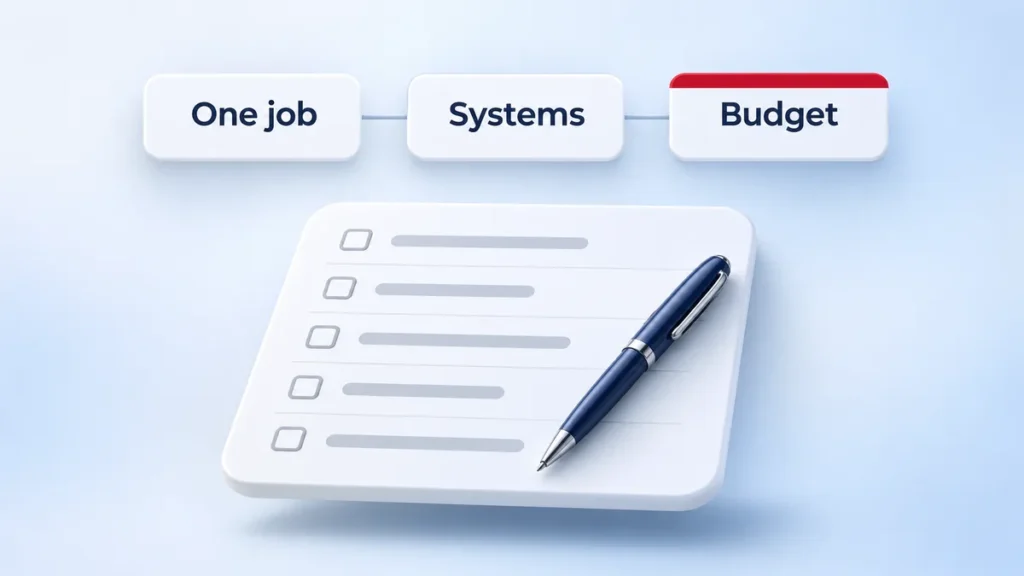
Before you call an AI agent development company, write down five things: the one job the agent does, the systems it reads and changes, who checks its work, the number that proves it works, and your build and monthly budgets. With that on one page, every vendor quotes the same project, and you can compare the prices side by side.
Vendors publish AI agent build prices from about $10,000 (Softude) to $500,000 or more (Master of Code). A quote without a brief tells you very little inside a range that wide. Our worksheet covers the questions we ask on a scoping call. Copy it, fill it in and send it to two or three companies, us included.
What counts as an AI agent
An AI agent uses a model such as Claude or Gemini to choose its next step, then acts through your tools: the CRM, the inbox, the calendar, the help desk. A workflow follows steps your team wrote in advance. Anthropic’s engineers draw the same line. Workflows run “through predefined code paths,” while agents let the model pick the steps and tools as it goes (Anthropic, Building effective agents).
That choice sets the price. An agent makes more model calls, needs more tests and needs rules on what it may change. Anthropic’s advice is to start by “finding the simplest solution possible, and only increasing complexity when needed.” The same post adds: “This might mean not building agentic systems at all.” If a fixed workflow with one AI step does the job, buy that. Our no-code AI automation stack shows what those look like.
Vendors also stretch the label. Gartner expects companies to cancel over 40% of agentic AI projects by the end of 2027, because of rising costs, unclear business value or weak risk controls. It also estimates that only about 130 of the thousands of vendors selling agentic AI offer real agents, and it calls the rest “agent washing” (Gartner, June 2025). A tight scope protects you from both problems.
Start with one job
Write the job in one sentence, with a verb and an object. “Qualify inbound demo requests and book the good ones” works. “Help sales” doesn’t. One job keeps the build small, the tests short and the quote honest.
Then measure how your team does the job today:
- Volume. How many times a month does it happen? Pull the number from your CRM or help desk.
- Hours. Who does it now, and how long does each one take?
- Speed. How long does a customer wait today?
- Errors. What goes wrong, and what does a mistake cost?
These four numbers become your baseline. Skip them, and you can’t prove the agent worked. The vendor will pick the success number for you.
Last, mark the steps that need judgment. Reading an email and deciding whether the sender fits your buyer profile needs a model. Copying a field from a form into HubSpot doesn’t. Plain code handles the second step for a fraction of the cost, and it never makes things up.
If you have one technical person and a simple read-only job, you may not need a vendor at all. Our free AI agent stack guide shows a $0 setup with Claude.
Pick your scope tier
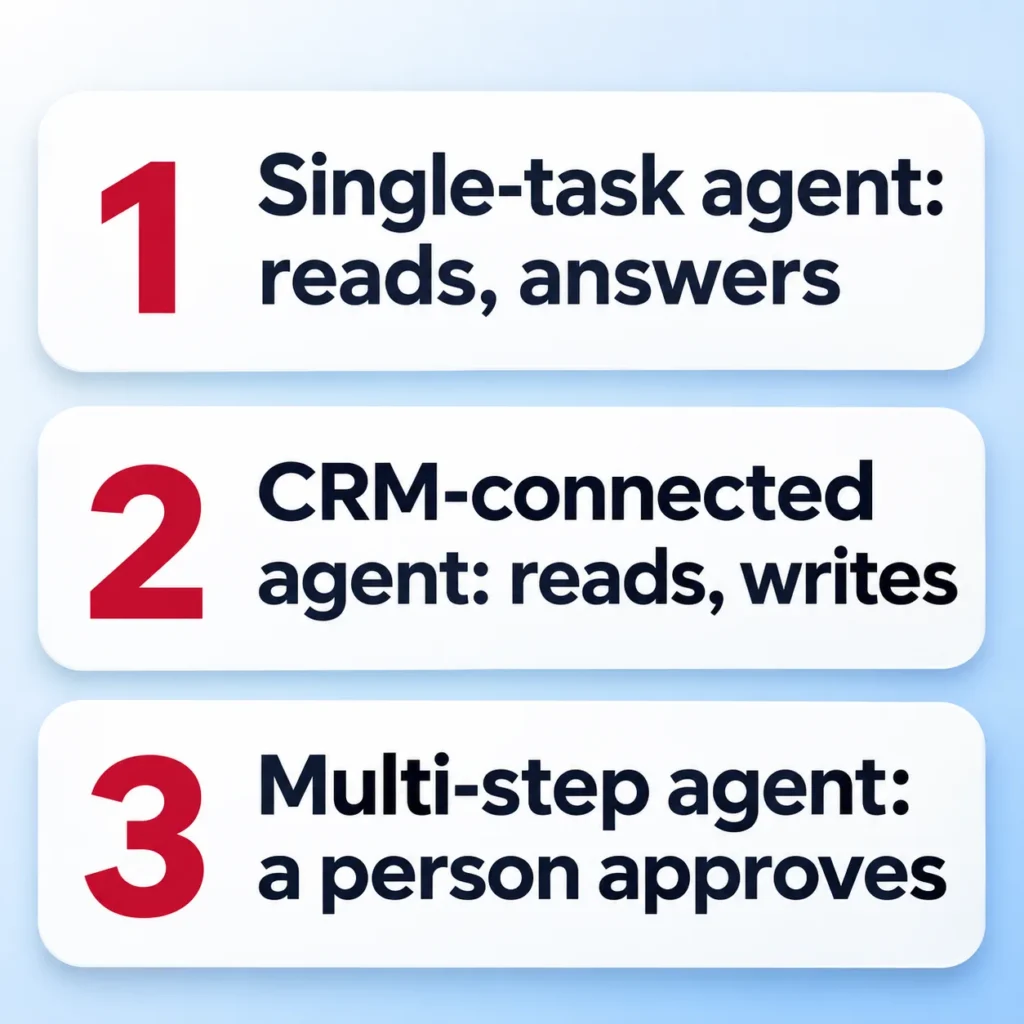
Sort your project into one of three tiers. The tier drives the build price, the timeline and the monthly bill.
| Scope tier | What it does | Systems | Human review | Vendor build estimate | Model fees a month (our example) |
|---|---|---|---|---|---|
| Single-task agent | Answers questions from your documents, with a source | Reads only | Spot-check answers each week | $20,000 to $30,000, 4 to 6 weeks | About $51 on Claude Sonnet 5.5 |
| CRM-connected agent | Qualifies leads, updates records, books meetings | Reads and writes 1 to 3 tools | A person approves anything the agent sends to a customer | $30,000 to $45,000, 6 to 10 weeks, plus $2,000 to $4,000 for the CRM link | About $102 on Claude Sonnet 5.5 |
| Multi-step agent with human review | Runs a process across systems, such as quote to order | Reads and writes CRM, ERP, email | A person approves every risky step | $45,000 to $60,000, 10 to 14 weeks, plus $4,000 to $8,000 for an ERP link | About $240 on Claude Opus 5.5, $120 on Sonnet 5.5 |
The build estimates come from Biz4Group’s AI agent cost guide, which Biz4Group last updated in August 2026. Other vendors price higher. Master of Code lists $25,000 to $80,000 for a proof of concept, $60,000 to $180,000 for a production agent and $150,000 to $500,000 or more for a multi-agent platform. On Clutch’s AI agent directory, the first 10 firms set minimum projects from $5,000 to $100,000. Treat every one of these as a vendor’s own estimate.
Our own starting prices sit lower. On our custom software page, a Build starts at $7,500 and covers an AI agent or chatbot with up to 3 integrations in 3 to 6 weeks. An Automation starts at $2,500 when a workflow with one AI step does the job. A Platform starts at $15,000 when the agent lives inside a portal with logins. Every project gets a fixed quote after a free scoping call.
If your agent mostly answers questions on your website, read our B2B chatbot guide first. It covers that tier in more depth.
Fill in the scoping worksheet
Copy this table into a doc or sheet. Fill in the middle column and leave a cell blank when you don’t know the answer. A blank cell tells the vendor where to ask questions. The example is a made-up $30M B2B distributor.
| Field | Your answer | Example |
|---|---|---|
| Company, revenue, your role | B2B distributor, $30M, VP Sales | |
| The one job, in one sentence | Qualify inbound demo requests and book the good ones | |
| Scope tier | Single-task / CRM-connected / Multi-step | CRM-connected |
| Who does it today | 3 sales reps | |
| Volume a month | About 1,200 inbound leads | |
| Hours a month today | About 60 rep hours | |
| Systems it reads | Web form, HubSpot, Google Calendar | |
| Systems it writes to | HubSpot contact and deal, Google Calendar | |
| Who can grant access to each | RevOps lead for HubSpot, IT for Google | |
| Human review rule | A rep approves any email before it goes out for the first 30 days | |
| Things it must never do | Quote prices, promise delivery dates, email existing customers | |
| Data limits | No payment data; contact data stays in HubSpot | |
| Success number and date | First reply from 4 hours to 5 minutes by day 60 | |
| Build budget | $10,000 to $20,000 | |
| Monthly run budget | Up to $600, model fees and hosting | |
| Deadline and why | Live before the March trade show | |
| Who signs, who owns the result | CEO signs; VP Sales owns the number |
Send the same filled worksheet to every vendor. Quotes that answer the same brief line up, and you can see who padded the price.
Get your data and access ready
Collect these before the first call. Each missing item can hold up the quote or the build:
If your agent will connect to tools through MCP, our Claude Agent Skills and MCP explainer covers how those connections work.
Work out what the agent costs each month
The build fee is a one-time bill. Four costs keep running after launch.
Model fees. Anthropic lists Claude Opus 5.5 at $4 per million input tokens and $20 per million output tokens, Sonnet 5.5 at $2 and $10, and Haiku 5.5 at $0.10 and $0.50 for prompts up to 100,000 tokens. The Batch API cuts both prices in half for jobs that can wait (Anthropic pricing). These are today’s list prices. Our tier examples use them:
- Single-task agent. 3,000 questions a month, 6,000 input and 500 output tokens each, on Sonnet 5.5: $36 plus $15, or $51.
- CRM-connected agent. 1,200 leads a month, 5 model calls per lead, 6,000 input and 500 output tokens per call, on Sonnet 5.5: $72 plus $30, or $102.
- Multi-step agent. 500 tasks a month, 10 calls per task, 8,000 input and 800 output tokens per call: $240 on Opus 5.5 or $120 on Sonnet 5.5.
Your volume could sit well above or below these. Anthropic’s engineers warn that agentic systems “trade latency and cost for better task performance,” so every extra step in the design shows up on this line.
Hosting and tools. Biz4Group puts cloud hosting at $300 to $2,000 or more a month, monitoring at $200 to $1,000 and a vector database at $100 to $1,000. Softude quotes smaller tools: Weaviate Cloud at $25 to $200 a month and LangSmith at $39 to $299. A small agent on existing tools can sit at the low end.
Maintenance. Biz4Group budgets 15% to 20% of the build cost each year for fixes and updates. Softude says 15% to 25%. On a $30,000 build, 15% to 20% comes to $4,500 to $6,000 a year. Our support plan starts at $500 a month.
People. Count the reviewer’s hours from your worksheet. In the first month, that person checks samples every week.
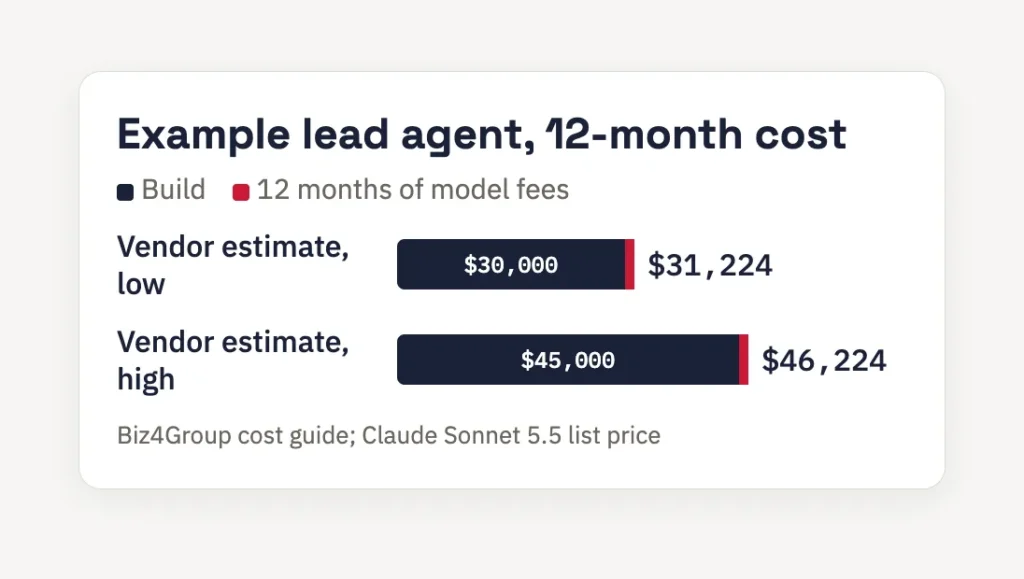
Ask every vendor for a 12-month total: build fee, plus 12 months of model fees, hosting, tools and support. Keep the model and hosting accounts in your company’s name. On our builds, tool, hosting and AI usage bills go to your own accounts at cost.
If the agent will answer phone calls, see our AI voice agent page. Voice adds its own costs.
Take one lead-qualification agent from brief to quote
Take the made-up distributor from the worksheet and follow it from brief to price.
The brief. About 1,200 inbound leads a month. Three reps spend about 60 hours a month reading forms, checking company size, replying and booking calls. A lead waits about 4 hours for a first reply.
The scope. The agent reads each new form, checks the company against the buyer profile, writes a reply, and books a call on a rep’s calendar for good fits. It updates the HubSpot contact and deal. A rep approves every reply for the first 30 days, then only replies to companies over $50M. It never quotes prices.
The tier. CRM-connected: three tools (web form, HubSpot, Google Calendar), all within a 3-integration build.
The price. Vendor estimates for this tier run $30,000 to $45,000 plus a CRM link (Biz4Group). On our pricing, it fits a Build, which starts at $7,500. Model fees come to about $102 a month on Sonnet 5.5, plus hosting and support.
The test. Before launch, the agent runs on the last 200 leads. A rep marks each answer right or wrong, and the agent must match the reps’ calls on at least 180 of them before it goes live. The success number from the brief, a 5-minute first reply by day 60, decides whether it stays.
Put the hours it saves into our automation ROI calculator to see the payback.
Ask every vendor these 10 questions
- Which of my answers changed your price? A good vendor points to specific cells on the worksheet.
- Does this job need an agent, or would a workflow do? Look for an honest answer, even if it shrinks the deal.
- Which model will you use, and why? Ask for the expected cost per task.
- What will the agent cost to run each month at my volume? Ask for one number at your volume.
- Whose accounts will it run in? You want the model keys, hosting, code and logs in your name.
- How will you test it before launch? Ask for the test set, the pass rate and who checks the results.
- What can the agent change without a person’s approval? Get the list in writing.
- What happens when the agent is unsure? It should hand off to a person, with the context.
- What will you hand over at the end? Code, prompts, logins and plain-language docs.
- Show me one agent you built that runs today. Ask what it does, its volume and what broke in the first month.
Spot the red flags in a proposal
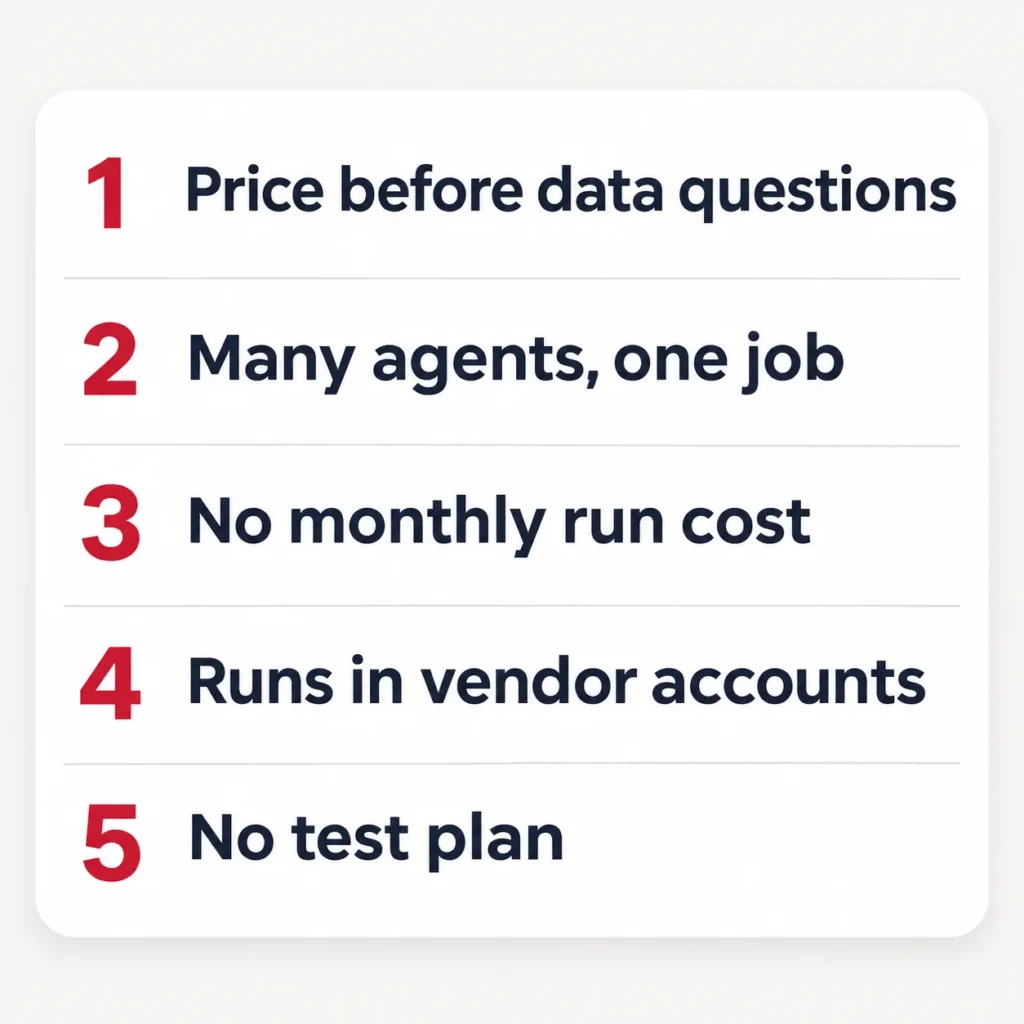
Push back on any proposal that shows one of these five signs:
- A price before any question about your data. A vendor who quotes on the first call has priced a template.
- Several agents for a one-job problem. Three agents to answer FAQs means three times the tests. Anthropic’s advice to start simple applies here.
- No line for monthly run cost. A build fee alone hides model fees, hosting and monitoring.
- The agent runs in the vendor’s accounts. If you leave, the agent should stay with you.
- No test plan and no success number. Without both, you can’t tell whether the project worked.
Send your brief this week
- Pick one job and write it in one sentence.
- Pull last month’s volume and hours from your CRM or help desk.
- Fill in the worksheet. Leave cells blank where you don’t know.
- Send the access list to your IT or RevOps lead.
- Send the brief to two or three AI agent development companies and check their replies against the red flags.
If you want us on that list, tell us what to build on our custom software page. We reply within 24 hours with our questions and a time for the free 30-minute scoping call. You get a written scope, price and timeline within 3 working days, and nothing starts until you sign off.
FAQ
How much does it cost to build an AI agent?
Vendor estimates vary widely. Biz4Group lists $20,000 to $30,000 for a simple agent and up to $60,000 for an advanced one. Master of Code starts a proof of concept at $25,000, and Softude gives $10,000 to $300,000 overall. Our custom builds start at $7,500 for an agent with up to 3 integrations. Get two quotes against the same written brief.
What does an AI agent cost to run each month?
Model fees for a small agent can run about $50 to $250 a month at Claude’s current list prices, depending on volume and model. Add hosting, monitoring and a vector database if you need one. Biz4Group puts hosting at $300 to $2,000 or more a month. Budget 15% to 20% of the build each year for maintenance.
What should I give an AI agent development company before they quote?
Give them one page: the one job, today’s volume and hours, the systems it reads and writes, who grants access, the human review rule, what it must never do, a success number with a date, and your build and monthly budgets. Send the same page to every vendor so the quotes compare.
How long does it take to build an AI agent?
Biz4Group lists 4 to 6 weeks for a simple agent and 10 to 14 weeks for an advanced one. Master of Code lists 4 to 8 weeks for a proof of concept and 2 to 4 months for production. Our Build tier runs 3 to 6 weeks. Have access and review rules ready at kickoff so the clock doesn’t stall.
How do I tell a real AI agent from a chatbot with a new name?
Ask what the system decides on its own and which tools it calls. A real agent picks its next step and acts in your systems, such as updating the CRM or booking a meeting. Gartner estimates that only about 130 vendors sell real agentic AI and calls the rest “agent washing.”
You're All Set!
We have your request.
Expect a reply from our team within 24 hours. Want to talk sooner? Pick a time below.
Or call us at +1 (914) 297-6638