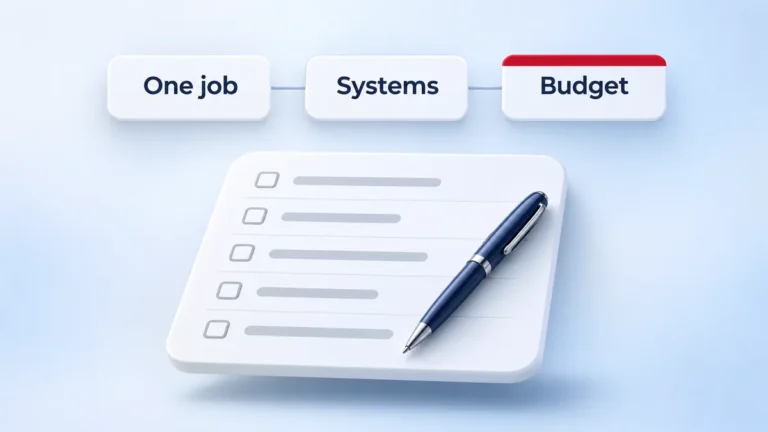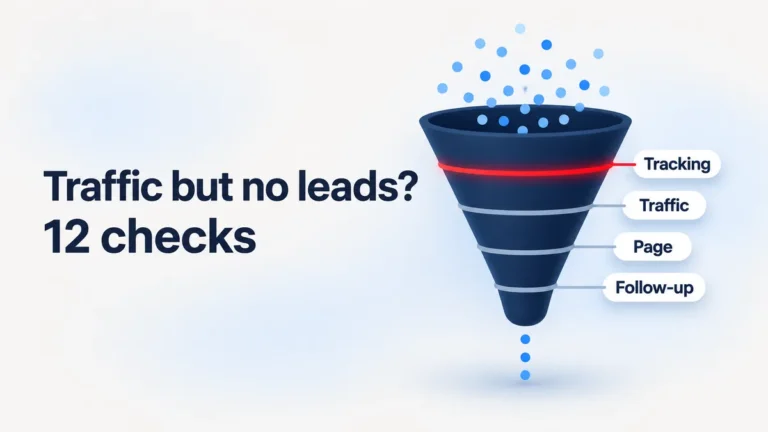

When we onboard a new service brand, we judge success on one number: revenue you can trace back to a source. Everything we do in the first 90 days serves that number. Before we scale a dollar of ad spend, we rebuild the tracking and data setup end to end. That covers ad account ownership and structure, pixels and conversion events, UTM rules, CRM pipelines and nurture automation, Google Business Profile, name-address-phone consistency, and a website and technical SEO plan based on what the data says. Below is the checklist we run and the reason for each item.
Revenue is the number we track first
Impressions, clicks and even cost per lead can all look healthy while the business stays flat. A $40 cost per lead means nothing if those leads never show up in the CRM with a source, never hear back before Monday and never turn into booked work. So we anchor every onboarding to one simple question: which channel brought in your last ten customers, and what did each one cost?
Most service brands can’t answer that on day one. The dashboard is rarely at fault. The data is: broken pixels, mixed-up UTMs, a CRM that never records lead source, and follow-up that depends on whoever checks the inbox. We spend the first 90 days fixing those inputs, because a report can only be as good as the data feeding it.
Days 1 to 14: access, ownership and account structure
The first two weeks are an audit. We check that the brand itself owns every asset: ad accounts, pixel and conversion datasets, GA4, Google Search Console, Google Business Profile, the domain registrar and the CRM. We often find ad accounts owned by a past vendor, so the brand would lose its whole performance history if that relationship ended. We move ownership to the brand and add our team as partners.
Then we take a baseline snapshot before we change anything: a 90-day export of spend, leads, cost per lead and close rate per channel. Without a baseline, you can’t prove the cleanup worked. With one, day 90 against day 0 becomes an honest comparison.
Last, we rebuild the campaign structure. Sprawling ad accounts with dozens of overlapping campaigns split the budget and starve the learning algorithms of data. We merge them into a few campaigns organized by intent tier, each with clear conversion goals. Our performance paid growth team handles this rebuild and owns the account structure and conversion goals for every brand we onboard.
Fix pixels and conversion events
Ad platforms optimize toward whatever conversion signal you feed them. Feed them a broken signal and they’ll spend your budget efficiently chasing the wrong result. These are the failures we find most often: pixels that fire on page views instead of submissions, duplicate events that count leads twice, a form fill treated as the final success, and no link at all between ad platforms and closed deals.
The fix has two parts. First, conversion events fire only on moments tied to money: a booked call, a qualified form submission, a phone call over a minimum length. Second, we connect the CRM back to the ad platforms through offline conversion uploads, so closed-won deals become the training signal. That one change points the algorithm at lead quality instead of lead volume, and it’s one of the biggest fixes in the whole onboarding.
Use one UTM naming convention
GA4 treats “facebook”, “fb” and “Facebook_Paid” as three different sources. If three people tag links three ways, channel reports break into noise, and the problem is easy to miss because each piece still looks plausible on its own.
We publish one UTM rules document per brand: fixed values for source and medium, a campaign naming pattern, lowercase everywhere, no spaces and no exceptions. Every link the brand sends carries tags: ads, emails, SMS messages, Google Business Profile posts, even the link in the Instagram bio. The benefit builds over time. The CRM stamps the UTM values onto each record at capture, and that’s what makes revenue-by-channel reports possible at all. Our search and content growth services rely on the same groundwork when we report organic and paid results side by side.
Find where leads drop out of your pipeline
A pipeline audit answers three questions. What are the stages, and does the team agree on what each one means? Where do leads drop out, and at what rate per stage? And does every record carry its lead source from the moment it’s created?
We map the stages, set entry and exit rules for each and measure conversion from one stage to the next. The leak is almost never where the founder thinks it is. It usually sits between “new lead” and “first contact”. That’s a process problem, and automation can fix it without more ad spend.
We also make lead source a required field that fills in automatically from UTMs and call tracking, so no one types it by hand. Hand-entered source data turns into “other” within weeks.
Answer leads within 5 minutes, day or night
The research here is old and famous, and most businesses still ignore it. The Harvard Business Review lead response study found that firms that contacted a lead within an hour were nearly seven times more likely to qualify it than firms that waited even an hour longer. Later research puts the sharpest drop at five minutes: respond within five minutes and you’re about 21 times more likely to qualify the lead than at 30 minutes. Meanwhile, the average business takes over 40 hours to respond.
Service businesses feel this most, because a large share of their leads come in on evenings and weekends, when no one is watching the inbox. So we set up three pieces of automation in the first 90 days. An SMS auto-reply answers every new lead within a minute and asks a qualifying question. A website chat assistant captures and books leads after hours. Missed-call text-back turns a phone call that rings out into a conversation. A person still does the follow-up. The automation keeps the lead warm until that person gets there.
Clean up your Google Business Profile and NAP
For local and regional service brands, the Google Business Profile is often the asset that converts best, and the one they neglect most. Google’s own data says a complete profile makes a business 2.7 times more likely to be seen as reputable, with customers 70% more likely to visit and 50% more likely to consider buying. Most profiles we inherit have outdated categories, no services listed, no posts in months and unanswered reviews.
The cleanup covers correct categories, full service and area listings, fresh photos, a weekly posting schedule, review replies within 48 hours, and UTM-tagged links so profile traffic shows up correctly in analytics. For Google’s own setup advice, see the Google Business Profile documentation.
Next to it, we run a NAP pass: we make the name, address and phone number identical across the website, GBP, directories and social profiles. Conflicting listings slowly drag down local rankings, and a stray old phone number swallows leads without anyone noticing. Where we use call tracking, we set it up with number pools that keep NAP consistent.
A consistent brand makes creative tests readable
Locking the brand kit (colors, logo files, fonts, tone) sounds like a design task, but it belongs in a tracking article. Creative tests only give readable results against a controlled baseline. When every ad, landing page and email looks like it came from a different company, you can’t tell whether a winning ad won because of the offer, the audience or because it happened to look trustworthy that week. One brand kit, used everywhere, turns creative results into data you can read. Our CRO and experience design work depends on the same baseline when we test landing pages against each other.
Plan the website rebuild and technical SEO
In the first 90 days we plan the rebuild. We don’t tear down the website while we’re still repairing tracking. The work covers a full technical crawl, an indexation and Core Web Vitals audit, and a topic cluster map built around the services that bring in revenue. Search Console and GA4 show which pages already earn traffic and leads, and the rebuild plan puts those pages first.
We do it in this order for a reason. If you rebuild a website before you fix tracking, you get a nice-looking site and no way to know if it beats the old one. If you’re comparing vendors for this kind of rebuild, our related post on questions to ask before hiring a marketing partner is a good place to start.
What the day-90 dashboard shows
By day 90, one dashboard answers the questions no one could answer on day one: spend, leads, qualified leads, closed deals and revenue, broken out by channel. Median speed to lead. Conversion from one pipeline stage to the next. After-hours capture rate from SMS and chat. Google Business Profile actions, week over week.
Scaling starts on day 91. By then every extra dollar of spend produces usable data.
To see what this looks like against your own numbers, try our free website CRO audit and free SEO audit. They’re the same first-two-weeks diagnostic we run for every brand we onboard.
Frequently Asked Questions
How long does marketing tracking cleanup take for a service business?
For most service brands, a full cleanup takes 60 to 90 days. Access and audit take two weeks, pixels, UTMs and CRM setup take four to six weeks, and automation, GBP and baseline reporting fill the rest. Simple single-location businesses move faster. Multi-location brands with old CRMs take the full window.
What is a good lead response time?
Under five minutes. Research made popular by Harvard Business Review shows the odds of qualifying a lead fall sharply after the first hour, and later studies show the steepest drop after five minutes. The standard we set up is an automated SMS reply plus a fast follow-up from a person.
Do I need a CRM before running paid ads?
Yes, if you want to know whether the ads work. Without a CRM that records lead source, paid traffic brings in leads you can’t attribute or nurture, and the ad platforms never learn which leads turned into revenue. Even a simple CRM set up correctly beats a spreadsheet.
What does NAP consistency mean in local SEO?
NAP stands for name, address, phone. Search engines compare these details across your website, Google Business Profile and directories to confirm your business is real. Mismatches weaken local rankings, and outdated phone numbers on old listings lose leads.
You're All Set!
We have your request.
Expect a reply from our team within 24 hours. Want to talk sooner? Pick a time below.
Or call us at +1 (914) 297-6638