Someone on your team put your category into ChatGPT and got back a competitor’s name instead of yours. Or your AI Overview traffic dropped off a cliff in the AI visibility reporting in Search Console and your rankings hardly moved. In either case, the instinct is the same: panic-publish new content and pray.
Wait for it. But before you even get to a single page, you need to know what actually broke because there are three very different events that all look like “we lost our citation” and only one of them needs a content fix. That’s the same discipline behind answer engine optimization in general: diagnose the retrieval problem before you touch the content.
You Might Not Have Lost Anything
Here’s the part that almost no one looks at first. A seven-day study of 2,398 queries run daily across Google AI Mode, Perplexity, Gemini and Chatbot showed that 69% of the sources behind a typical AI answer change from day to day. That’s not a bug. And that’s the engine rebuilding its answer. And that happens regardless of whether your content changed at all.
So before you rewrite anything, separate the three events:
- Rotation. The answer re-rolled and a different set of domains showed up. This happens daily and doesn’t mean you did anything wrong.
- Displacement. The same competitor holds your old spot, run after run. This is the one your team is probably worried about.
- Removal. Your domain doesn’t show up on any engine across multiple days. This is the only event that actually needs a repair.
Even the rebuild rate varies between engines. Perplexity retains 66.8% of its sources overnight and 11.1% over a full week. ChatGPT has a mere 1.1% share over a week. If you’re tracking ChatGPT and one screenshot looks bad, you’re probably looking at plain old churn.
The Four-Step Diagnostic (Do This Before Anything Else)
This takes about twenty minutes and it’s the step that decides whether you spend the next month fixing the right thing or the wrong thing.
- Run the query five times across three days on the engine where you used to appear. If you show up in any run, you’re still in the set.
- Repeat it on Perplexity as a control, since it’s the most stable of the major engines.
- Record which domains fill your old spot. Same one every time, or a rotating cast?
- Classify the result. Varied domains means rotation. One repeat competitor means displacement. Zero appearances across every run and every engine means removal.
PageLens’s diagnostic workflow adds an interesting wrinkle here: don’t assume that a “citation loss” and a “mention loss” are the same problem. A citation is a linked source . A mention is when your brand name appears but there is no link. A recommendation loss is again different, it means you are still cited but dropped from the shortlist language. Taking a screenshot of one bad answer and calling it a citation loss confuses four different signals, all of which need a different fix.
This is what that means in practice. A local HVAC company’s branded search for “best HVAC company near me” brought up a competitor two towns over instead of them. They started by writing a new home page. Three weeks later, no change. When they finally ran the diagnostic it wasn’t even removal, it was displacement on chatgpt only. Perplexity still quoted them. The real gap was that the competitor had a more recent description in their Google Business Profile and a recent mention in a local news story, while the HVAC company’s last press coverage was two years ago. The homepage rewrite didn’t change either signal either. That’s a week of wasted effort that would have been caught in twenty minutes by the four-step diagnostic.”
Why a Competitor Actually Wins the Slot
Once you have verified actual displacement or removal, this is what is usually at work. Rarely is it “their content is better written”.
Even more so for the smaller operators. For small businesses, AEO usually demands fewer but more powerful fixes than a large enterprise site would require, which is good news once you know where to focus.
Their pages are structured to be lifted, not read. Most business sites are written for a human, looking around for 30 seconds. If your competitor starts with a direct answer and yours starts with a story about how your company started, the model goes for the competitor.
Their content is fresher. About half of all AI-cited sources for commercial queries are content published in the last 13 weeks and content less than 30 days old gets about 3.2 times more citations than older pages. If your page has not been touched in a year, then by default you are competing against a pool of much younger competitors. This is because B2B buyers are now researching on ChatGPT before Google, so the most up-to-date, quotable response is the first one seen by a shrinking pool of buyer attention.
They’re listed in more places you’re not. Answer engines are confident because they hear over and over from trusted sources. Your competitor may not be running a better business. It may just be that they’re listed in 10 directories, review sites and trade articles where you’re not. This is a pattern that shows up regularly in the AEO work we do for plumbing, HVAC and other local service businesses. So the solution often begins with an audit of exactly where the competitor is listed that you are not.
Their pages can actually be fetched. ChatGPT’s live search is heavily reliant on the Bing index. If your facts are in a PDF, a video or in wishy-washy brand copy that the crawler can’t digest, the model literally can’t quote you, no matter how good your service is.
They’re described the same way everywhere.Conflicting identity signals (different business name variant on your homepage than on your Google Business Profile, inconsistent service areas, mismatched contact details) reduce the model’s confidence in classifying you at all. This is the slowest thing to fix and usually the actual reason a “content refresh” doesn’t move the needle.
The Repair Order Matters More Than the List of Fixes
Teams that reverse this order waste the earlier work. Run it in this sequence:
| Layer | Fix | Typical Timeline |
|---|---|---|
| 1. Freshness | Update the specific page that used to be cited, not a new page on the same topic | Days to a few weeks |
| 2. Extraction structure | Add a direct, standalone answer near the top; break up walls of text into quotable statements | 1 to 3 weeks |
| 3. Entity consistency | Align business name, service area, and contact details across your site, directories, and press | 2 to 4 months |
Freshness and extraction structure are the quickest levers you have complete control over and where most of the near-term recovery lies. Entity consistency is the slowest, but skipping it is why so many “we published a bunch of new blog posts” recoveries stall out after week three.
A 30-60-90 Day Plan, Not a Panic Sprint
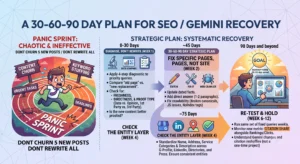
Week 1: Diagnose, don’t rewrite. Apply the above four-step diagnostic to your priority queries. Remove the page that was cited before and compare it head to head to what replaced it: Is the replacement fresher, more direct or citing a different kind of proof (data versus opinion, first-party versus third-party)? Don’t think longer is better. Ask what actual proof the answer needed.
Week 2: Fix the specific page, not the whole site. Update dated facts Add a one-to-two paragraph direct answer to the top of the section that used to get cited Fix crawlability issues (broken canonicals, JavaScript-only content, accidental noindex tags) No need to churn out five new posts this week. More unstructured content can make you harder to classify, not easier.
Week 4: Check the entity layer.Double-check your name, address, service categories and description on your Google Business Profile, LinkedIn, major directories and any press mentions. Standardize them wherever they go. This is tedious tasks and often the real reason a competitor continues to win contested slots long after your content refresh launched.
Weeks 6-12: Re-test and hold. Run the same set of fixed queries every week. Set a realistic expectation with your team. It is not a sign that the fix failed, a recovery curve of 60 to 120 days is normal. Add citation share as a separate metric alongside rankings and clicks because Gemini’s citation reshuffle in early 2026 replaced around 42% of the previously cited domains in a single model swap and this is a reminder that this is not a one-time project.
What Not to Do
- Don’t rewrite the whole site off one bad screenshot. Confirm removal first.
- Don’t treat every engine the same. A drop on ChatGPT with normal churn rates is a different situation than a drop that persists on Perplexity, which is the most stable of the four.
- Don’t chase the competitor instead of the gap. The replacement page is a clue about what proof the answer needed, not just a rival to out-word.
- Don’t skip the denominator. “Our citations dropped” and “the source set behind one answer changed” are different claims. Know which one you’re measuring before you report it up the chain.
- Don’t abandon a page just because it lost the citation. It may still be feeding brand recall and assisted conversions. Measure before you prune.
- Don’t run the repair steps out of order. Fixing entity consistency before freshness is like repainting a house before you patch the roof. The later work just gets undone by the thing you skipped.
One more thing worth saying plainly: not every lost citation is worth fighting for. If the query was never tied to revenue, spend your twenty minutes on the diagnostic, confirm it’s rotation, and move on. Save the repair sprint for queries that actually touch your pipeline.
What This Actually Costs You If You Wait
An answer mentioning a brand name will get about 35% more organic clicks than if the same question is answered with an unnamed competitor, and some studies report an even higher paid-click lift. That’s also why now that you’re not the source you’re citing, #1 on Google leaks most of the click. Buyers are increasingly acting on the citation, not the blue link position. It’s the number that should matter, not the screenshot itself. We’re volatile enough now that one model swap can shuffle nearly half the citations in a vertical overnight. So the businesses that recover fastest are the ones with a fixed prompt set they’ve already been tracking, not the ones starting from a cold screenshot.
If your team doesn’t have that tracking in place yet, that’s the actual starting point, before the content work, before the entity cleanup. You might also want to do a quick check of your current agency or in-house set-up to make sure that citation tracking is actually on someone’s to-do list. You can’t fix what you haven’t measured and one nice screenshot next week doesn’t prove anything until the same query cites you again the week after.
FAQs
How do I know if I actually lost the citation or if the AI just re-rolled its answer?
Run the same query five times over the course of three days on the engine you used to show up on. Then run it on Perplexity too since it holds its sources the longest. if each time different domains appear, it means rotation and nothing else. Displacement means the same competitor holds the spot every run. If your domain does not show up on any engine in all three days that is removal and removal is the only one that requires a fix.
How long does it take to win back a lost AI citation?
Don’t expect it to bounce back overnight. Expect a real repeatable recovery to take 60 to 120 days. You may see movement on a page that used to be cited by freshness fixes in a few weeks. Entity consistency work cleaning up how your business is described across your site, directories and press – takes months because it relies on external sources getting re-crawled and re-trusted.
Should I just publish more content to win the citation back?
No. Adding more content to a page structure that already was not extractable usually makes visibility worse, not better, because it adds more pages for the AI to classify without fixing the underlying reason it stopped citing you. Determine which of the three events occurred first and then repair the particular page or signal that broke rather than augmenting your content library.
Why does my competitor keep showing up in ChatGPT when their reviews are worse than mine?
ChatGPT is not rated by star rating. It is pulling from a small number of pages it can retrieve, read and trust, largely through Bing’s index and then summarizing what it finds. If your competitor has their facts laid out on a page that the model can pull from and yours are buried in a PDF, a video, or fuzzy brand copy the model can turn to the source it can actually quote.
Is losing an AI citation the same as losing a Google ranking?
No.AI Overviews only overlap with organic top-10 results 17% to 38% of the time depending on the study . This means a page can still hold its normal Google ranking and lose its spot inside an AI Overview or a chat answer. Citation Share and Keyword Ranking are two separate things and must be tracked separately.
What is the correct order to fix a citation loss?
Freshness, then extract structure, then entity consistency. First, edit the page that used to be cited before writing anything new. Then make sure it starts with a direct, stand-alone answer at the top, and clean up how your business is described across your website, directories, and external coverage. Running the order backward wastes the previous work.
If you want the short version to hand to a founder or a CMO: don’t rewrite anything until you’ve run the four-step diagnostic. Most “we lost our citation” reports are rotation. The ones that are real get fixed in the order above, not by volume.
Want a second set of eyes on which layer actually broke? Our AEO and answer engine optimization service runs this exact diagnostic against your priority queries, and you can see the shape of the work in how we took NuVision Auto Glass’s online revenue from 20% to 40% of the business by fixing exactly this kind of visibility gap.