Google’s AI Mode crossed one billion monthly users in May 2026, roughly a year after launch, and AI Overviews now reach about 2.5 billion. Meanwhile no-click searches sit at 58.5% of US queries (SparkToro), and where AI features appear, position-1 organic click-through has fallen from 27% to 11%, per SISTRIX’s February 2026 data. The page-one prize got a lot smaller.
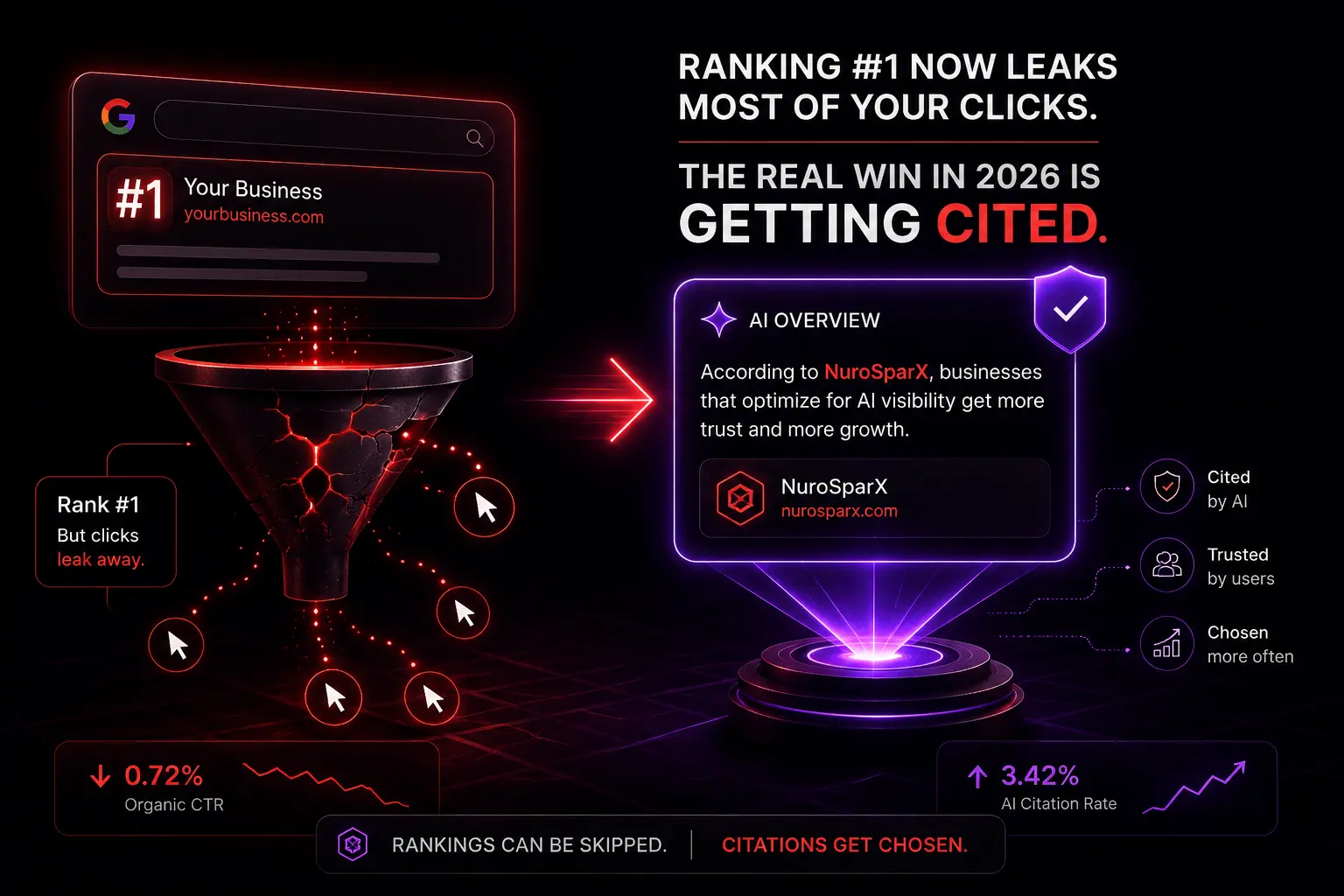
At NuroSparX we have watched a hard truth set in for growth teams: you can rank #1 and still watch most of your traffic get answered away inside an AI box you don’t control. The rules changed underneath the old playbook. The new goal isn’t to rank, it is to get cited inside the answer.
Short version
Zero-click is now 58.5% of US searches, and where AI features show, position-1 CTR fell from 27% to 11% (SISTRIX). Ranking still matters, but most clicks now get absorbed by the AI answer. The win in 2026 is being cited inside that answer, not just sitting below it.
Why ranking #1 stopped paying like it used to
AI Overviews and AI Mode answer the question above your link, so users get what they need without scrolling to you. Even at position one, you are now competing with a summary of your own content sitting on top of you.
SISTRIX’s February 2026 analysis found that when an AI Overview appears, position-1 CTR drops from 27% to 11%, roughly a 60% cut. Ahrefs measured a comparable 58% drop on position one for AI Overview queries. The link is still there. People just stop needing it, because the answer is already on screen and AI Mode, now past a billion users, makes answering-without-clicking the default behavior, not the exception. Pew Research saw the same pattern from the user side: with an AI Overview present, only about 8% of people clicked an organic result, versus 15% without one. The behavior shift is real and it is consistent across studies.
So the old win condition, “get to the top of the results,” now describes a position that leaks most of its traffic. The clicks didn’t disappear. They moved into the box.
What “getting cited” actually means
Getting cited means the AI answer names your brand and links you as a source inside the summary. That is now the high-value real estate, because cited brands capture the clicks that do still happen, plus the trust of being the named authority.
Seer Interactive analyzed 3,119 informational queries and found brands cited inside AI Overviews earn about 35% more organic clicks than uncited brands on the same query. Being in the answer beats being below it. Think of a B2B SaaS “best project management tools” query: the AI box names three or four products as sources. Those named brands get the visit and the credibility. Everyone ranking on the page beneath the box fights over scraps.
What this means in plain English for your content
Rebuild your highest-intent pages to be quotable: answer the exact question early, in depth, with clear structured data and clear sourcing, so the AI model can lift and cite you rather than paraphrasing a competitor.
This is the heart of our search and content growth engine. We shift the goal from “rank” to “get cited.” A recent example: a B2B SaaS comparison page rebuilt for citation. We restructured it into direct question-and-answer blocks, added a clean comparison table, tightened the claims with named numbers, and made the unique data points easy to quote. The practical goal is simple, give the AI model the cleanest, most liftable version of the answer so it cites you instead of summarizing someone else.
What we’d do first
Five moves to go from ranking to getting cited:
- Identify your money queries that now trigger an AI Overview or AI Mode answer, and treat those pages as priority one.
- Lead each page with a tight 40-to-60-word answer to the exact question, before any preamble.
- Add clear structured data and clear formatting so the AI model can parse and lift your content.
- Inject quotable, unique data: named numbers, original comparisons, things a competitor can’t claim.
- Track citations, not just rankings. Watch which queries name you in the AI answer and double down there.
Bottom line
The search game didn’t end, it inverted. Ranking is table stakes. Getting named inside the AI answer is where the clicks and the authority now live, and the 35% citation premium is real money on the table.
We rebuild high-intent pages to win citations instead of fighting over the shrinking links beneath the box. If you want to see which of your pages are getting answered away and which could be cited, get your free audit and we will map it for you.
Get your free search visibility audit
Frequently Asked Questions
What is zero-click search?
A no-click search is one where the user gets their answer directly on the results page, often from an AI Overview or featured snippet, without clicking through to any website. As of 2026, SparkToro data puts this at 58.5% of US searches.
How much traffic does ranking #1 still get with AI Overviews?
Less than it used to. SISTRIX found position-1 click-through falls from 27% to 11% when an AI Overview appears, roughly a 60% drop. Ahrefs measured a similar 58% decline. Ranking helps, but the AI answer absorbs most of the clicks.
What does it mean to get cited in an AI answer?
It means the AI Overview or AI Mode response names your brand and links to you as a source inside the summary. Seer Interactive found cited brands earn about 35% more organic clicks than uncited brands on the same query.
Is SEO dead because of AI Mode?
No, but the win condition moved. Classic ranking still feeds the AI systems and brings some clicks, but the high-value goal is now being cited inside the answer. The work shifts from chasing position to becoming the most quotable, trustworthy source.
How do I make a page more likely to be cited?
Answer the exact question early and in depth, use clean structure and schema, and include unique, quotable data the AI model can lift. The cleaner and more authoritative your answer, the more likely the AI system cites you over a competitor.