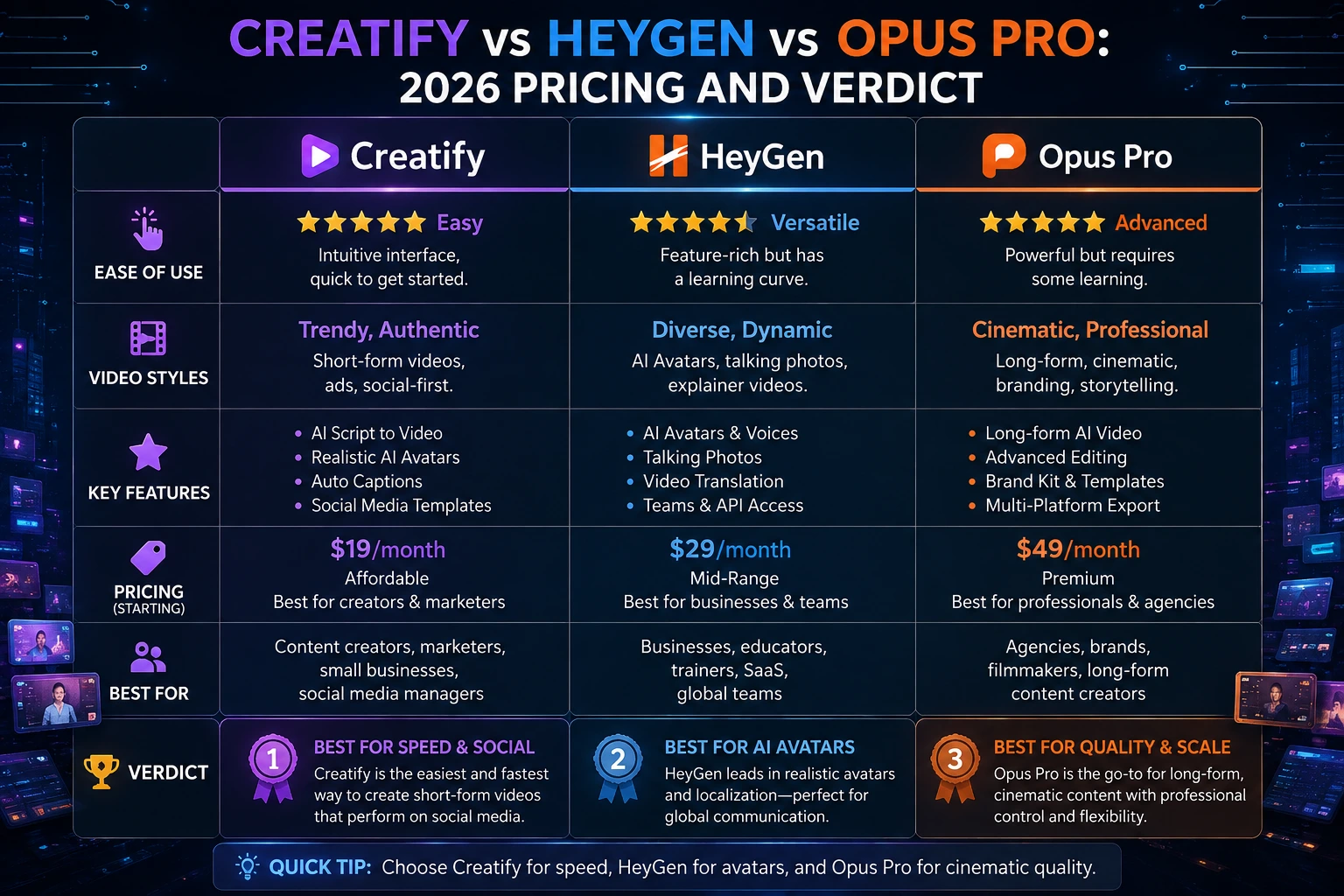
Verdict: Pick Creatify for paid social ad creative, because a product URL becomes UGC-style variants and batch mode handles volume testing. Pick HeyGen for a spokesperson reading a script, and especially for localising one video into many languages. Opus Pro is not competing with either. It clips footage you already have rather than generating footage you do not. Creatify from $39/mo, HeyGen from $29/mo, Opus Pro from $15/mo, all verified August 2026.
Everything below is the reasoning, the credit math that changes those prices, and where each one breaks.
They are not three versions of the same tool
Most comparisons of these three fail at the first step by treating them as interchangeable. They are not.
Creatify and HeyGen are generators. You give them text and they produce video that did not previously exist. Opus Pro is a clipper. You give it a long recording and it extracts short vertical cuts.
HeyGen’s own comparison makes the structural point cleanly : a clipper has nothing to produce once the source library runs dry. That is the entire distinction, and it decides the choice before price enters the conversation. If you have 40 hours of podcast or webinar footage, Opus Pro is the cheapest useful thing on this page. If you have none, it cannot help you at all.
So the real comparison is Creatify against HeyGen, with Opus Pro as a separate line item you may want alongside either.
Pricing, August 2026
| Creatify | HeyGen | Opus Pro | |
|---|---|---|---|
| Free tier | Yes, watermarked, ~10 credits | Yes, 3 videos, 720p, watermark | Yes, ~60 min/month |
| Entry paid | $39/mo, 100 credits | $29/mo, 600 credits ($24 annual) | $15/mo |
| Mid tier | $99/mo Pro, 300 credits | $49/mo Pro, 4K export | Pro, ~300 source minutes |
| Team tier | Enterprise, custom | $149/mo Business, +$20/seat | Pro caps at 4 seats |
| Credits expire | Rolling 2-month cycle | Monthly, no rollover | Per plan |
| Actor library | 300 on Starter, up to 1,500 Pro | 500+ stock avatars | Not applicable |
Confirm on the billing screen. This category re-tiers constantly and promotional pricing shifts the numbers by 30% or more.
One note on annual billing. HeyGen’s annual discount is modest, roughly $29 down to $24, so committing early costs little and saves little. Creatify advertises up to 50% off on annual, which is a much larger swing, but the two-month credit expiry still applies inside an annual plan. Paying for twelve months does not bank twelve months of credits. Read that clause before you take the discount.
Creatify vs HeyGen, the parts that actually differ
Credit consumption is the real price
Both platforms advertise credits, and both let a single video eat a lot of them.
On Creatify, a render can consume anywhere from 2 to 20 credits depending on length, avatar and quality setting. At the high-quality end, Starter’s 100 credits produces roughly five usable videos a month, not fifty. On HeyGen, premium avatar generation runs about 20 credits per minute, so Creator’s 600 credits covers roughly 30 minutes of premium output.
Neither number is hidden exactly, but neither appears on the pricing page either. Work out your monthly minutes before you subscribe.
What each one is actually built for
Creatify starts from a product. Paste a URL or upload a photo and the product stays on screen. For ecommerce and DTC that is the deciding feature, because an avatar gesturing at nothing converts worse than an avatar holding the thing. Batch mode generates variants at once, which is what volume hook testing needs. Our guide on writing marketing scripts with Codex pairs well with batch mode, since the bottleneck becomes script supply rather than render capacity.
HeyGen starts from a person. Lip-synced translation across 175 languages is genuinely the best thing either tool does, and nothing in Creatify approaches it. Its Video Agent generates B-roll from frontier video models, and LiveAvatar produces real-time conversational avatars, both shipped in late 2025.
The practical read: HeyGen is a presenter platform that can make ads. Creatify is an ad platform that happens to use avatars.
Feature by feature
| Creatify | HeyGen | |
|---|---|---|
| Product URL to video | Yes, core feature | No |
| Real product on screen | Yes, product-in-frame | Limited |
| Batch variant generation | Yes | No |
| Custom avatar from your photo | Pro tier, 3 included | Yes, extra slots $29/mo |
| Lip-synced translation | Basic | 175+ languages, best in class |
| Real-time conversational avatar | No | Yes, LiveAvatar |
| Generative B-roll | Limited | Yes, via frontier video models |
| 4K export | No | Pro tier and above |
| API access | Enterprise only | Yes, billed separately |
| Watermark-free on free tier | No | No |
The asymmetry is the point. There is almost no overlap in the top half of that table, which is why teams running both is the normal outcome rather than a sign of indecision.
Cost per shipped video
Sticker price ignores failed renders and the editing that follows. Assume one render in five is unusable and 15 minutes of finishing per video at $30 an hour.
| Plan | Monthly | Realistic finished videos | All-in per video |
|---|---|---|---|
| Creatify Starter | $39 | 5 to 8 | $12 to $16 |
| Creatify Pro | $99 | 15 to 25 | $11 to $14 |
| HeyGen Creator | $29 | 8 to 12 | $10 to $14 |
| HeyGen Pro | $49 | 15 to 20 | $10 to $12 |
| Opus Pro Starter | $15 | 20 to 40 clips | $8 to $9 |
Two conclusions. HeyGen is marginally cheaper per finished asset at every tier, mostly because its credit allocation is more generous relative to price. And Opus Pro looks cheapest per unit while producing a different kind of unit, so that row is not really comparable to the others.
Where each one breaks
Creatify’s failure mode is the credit cliff plus the two-month expiry. Skip a month of production and the credits are gone. Public reviews also flag occasional voice assignment errors across scenes, and a no-refund policy that has caught out at least one founder on G2.
HeyGen’s failure mode is add-on creep. Extra custom avatar slots run about $29 a month each, real-time avatar slots more, and top-up credits are available only on the Business tier, so Creator and Pro users have to upgrade rather than buy a small pack. The sticker price understates sustained cost more than Creatify’s does.
Where Opus Pro fits
At $15 a month it is the cheapest thing here, and it is priced that way because it is doing less.
One credit covers one minute of imported source video. Starter processes around 150 minutes, Pro around 300. The pricing page does not publish static refill-pack prices using a dynamic calculator instead, and Pro caps at four seats in packs of two, which pushes mid-market teams into custom negotiation sooner than expected.
Use it if you already record: webinars, podcasts, long-form YouTube, recorded calls. It mines existing assets efficiently and the output goes straight to Reels and Shorts. Do not buy it expecting ad creative, because the raw material has to be good on camera before the clipper can help.
What the review scores tell you, and what they hide
G2 puts Creatify and HeyGen both around 4.8 out of 5 , Creatify across roughly 1,200 reviews and HeyGen across roughly 1,440. Opus Pro sits at 4.6 across about 115. Trustpilot scores for the same products run dramatically lower.
Both sets of numbers are real. G2 collects reviews through vendor-run campaigns from people still using the product. Trustpilot collects people who went looking for somewhere to complain. Averaging them tells you nothing.
The useful signal in G2’s data is the sub-scores. Creatify edges HeyGen on quality of support and ease of setup, HeyGen carries the higher overall G2 score. Read the one-star reviews on both, then decide which failure mode you can live with.
What neither tool does well
Three limits worth knowing before you buy either.
Hand-to-product interaction. Both struggle with an avatar physically handling a product. Fingers pass through objects, grip looks wrong, and the illusion breaks in the exact second a viewer is deciding whether this is real. If your product needs demonstrating rather than describing, a human creator filming with the actual item still wins outright.
Shared avatar fatigue. Every actor in either library is available to every other customer. Your audience meets the same faces selling supplements, software and dropshipped gadgets in one scroll, and measured performance decays as recognition builds. Rotate deliberately rather than picking whichever avatar looks best, and retire faces that have been running for a quarter.
Neither publishes to your ad accounts. Both hand you a file. You download it and upload it manually. For a team shipping 40 variants a month, that is real time nobody budgets for, and it is the step most likely to become somebody’s Friday afternoon.
Which one to pick
DTC or ecommerce, under $15k monthly ad spend. Creatify. Free tier first, then Starter. The product URL workflow removes the most steps and the price floor lets you fail cheaply. Watch the credit burn in week one and upgrade only if the math holds.
One winning creative, many markets. HeyGen Creator at $29. Nothing else on this page localises a proven asset this cheaply, and translation is where the money is if you sell across borders.
Service business with recorded content. Opus Pro plus HeyGen. Clip what you have, generate what you do not. That combination costs under $50 a month and covers more ground than either alone. Contractors in particular sit on usable footage without realising it, which we touched on in how AI helps roofing contractors close more jobs.
Lead generation rather than ecommerce. The tool matters less than the offer. Our breakdown of faceless UGC for lead generation covers why.
A 30-minute evaluation
Both have free tiers. Use them instead of reading another comparison.
- Pick one real product or service you sell, not a demo
- Write one 20-second script. Same script for both platforms
- In Creatify, paste the product URL and generate. In HeyGen, pick the closest avatar and generate
- Time it, including any re-render, and note credits consumed
- Export both and count the minutes each needed to reach shippable
- Run both against one existing winner in the same ad set, equal budget, 72 hours
Compare three-second hook rate rather than click-through. Hook rate isolates whether the creative survives the scroll, which is the only thing the tool controls. Everything after three seconds is your script and your offer, and no platform choice fixes those.
Log the credits number. It is the figure that decides which tier you actually need, and it is the one neither pricing page will tell you in advance.
The stack most teams land on
Almost nobody stays on one tool. The pattern that settles is Creatify for volume ad variants, HeyGen for the polished spokesperson piece and any translation work, and Opus Pro if a content library already exists. Total around $85 a month at entry tiers, which is less than one filmed shoot.
Two things matter more than any of this. Your hooks, because avatar quality only counts if it survives three seconds. And your landing page, because AI-referred and social-referred visitors arrive with more context than organic ones and need objection handling rather than introduction. Hygeia Health rebuilt its storefront and grew direct traffic 600% in a month on the post-click side of exactly that problem.
Also worth watching where the creative ends up running. Google’s AI-native ad formats and the growing overlap between ads and AI Overviews are changing which aspect ratios and lengths matter. If your brand assets are the constraint rather than the video tool, Midjourney plus Figma closes that gap without a designer.
FAQs
Is Creatify or HeyGen better?
They win at different jobs. Creatify is better for paid social ad creative, because it turns a product URL into UGC-style variants and runs batch mode for volume testing. HeyGen is better for a spokesperson reading a script, and its lip-synced translation into 175 languages is the strongest feature either tool has. If you are testing ad hooks, Creatify. If you are localising one video, HeyGen.
How much do Creatify and HeyGen cost in 2026?
Creatify has a free tier with a watermark, Starter at $39 per month for 100 credits, and Pro at $99 for 300 credits. HeyGen has a free tier limited to three watermarked videos, Creator at $29 per month or about $24 billed annually, Pro at $49, and Business at $149 plus $20 per additional seat. Both bill by credit, so the plan name tells you less than the credit math does.
Is Opus Pro a Creatify or HeyGen competitor?
Not really. Opus Pro clips footage you already recorded into short vertical videos. Creatify and HeyGen generate footage that does not exist yet. If you have a library of long video, Opus Pro is the cheapest way to mine it. If you have no footage, it has nothing to work with and the comparison collapses.
Do Creatify and HeyGen credits roll over?
No, and this is where both plans cost more than they look. Creatify credits expire on a rolling two-month cycle. HeyGen credits reset monthly with no carryover. A slow production month burns money on both platforms, so match your tier to your realistic volume rather than your best month.
Can I trust the G2 ratings for these tools?
Read them for the failure modes, not the average. Creatify and HeyGen both sit around 4.8 out of 5 on G2 across thousands of reviews, while Trustpilot scores for the same products run far lower. Both figures are real and measure different populations. The one-star reviews are the useful part.
Which tool is cheapest for high-volume ad testing?
Creatify, because batch mode and the product URL workflow remove the most steps per variant. The caveat is credit consumption: a high-quality render can use up to 20 credits, so Starter’s 100 credits realistically yields about five polished videos rather than fifty. Price your real output, not the headline credit count.
Test both free tiers this week
Same script, same product, both platforms, then count the minutes each one needed to reach shippable. That comparison answers this question better than any table, including the one above.
If you would rather skip the evaluation entirely, our shorts and graphics studio handles the production volume and performance paid growth runs the testing behind it. A social content strategy audit is the cheaper starting point if you are not sure the creative is the bottleneck.