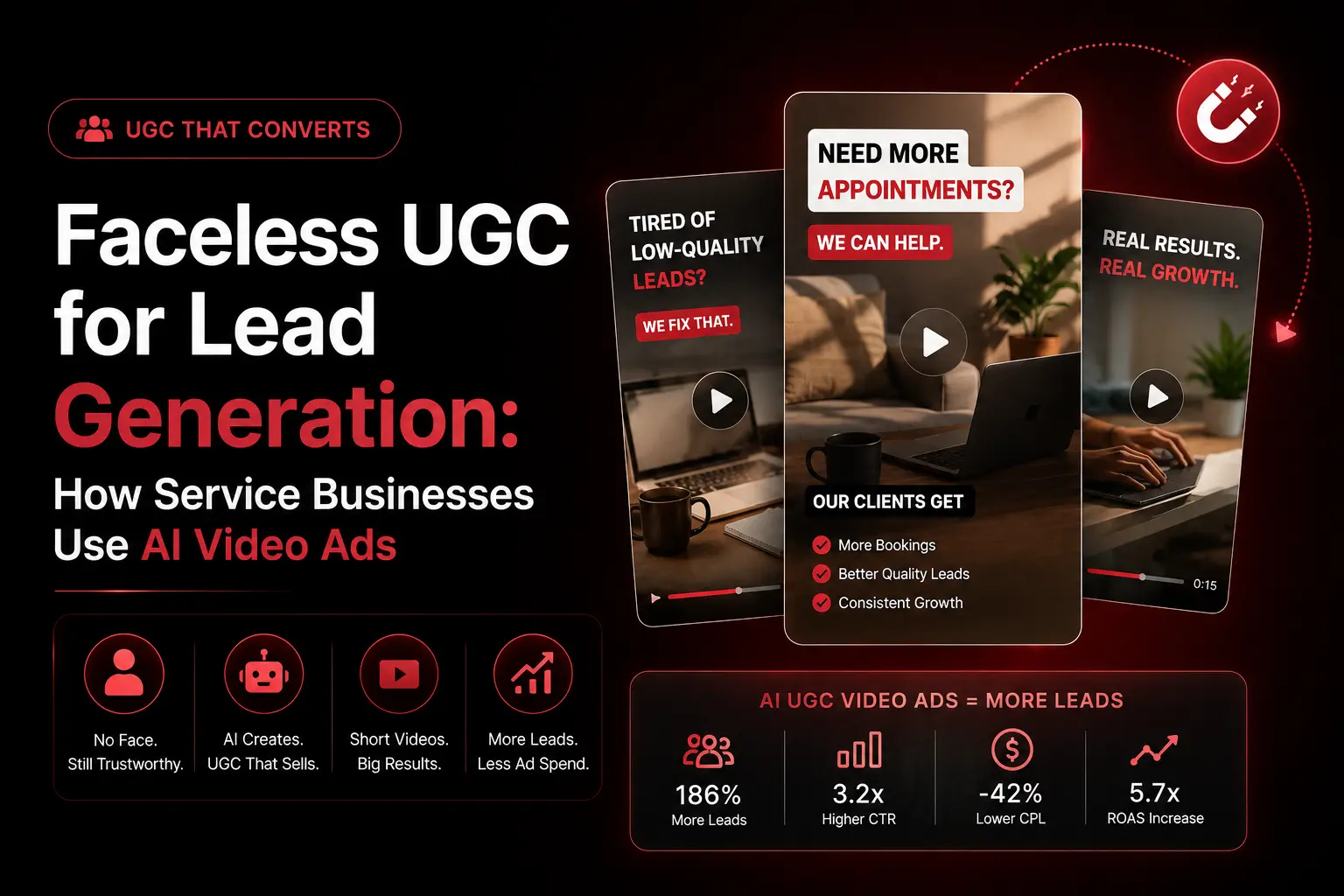
Faceless UGC for lead generation is how service businesses turn paid social into a steady flow of qualified leads without putting a founder in front of a camera 50 times a month. AI faceless video ads let legal, dental, consulting, and home-services firms produce educational content at volume, then test which angles actually drive calls and form fills. At NuroSparX, we run these programs for service businesses, and the pattern is clear: the win is not a single great video, it is the ability to test 20-plus educational angles a month and let the data tell you what converts.
Most video ads fail service businesses because they borrow the e-commerce playbook of features, urgency, and “buy now.” Services do not sell that way. They sell on education, trust, and authority. Faceless AI video fits that formula and scales it, which is exactly why it has become a core lead-gen channel in 2026.
Want results like this for your business?
NuroSparX builds AI-powered growth engines for SMBs doing $5M-$100M. Let’s talk.
Get a Free Growth AuditWhat Is Faceless UGC for Lead Generation?
Faceless UGC for lead generation is the practice of using AI-generated, user-generated-style videos (no founder or actor on camera) to educate prospects and capture qualified leads for service businesses. Instead of a product pitch, each video teaches a specific problem-and-solution, builds authority, and ends with a consultation-focused call to action. Because the content is AI-produced, a business can generate dozens of variations cheaply and test which educational angles trigger real lead response.
Why Service Businesses Need a Different Video Format
The conversion path for a service is not the conversion path for a product. E-commerce stacks features, social proof, urgency, and a buy button to drive an immediate sale. A service business is generating a qualified lead, which means the formula is education, trust-building, authority, a specific problem-solution, and a low-pressure next step. Get that order wrong and the ad fails, no matter how polished it looks.
Consider a cosmetic dentistry practice. A slick before-and-after clip earns a “that’s cool” on Instagram, but it rarely makes a viewer pick up the phone. What moves a prospect is understanding why the procedure matters, why this practice is credible, and why acting now is reasonable. Founder-on-camera videos can deliver that trust, but they do not scale, because the founder does not have time to film fifty of them. Faceless AI UGC scales the educational-authority-trust formula without burning the founder’s calendar, which is the core reason service businesses adopt it.
The Lead-Gen Video Format That Works for Services
The structure that performs for services is education first, proof second, a soft ask last. A reliable 30-second template looks like this:
- 0 to 3 seconds: a problem hook tied to a specific, relatable pain point.
- 3 to 15 seconds: teach the answer to that problem in plain language.
- 15 to 20 seconds: why it matters for this particular viewer.
- 20 to 25 seconds: social proof such as results, credentials, or a brief testimonial.
- 25 to 30 seconds: a specific call to action like booking a consultation or downloading a guide.
The deliberate omission is e-commerce pressure. No urgency, no scarcity, no “buy now.” Lead-gen video qualifies and educates, and the sale conversation happens later with a human. That restraint is what separates a service ad that books consultations from one that just collects views.
Lead-Gen Video Angles by Service Type
The repeatable pattern is the same across verticals: open on a pain point, educate on the solution, close on authority. Here are angles that work by service type.
Legal services. Personal injury: the biggest mistake after an injury that ruins a claim. Family law: what judges actually look for in custody cases. Bankruptcy: the things quietly destroying a credit score and how bankruptcy can help. DUI: why you should not talk to police after an arrest and what to do instead.
Dental services. General: hidden signs you may need a root canal and how dentists catch them early. Cosmetic: the confidence psychology behind a smile transformation. Orthodontics: the real differences between Invisalign and braces on timeline and cost. Implants: why implants are a durable solution, with honest success rates.
Consulting and B2B. Marketing agency: why ad spend underperforms and what strong agencies do differently. Accounting: deductions most owners miss and the savings at stake. HR consulting: why high turnover costs roughly twice a salary to replace, and how to fix it.
Home services. Plumbing: how to spot a foundation or slab leak before it becomes catastrophic. HVAC: why a system runs far more expensively than it should and the efficiency signals to watch. Roofing: signs a roof needs replacing within two years. Electrical: outdated wiring that raises fire risk and the code standards that matter.
Across every one of these, the energy is educational, not promotional. You are qualifying prospects, not pressuring them.
Platform Strategy and Expected Cost
For most service businesses, Meta (Facebook) and YouTube together drive the majority of qualified leads, with TikTok useful for younger-skewing services like family law, cosmetic procedures, and coaching. Google Local Services Ads remain a strong high-intent channel for home services. The cost figures below are directional 2026 ranges and vary widely by market, vertical, targeting, and creative quality, so treat them as starting expectations rather than guarantees.
| Platform | Best audience | Format that works | Strong service fit | Typical lead cost range |
| Meta (Facebook) | 35 to 65, affluent | Educational + testimonial | Legal, medical, financial | $8 to $25 |
| Meta (Instagram) | 25 to 50, affluent | Before-after + social proof | Dental, cosmetic, wellness | $12 to $35 |
| YouTube | All ages, high intent | Tutorial + expertise | Technical services, coaching | $5 to $18 |
| Google Local Services Ads | Local, high intent | Credentials + reviews | Home services, plumbing, electrical | $8 to $22 |
| TikTok | 18 to 40, early adopters | Educational + entertaining | DUI and family law, fitness | $15 to $45 |
A practical structure is to produce educational content with national appeal, then attach location-specific calls to action (“Book your free consultation in [City]”). One library of educational videos can serve many service areas, and the localized CTA is what concentrates spend on high-intent local prospects.
How to Run Your First Testing Round: Step by Step
The advantage of faceless AI video is testing speed. Here is a four-week round that turns guesses into a data-backed content plan.
- Pick one core service and five angles. Choose your highest-value service and five educational angles prospects actually ask about: the biggest mistake clients make, warning signs to watch, why timing matters, DIY versus professional, and a client-results angle.
- Produce five faceless videos. Use an AI UGC tool such as Creatify to generate the five variations. Creatify uses a credit-based model starting around $33 to $39 per month, with credits that do not roll over, so plan your output. HeyGen, Synthesia, and Arcads are alternatives worth comparing for avatar quality and pricing.
- Run a small, even test. Put roughly $10 per day behind each video for three days and measure cost per lead, not vanity metrics like views. Keep targeting and CTA constant so the creative is the only variable.
- Double down and refresh. In week two, scale the top two performers and introduce three new angles. In week three, apply your winning angle to a second service. In week four, test the call to action itself.
- Test the CTA last. Compare “schedule a call” against “download a guide” against “get a free consultation.” In our experience, specific consultation-focused CTAs consistently beat vague “learn more” prompts.
- Lock in winners and rotate. After four weeks you will have tested 15 to 20 variations and identified a few clear winning patterns. Scale those and keep rotating fresh angles into secondary services.
By the end of the round you know which educational angles produce your cheapest, most qualified leads, and that data shapes the rest of the year.
Faceless AI Video vs Founder-on-Camera
Both have a place. Founder video builds credibility; faceless AI video builds volume and testing speed. The honest comparison is about throughput, not which looks better.
| Factor | Founder on-camera | Faceless AI video |
| Cost to produce one video | Time, plus $0 to $500 | A few dollars in credits |
| Time to produce one video | 3 to 5 hours | Around 15 minutes |
| Videos per month | 4 to 8 | 50 to 100 |
| Founder time per month | 30 to 40 hours | None |
| Scaling ability | Capped by founder time | Effectively unlimited |
| New-angle testing speed | Weeks | Days |
| Trust signal | Strong | Built through education and proof |
The approach we recommend is hybrid: keep one or two founder videos for the channel homepage and first-touch credibility, and use faceless AI video for the high-volume testing that discovers what actually converts. When CTRs are equal, cost per lead is similar across both, but the moment a founder’s filming time becomes the bottleneck, AI video wins on pure throughput. To automate the content side of this engine, see our guide on AI content workflows with Make.com and ChatGPT.
Mistakes That Waste Service-Business Ad Spend
Three errors quietly drain budgets on otherwise sound campaigns.
- Borrowing the e-commerce script. Urgency, scarcity, and hard sells suppress lead quality for services. Lead with education and authority, and let the consultation be the soft close.
- Measuring views instead of cost per qualified lead. A video with great engagement and no booked calls is a failure. Put UTM parameters on every CTA link and track lead source through to close rate and average deal size, so you separate angles that produce qualified leads from those that produce tire-kickers.
- Scaling before you have a winner. Pouring budget into a single unproven video is how money disappears. Test small and even first, then scale only the angles the data validates.
Frequently Asked Questions
Should service businesses use founder-on-camera or AI faceless video?
Use both. Keep one or two founder videos for homepage credibility and first impressions, and use AI faceless video for high-volume testing of 20-plus educational angles. Founder credibility matters, but AI is what lets you discover, quickly and cheaply, which content actually converts.
Does faceless AI video work for high-ticket services?
Yes, for the lead-generation stage. AI video educates and qualifies the prospect, and the actual high-ticket sale happens in a conversation with the founder or expert. The goal is to feed that conversation with more qualified leads at a similar cost.
What call to action works best for service lead gen?
Specific, consultation-focused CTAs like “schedule your free consultation” or “get a free [specific] consultation” reliably outperform vague prompts like “learn more.” Specific beats generic, and a clear free offer beats an ambiguous one.
How much should I budget to start?
A sensible starting point is about $10 per day per service offering during testing. With cost per lead often landing in the $8 to $25 range depending on platform and market, a few hundred dollars of spend can produce a meaningful number of leads, after which you scale the winning angles.
How do I track lead quality from video ads?
Use UTM parameters on your CTA links so you can see which video produced which lead, then connect that to your CRM to track close rate and average deal size by angle. This is how you tell which educational angles generate qualified leads versus unqualified inquiries.
Can I reuse the same video across different services?
Sometimes. If the problem-solution applies broadly, a generic angle can work across services. In practice, service-specific videos tend to convert better because the pain point is sharper, so test broad angles first and add service-specific ones as winners emerge.
Ready to Turn Video Into a Lead Engine?
Faceless UGC for lead generation works because it matches how service businesses actually win customers: education, trust, and a low-pressure path to a consultation, produced at enough volume to find what converts. The businesses that pull ahead are the ones testing angles every week, not the ones waiting on one perfect video. If you want to see where your current funnel is leaking qualified leads before you scale spend, book a free growth audit and we will map it. Questions first? Reach the team through our contact page.