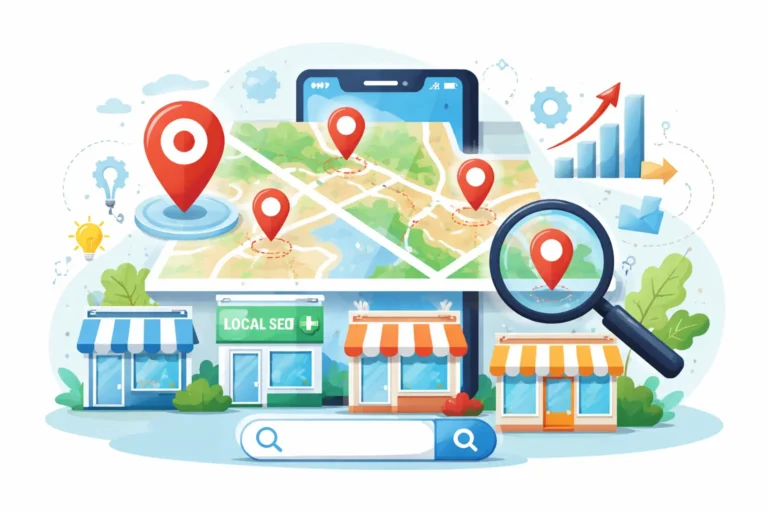

You have 7 locations. One has a Google Business Profile that’s fully optimized. The other six haven’t been updated in three years. Reviews on Location A are at 4.7 stars. Location C is at 3.2. Your website has no location pages. Customers search ‘your company + my city’ and can’t find you.
Managing local SEO for multiple locations is a different game than managing one. You can’t manually optimize 50 locations. You need systems. You can’t be inconsistent across locations. You need standardization. You can’t ignore reviews at any location. You need monitoring.
This guide shows you how to do local SEO at scale. Whether you have 2 locations or 500, the strategy is the same. The execution is different.
Multi-location local SEO requires systems: automated GBP management, citation syndication, review monitoring, and location-specific content. Without systems, you’ll never optimize all locations.
Multi-Location Local SEO Fundamentals (The Three Pillars)
Local SEO for multiple locations rests on three things:
-
Google Business Profile Optimization (GBP)
Each location needs a GBP that ranks in local search. Fully filled out. Regular posts. Good reviews. This is your foundation. One bad GBP tanks your whole local presence in that city.
-
Citations (Consistent Business Data)
Google verifies your information by checking if your business shows up consistently across the web. Same name, address, phone on your site, industry directories, Google, Yelp, etc. Inconsistency hurts rankings.
-
Local Content (Location-Specific Pages)
Your website needs pages for each location. Not just a directory. ‘Dental practice in Denver’ should have different content than ‘Dental practice in Colorado Springs.’ Local content ranks better than generic.
GBP Management at Scale (How to Actually Do This)
Google Business Profile is where most local searches start. Your GBP directly impacts rankings, visibility, and click-through rates. But managing 10, 50, or 100 profiles manually is impossible.
| Number of Locations | Manual Management Feasible? | Tool Required? | Recommended Approach |
| 1-3 | Yes | Optional | Manager or owner handles it |
| 4-10 | Difficult | Recommended | One person + tool |
| 11-50 | No | Required | One person + tool, or agency |
| 50+ | No | Absolutely required | Agency with multi-location platform |
Tools like Semrush Local Business, Yext, or Bright Local let you manage all your GBPs in one dashboard. Update hours, add photos, post content, respond to reviews across all locations from one place.
Citations and NAP Consistency (The Boring But Critical Part)
NAP = Name, Address, Phone. If one location shows up as ‘John’s Dental’ on Google and ‘Johns Dental’ on Yelp, Google gets confused. It treats them as different businesses. This kills rankings.
Multi-location citation strategy:
- Audit: Check where each location appears on the web. Google, Yelp, Yellow Pages, Apple Maps, Facebook, industry directories. Create a spreadsheet.
- Standardize: Choose one format for your name, address, phone. ‘Downtown Denver Dental,’ not ‘Downtown Dental Denver.’ Be consistent everywhere.
- Submit: Add your business to citation sources (directories, Google, Yelp, etc.) if not listed. This takes time.
- Correct: Fix any inconsistencies. If Location A says ‘123 Main St’ and Location B says ‘123 Main Street,’ standardize it.
- Monitor: Set up monitoring so you catch new bad citations quickly.
Location Pages: Why You Need Them (And How to Build Them)
Your website has a homepage and some service pages. But it doesn’t have location pages. This is leaving ranking opportunity on the table.
A location page for ‘Dental practice in Denver’ should answer questions specific to Denver patients. Hours. Insurance. Address. Reviews from Denver. What makes your Denver location special. This ranks better than a generic page.
| Element | Generic Page | Location-Specific Page |
| Title | ‘Dental Services’ | ‘Dental Practice in Denver – Accepting New Patients’ |
| Content | Describes all services | Services + Denver-specific info + local events |
| Hours | May not show | Your Denver location hours |
| Reviews | All reviews mixed | Denver reviews highlighted |
| Local Info | None | Neighborhood info, parking, directions |
| CTAs | Generic | Call Denver office, book Denver appointment |
Build location pages using a template. One page, 500-800 words, optimized for location + service. You can automate this with programmatic SEO.
Review Strategy for Multiple Locations (Getting Reviews at Scale)
Reviews are critical to local ranking. But you can’t manually ask for reviews at 50 locations. You need a system:
-
Automated Request System
After customer visit/transaction, send automated email or SMS asking for review. Link directly to your Google review page. This generates 3-5x more reviews than manual asking.
-
Location-Specific Goals
Set a review target for each location. ‘Location A: 50 reviews, Location B: 30 reviews.’ Track monthly. This creates accountability.
-
Respond to Everything
Respond to all reviews. Good or bad. Shows potential customers you care. Use tools to aggregate all reviews from all locations in one dashboard.
Local Schema and Structured Data (Technical Local SEO)
Google understands structured data. If your website uses proper schema markup (Organization schema, Local Business schema, Opening Hours Specification), Google ranks you higher.
For multi-location: your homepage should have Organization schema with all locations listed. Each location page should have Local Business schema specific to that location. This is technical but not complicated.
Programmatic Local SEO (The Future of Multi-Location)
Most multi-location businesses create location pages manually. But you can automate this:
Template: ‘Get [service] in [location].’ Generate variations for all your locations and services. ‘Get dental cleaning in Denver,’ ‘Get dental cleaning in Colorado Springs,’ etc. 150 pages instead of 5.
This works because each city + service combination has search demand and different intent. You own all of it.
Multi-Location SEO at Scale: Tools and Platforms
You need tools to manage this at scale:
| Use Case | Tool | Cost | Best For |
| GBP Management | Semrush Local / Yext / Bright Local | $100-500/month | 1-500+ locations |
| Citation Building | Semrush / Moz Local / Yext | $100-300/month | Multi-location citation syndication |
| Review Management | Trustpilot / Birdeye | $100-500/month | Aggregate and respond to reviews |
| Local Landing Pages | Template + CMS | Custom | Programmatic location pages |
| Monitoring | Semrush / Ahrefs Local | $100-200/month | Track rankings per location |
Frequently Asked Questions
Q: Do we need separate Google Business accounts for each location?
A: Yes. One GBP per location, verified by someone with access to that location. Not one account with multiple locations.
Q: Can we use one website with location pages instead of separate sites?
A: Yes, actually better. One website with location pages ranks better than separate location websites. Consolidate if you have multiple domains.
Q: How long until we see local ranking improvements?
A: 4-8 weeks for GBP and citations. 2-3 months for location pages. 3-6 months to see full effect across all locations.
Q: What if one location is hard to find or less competitive?
A: Start with most competitive locations first. Build playbook there. Apply to easier locations later. Some locations will rank faster.
Q: Should we invest more in reviews than location pages?
A: Both matter equally. Reviews for ranking. Location pages for ranking and conversion. Invest in both. Can’t do one without the other.
Next Steps
Multi-location local SEO isn’t harder than single-location SEO. It’s just more complex. The companies managing it with systems and tools are seeing 300-400% increases in local visibility within 6 months. Most competitors are still doing it manually and losing.
Multi-location businesses scaling fastest partner with agencies that have local SEO platforms and experience managing consistent optimization across dozens of locations and markets.