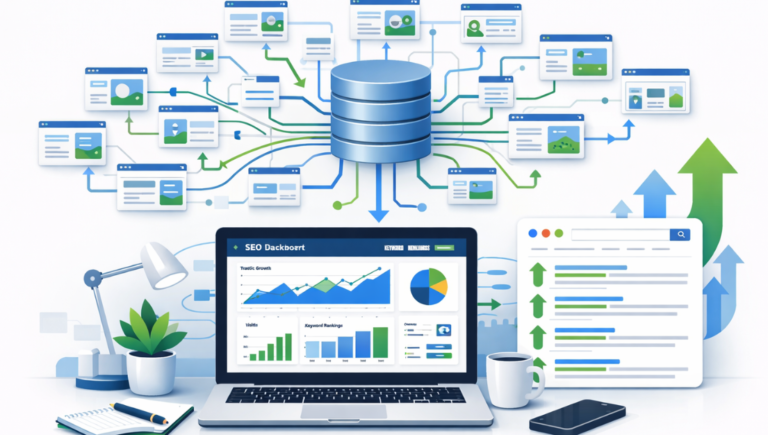

Programmatic SEO is how a small team outranks competitors still writing one blog post at a time. Instead of hand-crafting each page, you build one strong template and use AI to generate hundreds of unique variations that target an entire keyword universe at once. At NuroSparX, we build these page systems for SMBs across local services, comparison queries, and buyer-intent searches, and the leverage is real: 100 well-built pages can compete for thousands of keywords that a traditional blog would never reach.
There is a catch, and it is the part most guides skip. Since March 2024, Google has actively penalized thin, mass-produced pages under its scaled content abuse policy, and the March 2026 spam update sharpened that enforcement. So the goal is not “publish as many pages as possible.” It is “publish many pages that each earn their place.” This guide shows you how to do exactly that with AI in 2026.
Want results like this for your business?
NuroSparX builds AI-powered growth engines for SMBs doing $5M-$100M. Let’s talk.
Get a Free Growth AuditWhat Is Programmatic SEO?
Programmatic SEO is the practice of generating large numbers of landing pages from a single template, where only the variables change (city, product, use case) while each page delivers genuinely unique, useful content. It targets repeatable keyword patterns at scale instead of writing one page per topic by hand. Done well, it captures long-tail search demand that manual content cannot economically reach.
Why Programmatic SEO Still Works in 2026
The underlying math has not changed. One page targets one keyword, so 100 pages target 100 keywords and 500 pages target 500. That is 500 chances to rank for searches your competitors are ignoring. The difference in 2026 is that volume alone is worthless. Google’s enforcement now draws a hard line between two kinds of pages that look identical on a spreadsheet.
On one side sits legitimate programmatic SEO, like a real-estate site publishing property listings backed by live MLS data, where every page answers a distinct query with distinct information. On the other side sits scaled content abuse: thousands of pages where only a city name changes and nothing else adds value. Google’s policy is method-agnostic, meaning it does not care whether a human, an AI, or a hybrid produced the page. It cares about intent and value.
The numbers back this up. After the March 2024 update, Search Engine Land reported a roughly 45 percent drop in unoriginal content appearing in results, and sites leaning on mass-produced landing pages took the steepest hits. Pages with strong experience, expertise, authority, and trust signals (E-E-A-T) often gained ground. The takeaway for 2026: programmatic SEO is alive and effective, but only when each page is built to help a real searcher.
The Page Patterns That Actually Scale
The best programmatic SEO follows a repeatable pattern where the structure stays fixed and only the variables move. Proven patterns include:
- “[Service] in [City]” for local intent. A law firm publishing pages for 200 cities ranks for 200 local searches.
- “[Tool] vs [Tool]” comparison pages that capture high-intent, decision-stage traffic.
- “[Job title] salary in [City]” data pages that pull large informational search volume.
- “Best [product] for [use case]” buyer-intent pages built to convert.
- “[Zodiac sign] and [zodiac sign] compatibility” style data pages, where a fixed set of combinations creates a large, coherent page set.
The pattern matters more than the topic. A good pattern has three traits: meaningful search volume across its variations, clear commercial or informational intent, and an obvious data source you can pull from, such as cities, products, or job titles. “Random blog topics” fail because they have no pattern and therefore no scale.
How to Build Programmatic SEO Pages with AI: Step by Step
Here is the full build, from pattern to published inventory.
- Find your template pattern. Choose a format where only the variables change and confirm it has the three traits above: volume, intent, and a data source. This single decision determines whether the whole project can scale.
- Build your keyword matrix. Open a spreadsheet with columns for the primary variable, search volume per variation, competition level, and a priority score. Pull data from Semrush, Google Keyword Planner, or Screaming Frog to see what competitors already rank for. Aim for 100 to 500 variations.
- Write one perfect page by hand. Before scaling anything, nail the template manually. Include an H1 with the keyword slot, three to five H2 sections that work for any variation, dynamic content blocks for stats and local detail, an internal linking structure, and clear CTA placement. A local-service template might run: H1 “Best [Service] in [City],” then H2s for why local residents need it, top options, how to choose a provider, and typical costs, ending in a “Get a Free Quote” CTA. This page is your blueprint.
- Use AI to generate unique variations. This is where AI earns its place. Give a model like Claude or ChatGPT your template, then prompt it per batch: keep the structure identical, make the content unique and locally relevant, include two to three specific details about each location, hold a consistent 800 to 1,200 word count, and never repeat the same phrases across pages. Generate in batches of 10 to 20, because quality drops on larger batches, and manually review at least 10 percent before publishing.
- Make each page earn its spot. Swapping a city name is not enough and is exactly what Google penalizes. Add real uniqueness: local statistics from Census or Bureau of Labor Statistics data, city-specific FAQs, links to nearby locations, local testimonials or case studies, and dynamic pricing. “Austin has 1.2 million residents and dozens of personal injury firms” earns its place. Generic copy with a swapped city name does not.
- Get the technical foundation right. Use clean URLs like /personal-injury-lawyer/austin/ rather than /pages/id=48271/. Submit an XML sitemap with all new pages, use internal linking to distribute authority, set proper canonical tags, and monitor indexing in Google Search Console. Because every page shares the same template and assets, compress images once and reuse them, and lazy-load below-the-fold content so pages stay fast at scale.
- Roll out gradually and prune. Do not publish 500 pages on day one. Ship 20 to 30 in week one, add 50 to 100 over weeks two through four, and scale to full inventory from month two. Track indexing rate, impressions, click-through rate, and position changes in Search Console. Kill or consolidate pages that fail to perform after 90 days.
How to Avoid Google’s Scaled Content Abuse Penalty
This is the section most programmatic SEO guides skip, and it is the one that decides whether your campaign survives. Google introduced the scaled content abuse policy in March 2024, rebranding the older “spammy automatically generated content” rule. The definition is blunt: generating many pages primarily to manipulate rankings rather than help users is spam, no matter how the pages are created. The March 2026 spam update enforced this faster and harder than any rollout before it.
To stay on the right side of the line, treat each page as a standalone asset:
- Make the majority of each page genuinely unique. A practical practitioner standard is to keep well over half of every page distinct from its siblings, pulling from multiple real data sources rather than one template with a find-and-replace.
- Lead with information, not a funnel. Pages built only to push users toward a single conversion destination read as doorway pages, which the policy explicitly targets. Answer the query first.
- Build E-E-A-T signals in. Author information, real local data, citations, and genuine testimonials separate a useful page from a spun one.
- Change your success metric. Replace “pages published per month” with “pages that earn impressions, rankings, or qualified leads.” If a page cannot attract or convert anyone, it is a liability, not an asset.
If you are not sure where your existing pages fall on that line, our SEO, GEO and AEO audit is built to flag thin and at-risk pages before an update does.
Programmatic SEO vs Traditional Blogging: When to Use Each
Both belong in a mature content strategy. The decision is about query type, not which is “better.”
| Criteria | Programmatic SEO | Traditional Blogging |
| Best for | Repeatable, data-backed query patterns | Unique, narrative, or expertise-led topics |
| Content creation | One template, AI-assisted variations | One hand-written piece per topic |
| Scale | Hundreds to thousands of pages | One at a time |
| Ranking timeline | Compounds over months as pages index | Slower per page, but deep authority |
| Main risk | Scaled content abuse if pages are thin | High time cost, limited reach |
| Maintenance | Prune and refresh at scale | Update individually |
The rule we give clients: use programmatic SEO when a query has a clear pattern and a real data source behind it, and use traditional blogging for thought leadership, complex how-tos, and topics where your specific experience is the value. The strongest sites run both, with programmatic pages capturing demand and blog content building the authority that helps those pages rank. To automate the generation side without sacrificing quality, see our guide on building AI content workflows with Make.com and ChatGPT.
Mistakes That Kill Programmatic SEO Campaigns
Most failed campaigns share the same handful of errors. Avoid these and you are ahead of the large majority of people attempting this.
- Zero unique content. Swapping only the city name is the single fastest way to trigger a scaled content abuse penalty. Every page needs real, distinct value.
- No internal linking. Pages published in isolation strand their own authority. Link related pages to each other and back to relevant hub pages so link equity flows through the set.
- Publishing everything overnight. A 500-page dump on day one strains crawl budget and looks unnatural. Stage the rollout so Google can index and assess pages in waves.
- Ignoring page speed and mobile. At scale, a slow template multiplies its damage across every page. Optimize the template once so every page inherits the fix.
- No conversion tracking. If you cannot tell which pages produce leads, you cannot prune the dead weight, and dead weight is what gets sites flagged.
Frequently Asked Questions
Is programmatic SEO still safe in 2026?
Yes, when done well. Google penalizes thin, mass-produced pages under its scaled content abuse policy, but legitimate programmatic SEO with genuinely unique, useful pages continues to rank. The policy targets intent and value, not the use of templates or AI. Build each page to help a real searcher and you stay on the right side of it.
Can I use AI to generate the pages, or will Google penalize that?
You can use AI. Google has stated its policies target low-value content, not AI assistance specifically. The risk is publishing unedited, near-identical AI output at scale. Use AI to draft genuinely distinct content per page, add real data, and review a sample before publishing, and AI-assisted programmatic pages can rank fine.
How many pages should I start with?
Start with 20 to 30 pages, then add 50 to 100 over the following month before scaling to full inventory. A gradual rollout helps Google crawl and index your pages in waves and lets you catch quality or template issues before they multiply across hundreds of URLs.
How long until programmatic SEO pages drive traffic?
Expect roughly 60 to 70 percent of pages indexed within 60 days, first rankings around month two or three, and traffic compounding from month four onward. Programmatic SEO is a traffic system that builds over time, not a quick win, so plan for a multi-month horizon.
What data sources make pages unique enough?
Strong sources include Census population data, Bureau of Labor Statistics figures, local landmarks and industries, city-specific FAQs, real testimonials, and dynamic pricing. The goal is for the majority of each page to be distinct from its siblings, pulled from more than one real source rather than a single swapped variable.
How much does a programmatic SEO campaign cost to run?
The main costs are a keyword research tool such as Semrush, AI generation through a model API, and your time building and reviewing the template. Compared with hiring writers to produce hundreds of pages manually, an AI-assisted programmatic approach is dramatically cheaper, with the largest investment being the upfront template and quality-control work.
Ready to Build a Programmatic SEO Engine That Survives Updates?
Programmatic SEO done right is one of the highest-leverage moves an SMB can make in 2026, and done wrong it is one of the fastest ways to get penalized. The difference is whether each page earns its place. If you want to know whether your current pages are assets or liabilities, book a free SEO, GEO and AEO audit and we will show you exactly where you stand. Want a free way to audit page-level SEO and schema as you build? See our walkthrough on using the Gemini CLI for SEO audits. Questions first? Reach the team through our contact page.