
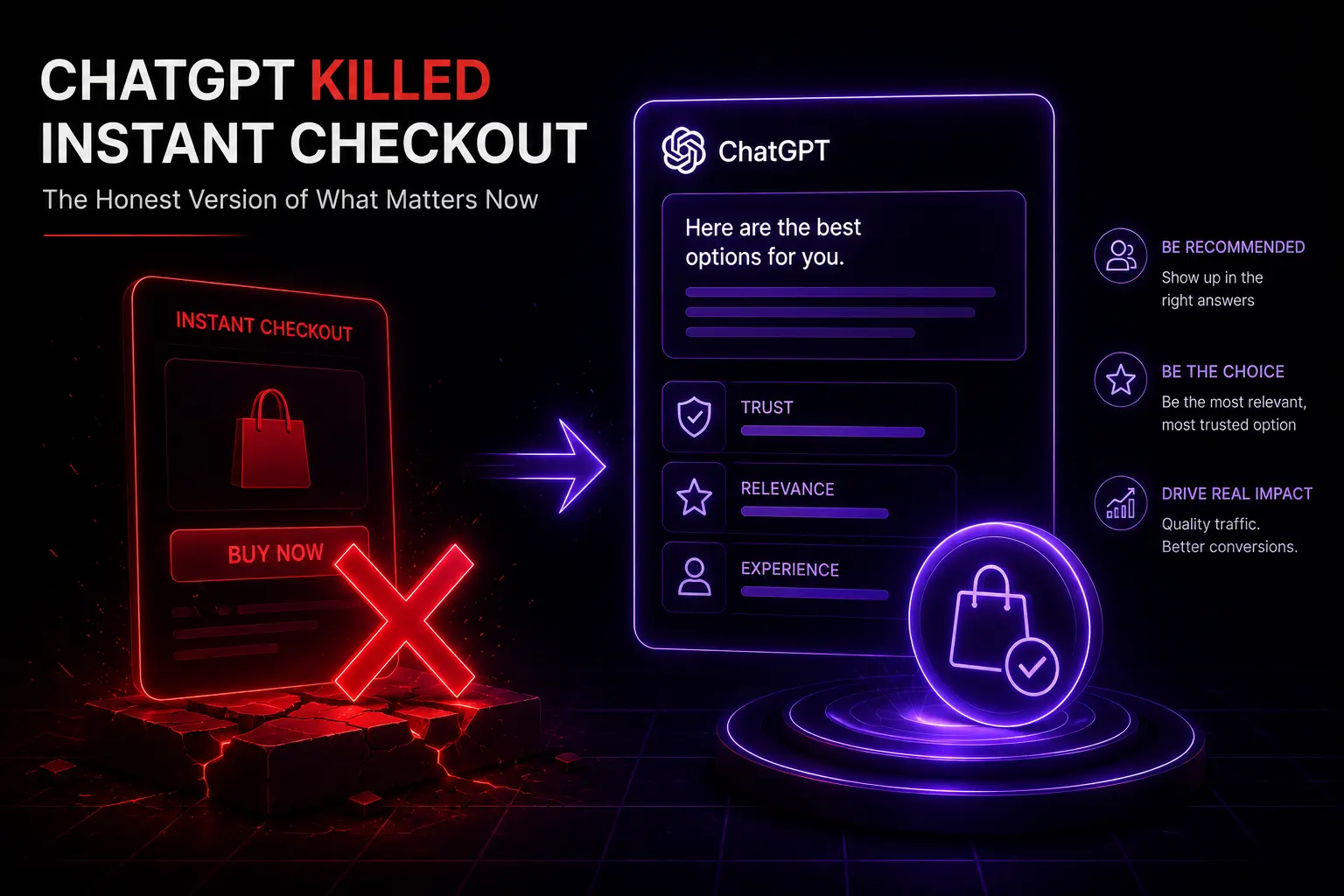
On February 16, 2026, OpenAI launched ‘Buy it in ChatGPT,’ an Instant Checkout feature that let US users purchase products without leaving the chat. By March 2026, it was gone. The Information reported the shutdown on March 6, and OpenAI confirmed the pivot soon after. If you spent the spring chasing ‘sell inside ChatGPT,’ you chased a feature that lasted about three weeks.
At NuroSparX we tell ecommerce founders the unglamorous truth, because the glamorous version costs you money. The checkout button died, but the bigger shift survived and got clearer. Discovery and clean product data are what actually win in agentic commerce. We structure product catalogs so AI agents can show up, understand, and recommend your products, which is the part that still pays off no matter which checkout layer wins.
Short version
OpenAI launched Instant Checkout in ChatGPT on February 16, 2026, then discontinued it in March 2026 after weak merchant adoption and product data gaps. It pivoted to a discovery-first model powered by the Agentic Commerce Protocol, co-built with Stripe. The real lesson: clean product data and discovery win, not native checkout.
What actually happened, in order
OpenAI shipped Instant Checkout on February 16, 2026, powered by the Agentic Commerce Protocol it co-developed with Stripe. Weeks later it pulled native checkout and pivoted to a discovery-first model that places products and routes shoppers to merchant storefronts instead of closing the sale inside the chat.
The launch promised purchases completed inside ChatGPT. The reality was thin. Fewer than 15 of Shopify’s millions of merchants ever went live. Walmart’s EVP Daniel Danker disclosed that purchases made directly inside ChatGPT converted at roughly one-third the rate of click-through transactions to Walmart.com. When your flagship retailer reports a conversion rate that bad, the feature is not a feature, it is a leak. OpenAI reversed course fast.
Why the checkout gimmick failed
Two things broke it: weak merchant adoption and bad product data. OpenAI scraped retailer sites to populate product info, but retail inventory is dynamic. Prices change hourly and items sell out, so shoppers saw products that were unavailable or priced differently at checkout, which destroyed trust at the exact moment of purchase.
This is the part ecommerce owners should sit with. The feature did not fail because AI shopping is fake. It failed because the underlying product data was wrong. If the agent shows a $79 price and checkout says $99, the buyer bails and never comes back. Clean, accurate, real-time product data was the missing ingredient, and almost no merchant had it ready. The lesson is not ‘AI commerce is hype.’ The lesson is that your catalog hygiene is now a revenue feature.
What survived: discovery and the protocol
The Agentic Commerce Protocol survived and is becoming the default way AI agents interact with commerce. The new model is discovery-first: ChatGPT places product recommendations and routes shoppers to merchant apps and storefronts. PayPal’s ACP server is set to bring tens of millions of additional small businesses onto the platform in 2026.
Discovery-first is actually better news for small and mid-sized businesses than native checkout was. You do not need to rebuild your checkout to play. You need to be discoverable and accurately described so the agent recommends you and sends a high-intent shopper to your store. With Etsy sellers already live, over a million Shopify merchants coming, and PayPal bringing tens of millions more via its ACP server, the show up where agents pick winners is expanding fast. The winners will be the catalogs the agent can read clearly.
What ecommerce owners should do right now
Stop chasing the checkout headline and fix your product data. Make titles, attributes, pricing, availability, and descriptions accurate and machine-readable so agents can show up you correctly. Clean catalog data is what gets you recommended in a discovery-first model, and it is the work that survives every checkout-layer change.
For a Shopify store, this is concrete: deduplicate variants, fill missing attributes, fix stale prices, write descriptions that state real specs instead of fluff, and keep availability synced. We call it agent discovery cleanup, and it is the highest-leverage ecommerce work of 2026 precisely because it is boring and almost nobody does it. The merchants whose data was clean would have survived even the failed checkout. The merchants whose data was dirty broke it.
What we’d do first
Here is the agent-discovery cleanup we run on a Shopify catalog.
- Audit the catalog for missing attributes, duplicate variants, and stale or mismatched prices.
- Rewrite product titles and descriptions to state real specs and use cases in machine-readable language.
- Sync real-time availability and pricing so agents never show an unavailable or mispriced item.
- Structure your feed to the data fields agentic protocols and shopping places actually read.
- Tune the post-click landing and checkout so the high-intent shopper the agent sends converts.
Bottom line
Instant Checkout was a three-week gimmick that failed on dirty data and thin adoption, but the discovery-first shift it left behind is real and it favors merchants whose catalogs an AI agent can actually read. Clean product data is the work that wins now and survives whatever checkout layer comes next. We do exactly this for Shopify and ecommerce brands. Get your free ecommerce growth audit and we will show you where your catalog is invisible to agents.
Get your free ecommerce growth audit
Frequently Asked Questions
Did ChatGPT discontinue Instant Checkout?
Yes. OpenAI launched Instant Checkout on February 16, 2026, then discontinued it in March 2026, pivoting to a discovery-first model that routes shoppers to merchant storefronts.
Why did Instant Checkout fail?
Weak merchant adoption and bad product data. Fewer than 15 Shopify merchants went live, and scraped product info was often unavailable or mispriced at checkout, which destroyed buyer trust. Walmart reported it converted at about one-third the rate of click-through purchases.
What is the Agentic Commerce Protocol?
An open standard OpenAI co-built with Stripe that lets AI agents securely access merchant catalogs, pricing, and checkout. It survived the Instant Checkout shutdown and is becoming the default for agentic commerce.
Can SMBs still sell through ChatGPT?
Yes, through discovery. ChatGPT now places recommendations and routes shoppers to your store. PayPal’s ACP server is bringing tens of millions of small and mid-sized businesses onto the platform in 2026.
What should ecommerce owners do now?
Fix product data. Clean titles, attributes, pricing, and availability so agents can show up you accurately. Clean catalog data is what gets you recommended and survives every checkout-layer change.