
A VP of Marketing at a $40M software company walks into her office Monday morning. She checks the search rankings for her core product keywords. Again, her enterprise competitor ranks #1, #3, and #5. Her company is nowhere to be found.
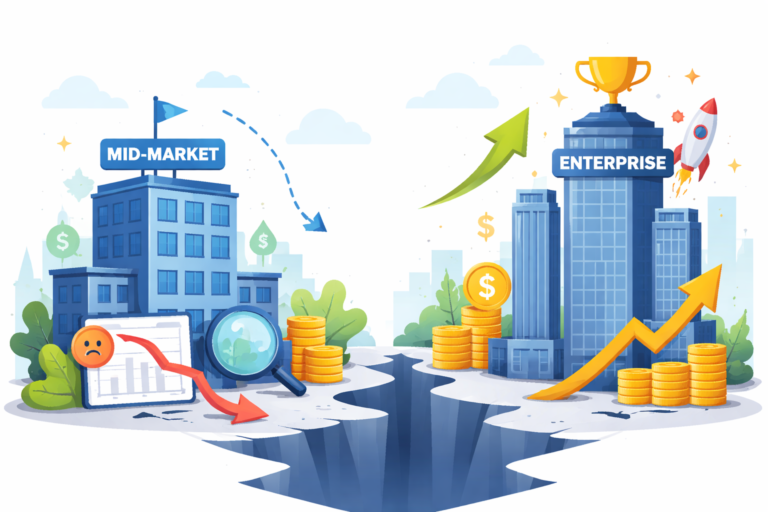
This isn’t a fluke. It’s a pattern. Mid-market companies consistently lose the battle for digital visibility against bigger competitors, not because their products are worse, but because enterprise budgets dwarf theirs. A Fortune 500 company spends $2M annually on SEO. Your $40M company spends $80K. That’s a 25x disadvantage.
The gap used to be insurmountable. Today, it’s not. AI-powered marketing strategies let mid-market companies punch above their weight, creating content at scale, automating technical SEO, and getting smarter about where they spend every dollar.
Enterprise companies win through budget; mid-market companies win through strategy. AI changes which matters more.
The Enterprise Digital Marketing Advantage (It’s Bigger Than You Think)
Enterprise companies have structural advantages that go beyond budget. They employ teams of 20+ marketing specialists, each focused on a single channel. They own multiple brand domains. They publish 50-100 pieces of content monthly. They A/B test everything. They have data scientists analyzing user behavior at scale.
| Team Size | Avg. Budget | Content/Month | Testing Cycles/Year |
| Enterprise ($1B+) | 25+ people | $2-5M | 52-104 |
| Mid-Market ($5-100M) | 4-6 people | $100-400K | 12-24 |
| Small Business ($1-5M) | 1-2 people | $20-50K | 2-4 |
This matters because digital marketing is fundamentally about volume and consistency. Search rankings reward sites with more quality content, faster technical optimization, more backlinks, and higher engagement. Enterprise companies simply do more, faster, and with more precision.
But here’s what happens next: diminishing returns.
Where Enterprise Strategies Fail (And Mid-Market Can Win)
Enterprise companies optimize for stability, not agility. They move slowly. A campaign idea discussed in January might launch in June. They have layers of approval. They have legacy systems that don’t talk to each other. Their SEO agency of record was hired three years ago and hasn’t fundamentally changed approach since.
Mid-market companies can exploit this gap:
- Speed: Deploy a new content strategy or test a new channel in weeks, not months
- Focus: Double down on 2-3 high-ROI channels instead of spreading budget across 10
- Personalization: Understand and serve your specific buyer persona better than a massive competitor can
- Agility: Pivot based on data without committee approval
- Authenticity: Tell your story in your voice, not through a corporate-approved template
The AI-Powered Strategy That Levels the Playing Field
AI changes the economics of digital marketing. It lets a team of 4 people do the work that used to require 20. Specifically:
- Content at Scale: AI tools generate SEO-optimized blog outlines, research summaries, and first drafts in minutes. Your team reviews and publishes 2-3x more content without hiring 3 new writers.
- Programmatic SEO: Instead of manually creating 20 landing pages, build systems that generate 200-500 targeted pages automatically. Enterprise companies are just starting to figure this out.
- Technical SEO Audits: AI crawls your entire site, identifies issues (missing schema, duplicate content, slow pages), and prioritizes fixes based on impact.
- Smarter Ad Targeting: AI predicts which audience segments will convert and shifts budget in real-time.
- Content Optimization: AI analyzes top-ranking pages and tells you exactly what your content is missing to rank.
Real Numbers: How Mid-Market Companies Actually Beat Enterprise
We’ve worked with mid-market software companies that ranked for zero commercial keywords three years ago. Today, they rank for 300+. How?
One B2B SaaS company with $25M revenue and a 3-person marketing team implemented programmatic SEO. They built systems that automatically generated 400 landing pages targeting specific buyer personas and use cases. Enterprise competitors focused on 12 flagship pages. Within 18 months, the mid-market company captured 35% more organic traffic and 22% more qualified leads.
Another example: A managed services provider ($18M revenue) started using AI to generate educational content in their niche. Instead of 1-2 blog posts per month, they published 8-10. Within 12 months, their organic traffic grew 340% and they established themselves as the thought leader in their category. Enterprise competitors were still publishing 2-3 posts monthly.
| Metric | Before AI Strategy | After AI Strategy | Improvement |
| Monthly Blog Posts | 2 | 10 | +400% |
| Organic Traffic | 12K visits/month | 52K visits/month | +333% |
| Qualified Leads | 8/month | 20/month | +150% |
| Time to Content (hours) | 40 | 12 | -70% |
Mistakes Mid-Market Companies Make (That Keep Them Behind)
Understanding the strategy is one thing. Executing it is another. Here are the most common stumbling blocks:
- Imitating Enterprise: Trying to compete on the same 10 keywords enterprise dominates. Instead, target long-tail, high-intent keywords your buyers actually search for.
- Ignoring Programmatic SEO: Still creating content manually when you could automate 70% of the work
- No Attribution Framework: Spending money across channels without knowing what actually moves the needle
- Slow Decision-Making: Taking months to test new strategies. Mid-market’s advantage is speed.
- Wrong Agency Partner: Working with an agency that applies a one-size-fits-all strategy built for enterprise clients
Building Your Mid-Market Digital Strategy (The Playbook)
Here’s what actually works for companies in the $5-100M range:
-
Own Your Niche Keywords
Don’t compete for ‘software platform’ (Enterprise owns that). Own ‘software platform for medical practices’ or ‘software platform for home service businesses.’ These keywords have lower search volume but higher intent and less competition.
-
Build Systems, Not One-Offs
Create content templates and processes that your team can repeat. If you’re creating one unique blog post per topic, you’re wasting time. Develop systems that generate 10 variations on a theme.
-
Leverage AI for Scale
Use AI to handle the high-volume, lower-value work. Your team focuses on strategy and quality control. This is how a small team competes with a large one.
-
Measure Everything
Set up proper attribution tracking so you know exactly what’s working. Enterprise companies get lost in vanity metrics. Mid-market companies win by being ruthlessly data-driven.
The Timeline: When You’ll Actually See Results
This is the question every CMO asks: how long until this works? The answer depends on your starting point, but here’s what we see consistently:
| Timeline | What Happens | Expected Results |
| Months 1-3 | Implement AI tools, build content systems, start pSEO | 20-30% more content, no ranking changes yet |
| Months 4-6 | Content gains authority, technical improvements compound | 10-15% organic traffic increase |
| Months 7-12 | Snowball effect: more content, more backlinks, more authority | 30-80% organic traffic increase |
| Year 2+ | Dominate niche keywords, establish thought leadership | 100-200% organic growth, qualified lead generation at scale |
Frequently Asked Questions
Q: Do we really need to compete with enterprise on the same keywords?
A: No. The best strategy is owning niche keywords your buyers actually search for. Enterprise dominates ‘marketing software.’ You own ‘marketing software for agencies’ or ‘marketing automation for nonprofits.’ More traffic, less competition.
Q: How much does it cost to implement AI-powered digital marketing?
A: AI tools cost $500-2,000/month depending on what you use. The bigger cost is time from your team. Most mid-market companies reallocate existing marketing budget rather than hiring new headcount.
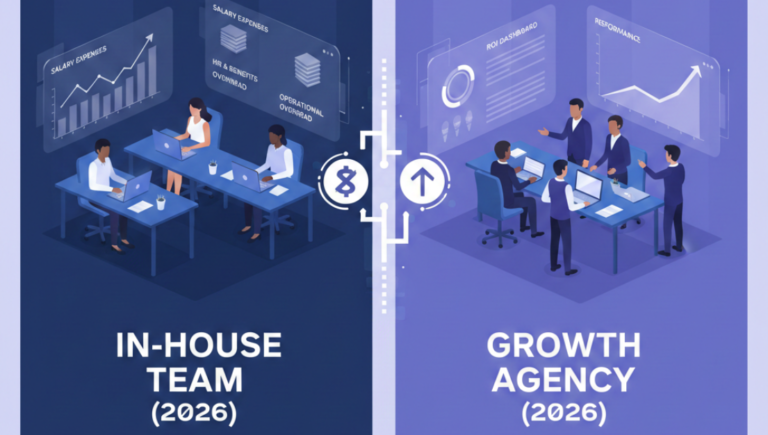
Q: Can we do this in-house or do we need an agency?
A: You can, but it requires learning new tools and strategies your team might not know. Agencies focused on mid-market companies can implement these strategies faster because they do it 20 times per year.
Q: What if we’re already losing market share to enterprise competitors?
A: Start now. The longer you wait, the harder it is to close the gap. Most companies that pivot to AI-powered strategies see results in 6-9 months.
Q: Which AI tools are actually worth the investment?
A: Start with SEO tools that include AI capabilities (Semrush, Ahrefs), content generation tools (Copy.ai, Jasper), and automation platforms. Don’t boil the ocean. Pick 2-3 tools and master them.
Next Steps
The window to compete with enterprise is closing. In two years, every mid-market competitor will be using AI. Get ahead now by building AI-powered systems your team can execute. Start with programmatic SEO, scale content creation, and measure relentlessly.
If you’re ready to build a mid-market digital strategy that actually competes, teams at companies like yours partner with growth agencies that specialize in this exact playbook. The goal isn’t to match enterprise budgets. It’s to outthink them.