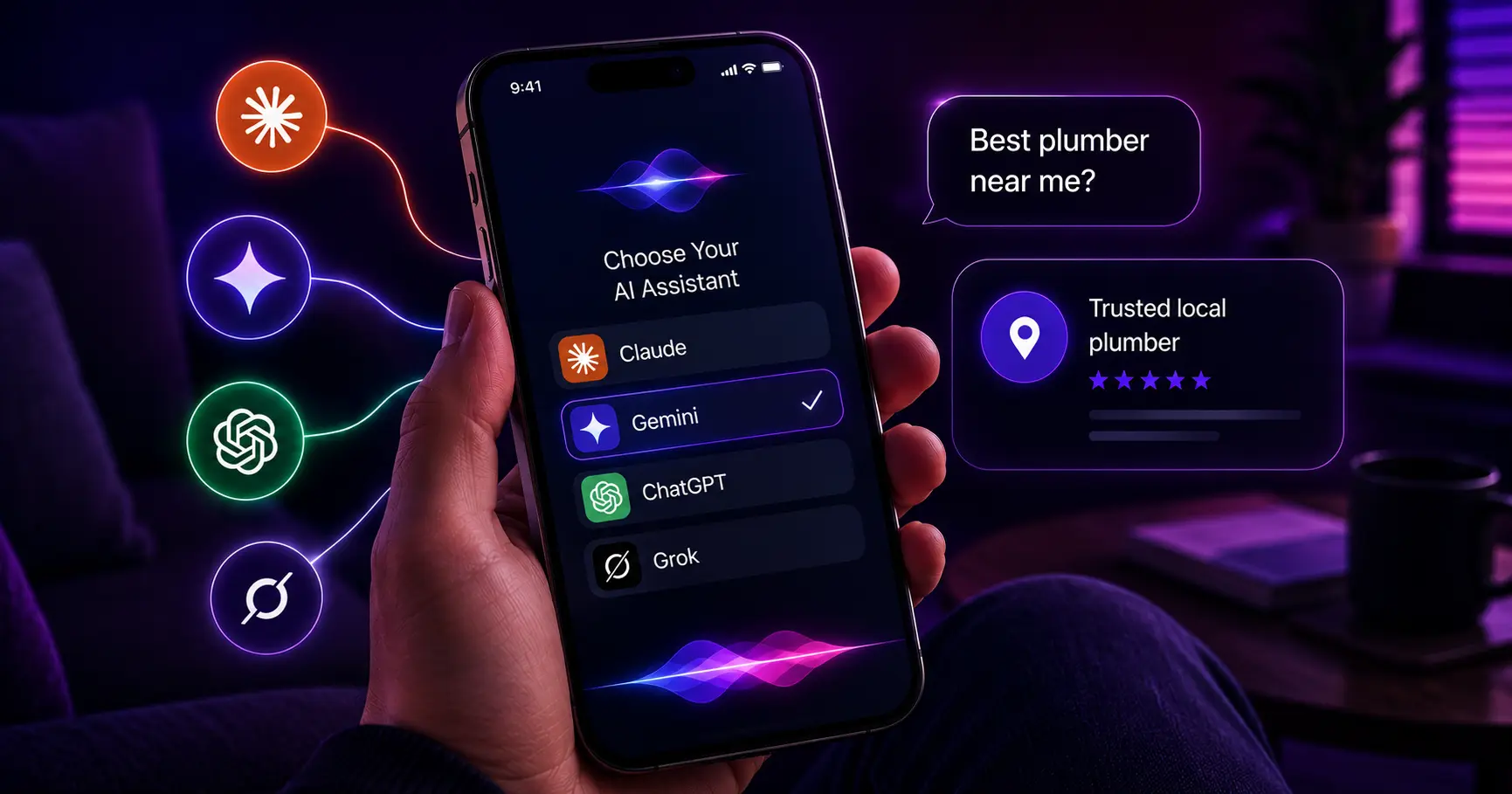
On June 8, 2026, Apple shipped iOS 27 with an Extensions system that lets people set Claude, Gemini, ChatGPT or Grok as the assistant behind Siri, and a rebuilt Siri running on Google Gemini models. For the first time, Claude is a native option on the iPhone. That puts a capable AI assistant one button press away on more than a billion devices.
At NuroSparX we watch where the moment a customer is ready to buy lives, because that is where customers get won or lost. When the default way to ask “who is the best plumber near me” shifts from a Google results page to an on-device assistant that just answers, your visibility stops being about ranking and starts being about whether the assistant can read, trust, and cite your business.
Short version
iOS 27 lets iPhone users run Claude, Gemini or ChatGPT inside Siri, so local buying questions get answered by an AI assistant instead of a search page. If that assistant can’t read or trust your business data, you are invisible at the exact moment someone is ready to buy.
AI on the home screen changes who answers buying questions
When customers ask an assistant instead of typing into a results page, the assistant picks one or two businesses to name. There is no page two in a spoken or AI-generated answer. If you are absent from the answer, you are absent from the decision. Simple as that.
Apple’s WWDC 2026 keynote opened Siri, Writing Tools and Image Playground to third-party AI through an App Store marketplace, with Claude and Gemini as the first partners alongside ChatGPT. According to MacRumors, users pick their assistant in the Apple Intelligence and Siri settings. So the question “best HVAC company in Austin” no longer returns ten blue links. It returns a short spoken or typed answer naming a handful of businesses, pulled from whatever sources the assistant trusts.
That leaves less room to be discovered later. A 2024 SparkToro analysis already found 58.5% of US searches end without a click, and on-device assistants push that further. If the AI model doesn’t have clean, consistent data about you, it picks a competitor and moves on.
Why AI assistants skip businesses with messy data
Assistants assemble answers from clear signals: business name, address, hours, services, reviews. When those signals conflict across the web, the AI model loses confidence and quietly drops you in favor of a business it can verify.
Picture a roofing company listed as “Apex Roofing LLC” on Google, “Apex Roofing & Exteriors” on Yelp, and “Apex Roofers” on its own site, with three different phone numbers. A human shrugs and figures it out. An AI assistant treats those as ambiguous, low-trust signals and reaches for the competitor whose name, address and service list match cleanly everywhere. Consistency is not cosmetic here, it is the trust score that decides whether you get named.
What this means in plain English
You need your business identity, name, address, services, and proof people can check, readable and identical across every place an assistant draws from. That is the work that gets you cited when a customer asks an AI who to call.
This is the core of our AI automation and analytics and GEO work, meaning AI visibility work. We run a local service business data cleanup: one official business name, address and service list, reflected consistently across your site, your directory listings, your schema and your review profiles, so assistants can read you without guessing. For a multi-location service small business, that cleanup is often the difference between getting named by Gemini-powered Siri and never surfacing at all. We pair it with clear structured data the AI models can parse and a citation check across the major assistants.
What we’d do first
Five practical things to do this month before AI assistants become the default first place customers go:
- Audit your business name, address and phone across Google, Apple, Bing, Yelp and your own site. Make them exactly the same.
- Write a plain, structured services list with the exact terms customers say (“emergency AC repair”, not “climate solutions”).
- Add or fix LocalBusiness schema so assistants can parse your hours, service area and offerings.
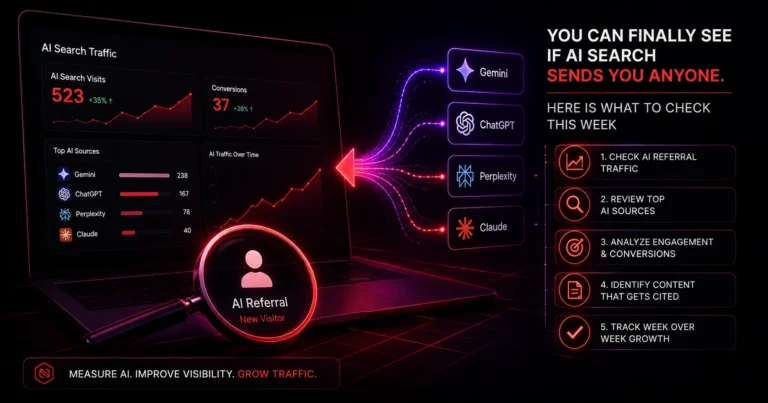
- Test the real questions: ask Siri, Gemini and ChatGPT “best [your service] near [your city]” and see if you appear.
- Fix the gaps the test exposes, then re-check monthly, because the assistant landscape is moving fast.
Bottom line
The home screen just became a search engine that gives answers instead of lists. The businesses that win the next year are the ones an AI assistant can confidently read, trust, and name when a customer asks who to hire.
We help local small and mid-sized businesses get there with business data cleanup, clear structured data and testing which answers cite or name you across the major assistants. If you want to know whether Claude, Gemini and Siri can actually find you today, get your free GEO audit, meaning an AI visibility audit and we will show you exactly where you stand.
Frequently Asked Questions
Can I really use Claude on an iPhone now?
Yes. With iOS 27, shipped June 8, 2026, Apple’s Extensions system lets you set Claude, Gemini, ChatGPT or Grok as the assistant behind Siri. Claude is a native iPhone option for the first time, chosen in the Apple Intelligence and Siri settings.
Does this replace Google for local search?
Not entirely, but it changes the first place customers go. Many buying questions now get answered by an on-device assistant naming one or two businesses, instead of a Google page listing ten. If you are not in that short answer, you lose the click before it happens.
What is GEO and why does it matter for my local business?
GEO, or generative engine optimization, is the practice of making your business readable and easy to cite by AI assistants and AI answer engines. It matters because assistants now mediate buying decisions, and they only name businesses they can verify and trust.
How does inconsistent business data hurt me with AI assistants?
When your name, address or services differ across the web, an AI assistant reads that as ambiguity and lowers its confidence in you. It then names a competitor whose data matches cleanly everywhere, because the AI model favors what it can verify.
What does a local service entity cleanup involve?
We standardize one official business name, address and service list, then make it consistent across your website, directory listings, schema markup and review profiles. That gives AI assistants a single trustworthy entity to read and cite.