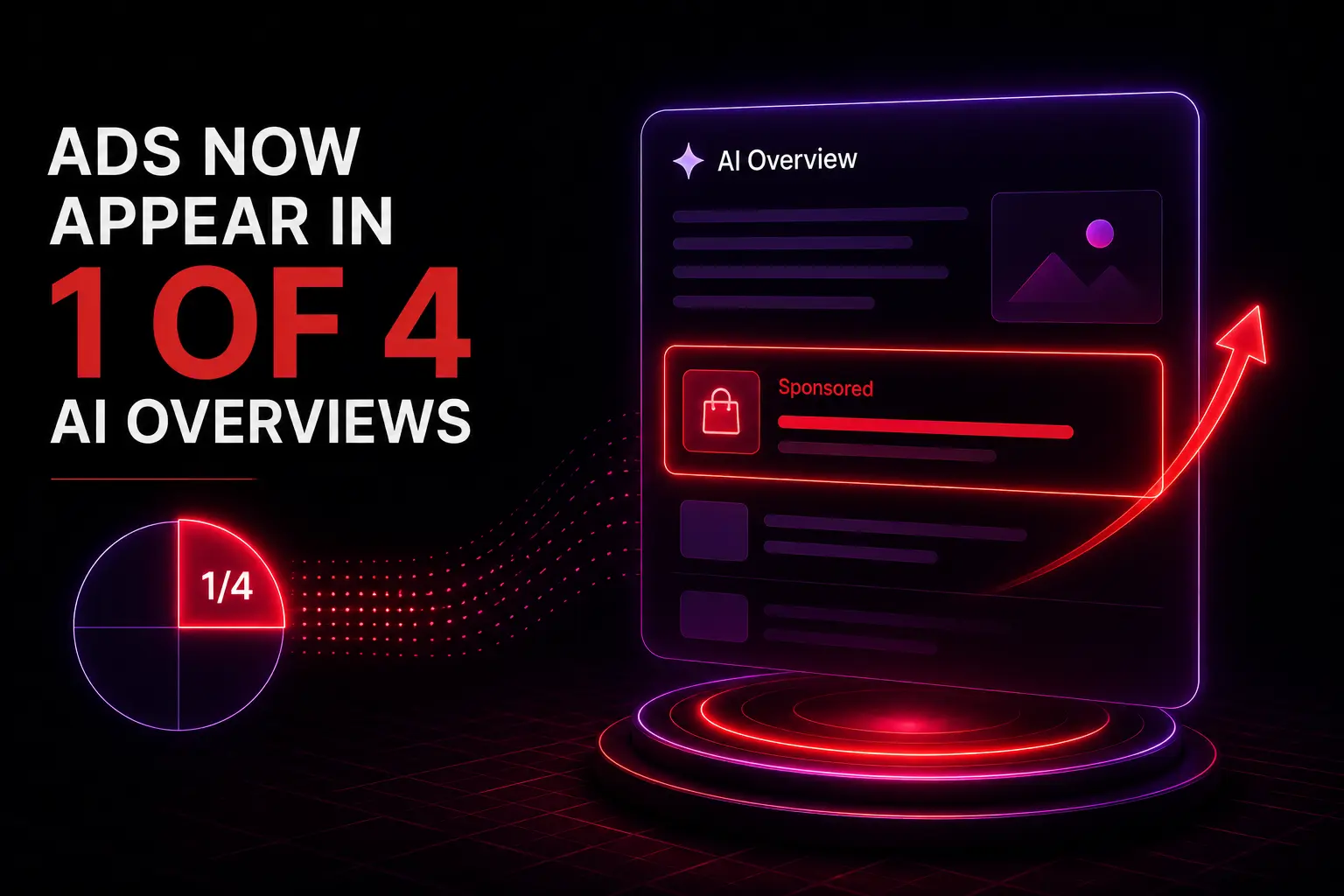
The wall between SEO and paid search is coming down, and it is happening inside the answer box. Ads appeared in 25.5% of AI Overview results in Q1 2026, up from roughly 5% a year earlier. That is close to a 394% jump in twelve months. One in four AI answers now carries a sponsored element sitting right next to the organic citations Google’s model pulled together.
At NuroSparX we have argued for a while that treating organic and paid as two separate budgets with two separate teams is now a structural mistake. When both show up in the same answer, competing for the same eye in the same moment, you have to plan them as one motion. We run full-funnel audits that tie the organic citation you earn to the paid capture that closes, because inside AI search they are no longer separate games.
Short version
Ads appeared in 25.5% of AI Overview results in Q1 2026, up from about 5.17% a year earlier, roughly a 394% year-over-year rise. SEO and paid now collide inside the same answer box, so small and mid-sized businesses running both channels must plan them as one connected funnel, not two budgets.
Why 25.5% is the number that should move your planning
In early 2025 ads ran alongside just 5.17% of AI Overview results. By Q1 2026 that hit 25.5%. Google is monetizing roughly one in four AI answers, and the rate quintupled in a year, which signals the answer box is becoming a primary ad show up, not an experiment.
A jump from 5% to 25.5% in twelve months is not a slow drift, it is a deliberate monetization push. For a brand, the implication is direct: the AI answer you hoped to win on organic merit increasingly has a paid slot above or inside it. If you only invested in organic citation, a competitor can now buy their way into the same answer. If you only invested in paid, you are missing the trust signal that an organic citation carries. The answer box rewards brands that show up both ways.
The collision: organic and paid in the same moment
Inside an AI Overview, the organic citation and the sponsored entry occupy the same screen and the same decision. The user is not choosing between a paid page and an organic page anymore. They are reading one synthesized answer that may cite you, sell to you, or both at once.
Imagine a buyer asks AI Mode ‘best commercial cleaning company for medical offices.’ The answer might cite your blog as a source while a competitor runs a Highlighted Answer in the same list. Your organic content earned the citation, but the paid slot captured the click. If those two efforts live in different spreadsheets and different teams, nobody notices the handoff is broken. Studies on AI Overviews show organic click-through can fall sharply when an answer satisfies the query, so the paid capture often becomes the only path to the click. Planning them together is the only way to read the real cost of a customer.
What separate budgets get wrong
When SEO and paid sit in separate budgets, you double-count wins, miss handoffs, and misread cost per acquisition. The organic team claims the citation, the paid team claims the conversion, and leadership never sees that one customer required both to appear in a single answer.
We see this constantly in audits. A brand celebrates a number-one organic citation while quietly paying a high cost per lead on the same query, never connecting the two. The fix is a shared view: which queries does the AI answer cite us on, where do we also need paid presence, and what is the blended cost to own that answer end to end. That is a full-funnel question, and it cannot be answered from inside one channel.
How to plan for the collision
Map your priority queries once, then decide for each whether you win it with organic citation, paid capture, or both. Tie the two together with shared tracking so you can see the blended cost to own an AI answer, and route both to a landing experience built to convert.
Start with the 50 to 100 questions your best customers actually ask an AI assistant before they buy. For each, check whether you are cited organically, whether ads appear, and whether you hold a paid slot. The overlap reveals where you are exposed. Then unify measurement so a citation that drives a branded paid click is not double-counted as two separate wins. Finally, make sure the page both channels point to is built to convert, because winning the answer is wasted if the click lands on a weak experience.
What we’d do first
Here is the full-funnel motion we run when paid and organic collide in the answer box.
- Build one query map covering the questions buyers ask AI assistants, not two separate keyword lists.
- Tag every priority query as organic-cited, paid-present, or both, and find the exposure gaps.
- Unify tracking so an organic citation feeding a branded paid click is not double-counted.
- Calculate the blended cost to own an AI answer, organic plus paid, per priority query.
- Point both channels at a CRO-tuned landing experience so the won click actually converts.
Bottom line
One in four AI answers now carries an ad, and that number quintupled in a year. The brands that keep SEO and paid in separate silos will keep misreading their numbers and overpaying to win answers they could own more cheaply with a connected plan. We tie your organic citations to your paid capture and show you the real cost to own each AI answer. Get your free full-funnel audit and we will map the collision points for your top queries.
Get your free full-funnel audit
Frequently Asked Questions
How often do ads appear in AI Overviews now?
Ads appeared in 25.5% of AI Overview results in Q1 2026, up from about 5.17% a year earlier. That is roughly one in four AI answers and close to a 394% year-over-year increase.
Why does this blur the line between SEO and paid?
Because the organic citation and the sponsored entry now appear in the same AI answer, competing for the same decision. The user reads one synthesized response that may cite you, sell to you, or both at once.
What is the risk of keeping paid and organic separate?
You double-count wins, miss handoffs, and misread cost per acquisition. One customer can require both an organic citation and a paid slot in a single answer, and siloed teams never see that.
What is a full-funnel audit?
A review that maps your priority queries, checks whether you win them organically, with paid, or both, and calculates the blended cost to own each AI answer end to end.
Where do I start?
Build one query map of the questions buyers ask AI assistants, tag each as organic-cited or paid-present, unify your tracking, and point both channels at a CRO-tuned landing page.