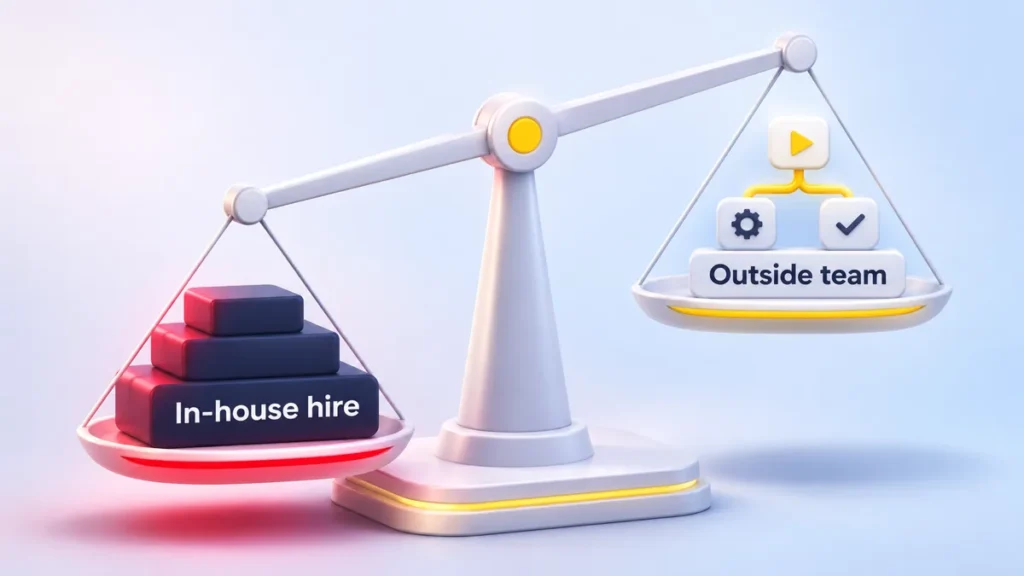
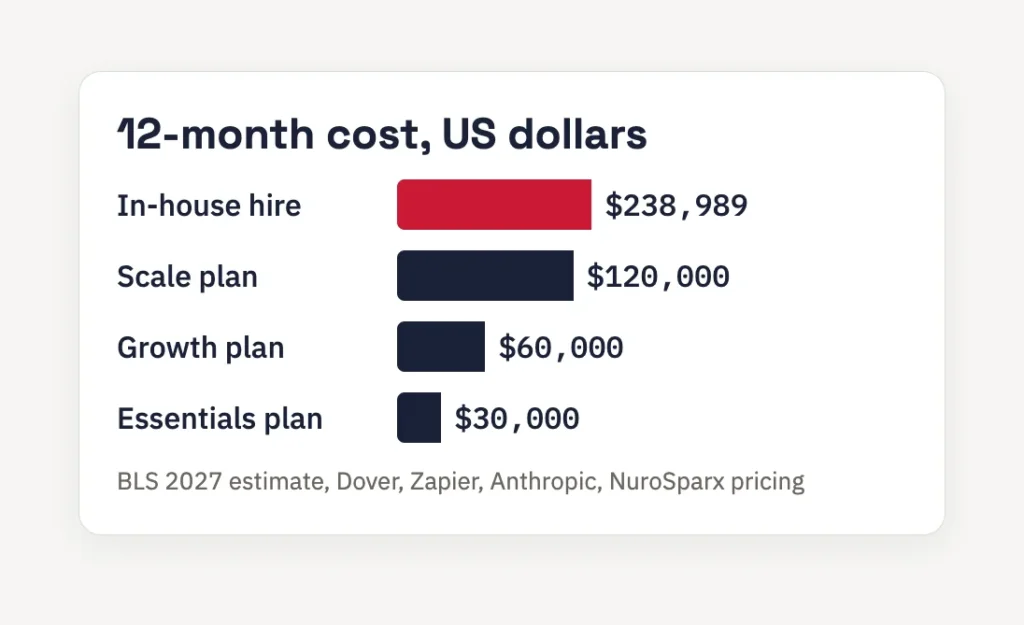
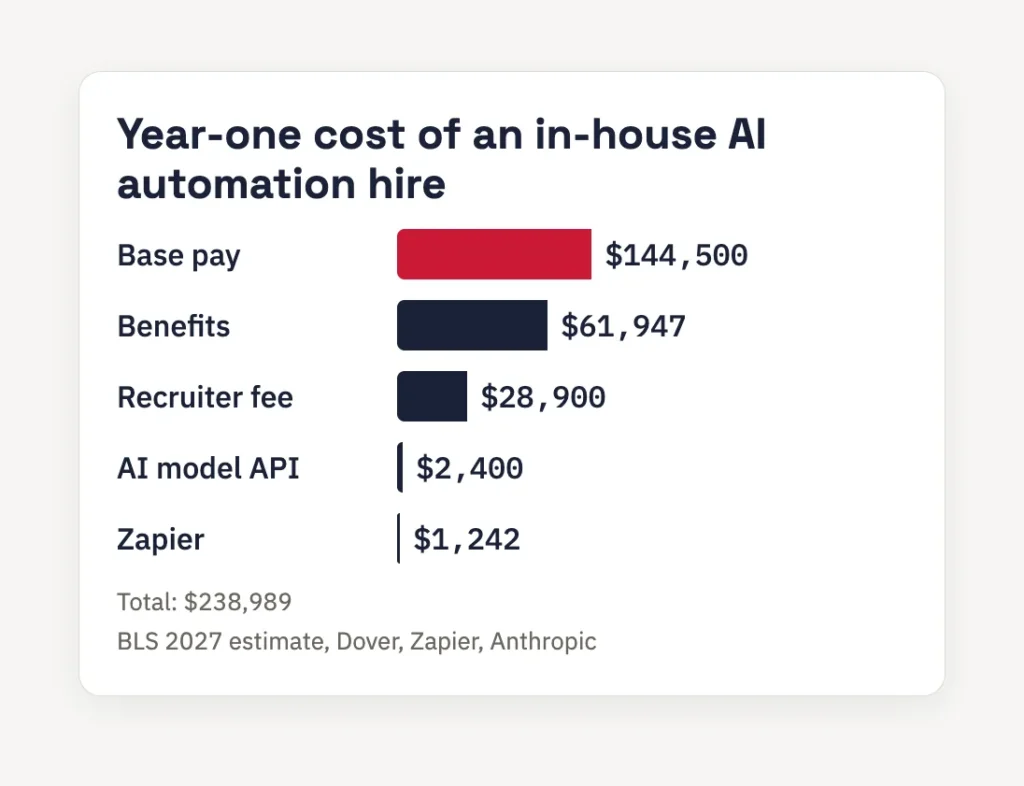
In 2027, one in-house AI automation engineer at the US median software developer salary will cost a $5M to $100M company about $239,000 in year one. That counts benefits, a recruiter fee and tools. An outside AI automation partner on a monthly plan costs $30,000 to $120,000 for the same 12 months. The hire wins when automation runs your core product and needs a person on site every day. For most mid-size companies, the outside team costs less and starts sooner.
The numbers below come from public pay data and vendor price pages. Swap in your own salary band and tool bills to get your number.
Add up the in-house hire
Most companies price a hire at the salary. The real 12-month cost has five parts: pay, benefits, recruiting, tools and the time you never see on an invoice.
Salary
The US Bureau of Labor Statistics puts the median pay for software developers at $135,980 a year as of May 2025. The lowest 10% earned under $82,460 and the top 10% earned over $214,670 (BLS, Software Developers).
We grow those figures to 2027. BLS reports that private-industry wages and salaries rose 3.1% in the 12 months ending September 2026 (BLS, Employment Cost Index). The pay data runs to May 2025, so we apply 3.1% for each of two years to reach May 2027. That gives a 2027 median of about $144,500 and a bottom 10% line of about $87,700. Every pay cost below is a 2027 estimate from the latest BLS data, grown at that rate.
BLS has no separate line for “AI automation engineer”. The software developer median makes a fair floor for a person who builds workflows, connects APIs and keeps them running. Engineers with machine learning skills cost more.
Benefits and payroll taxes
Pay is only part of what you spend on a person. In June 2026, private employers in the US spent $46.89 an hour per worker. Wages made up $32.82 of that and benefits $14.07, or 30% of the total (BLS, Employer Costs for Employee Compensation). Benefits here cover health insurance, paid leave, retirement and legally required costs such as Social Security and Medicare.
Measured against wages alone, benefits add about 42.9%. On a $144,500 salary, that’s $61,947 more a year.
Recruiting
A specialist hire rarely comes from a job post alone. Contingency recruiters charge a fee that is “typically 15% to 25% of the new hire’s first-year base salary” (Dover, 2026). At the 20% midpoint, the fee on a $144,500 salary comes to $28,900.
Hiring without a recruiter costs far less. SHRM’s 2025 benchmark puts the cost per hire at $1,200 for nonexecutive roles (SHRM, 2025 Recruiting Benchmarking). That figure covers job boards, referral bonuses and recruiter pay spread across all hires, so a hard-to-fill AI role will likely cost more.
Time matters too. SHRM’s 2026 data shows a median of 39 calendar days to fill a nonexecutive role, from the day the job opens to the day the candidate accepts (SHRM, Recruiting Benchmarking). Add the notice period at their old job, and you wait most of a quarter before the first workflow ships.
Tools and API spend
Your engineer needs a workflow tool and access to an AI model. We use today’s list prices for both. Zapier’s Team plan costs $103.50 a month billed monthly, with 2,000 tasks, or $69 a month billed yearly (Zapier pricing). n8n’s cloud plans start at 20 EUR a month for Starter and 50 EUR a month for Pro, both billed yearly (n8n pricing).
AI model calls bill by usage. Anthropic charges $2 per million input tokens and $10 per million output tokens for Claude Sonnet 5.5 (Anthropic pricing). Say your workflows send 50 million input tokens and get back 10 million output tokens a month. That example volume costs $200 a month, or $2,400 a year. Your real volume could sit well above or below that.
In our worked example, Zapier Team plus the API comes to $3,642 a year.
Time you don’t see on an invoice
Four costs never show up as a line item, and we can’t put a fair public number on any of them.
- Ramp-up. A new hire needs time to learn your CRM, your data and your people before they ship work that sticks.
- Management. Someone has to set priorities, review work and run one-to-ones. That person’s hours come out of their own job.
- Single point of failure. One engineer means one person who knows how every workflow runs. When they take leave or quit, the work stops.
- The empty seat. While the job sits open, the manual work you wanted to automate keeps eating your team’s hours. Your sales or ops staff keep copying data between tools for those weeks.
Count these in your own numbers. They push the true in-house cost above the table below.
Price an outside team for 12 months
An outside team bills a flat monthly fee. You skip benefits, recruiting and the vacancy gap. Tool and API bills stay with you either way, because the accounts belong to your company.
We sell three plans (NuroSparx pricing).
| Plan | Monthly | 12 months |
|---|---|---|
| Essentials | $2,500 | $30,000 |
| Growth | $5,000 | $60,000 |
| Scale | $10,000 | $120,000 |
Every plan runs month to month with 30 days’ written notice to cancel. The first 15 days of a new plan are free, so you can cancel inside that window and pay nothing. You get a report every Monday, and you keep every account and all your data.
One-off builds work differently. Custom software starts at $2,500 for an automation, $7,500 for a dashboard, chatbot or AI agent, and $15,000 for a portal or app with logins. After a free 30-minute scoping call, you get a fixed price in writing.
Compare the two over 12 months
| Cost line | In-house hire (BLS median) | Outside team |
|---|---|---|
| Base pay (2027 estimate) | $144,500 | $0 |
| Benefits and payroll taxes (42.9% of pay) | $61,947 | $0 |
| Recruiter fee (20% of base) | $28,900 | $0 |
| Workflow tool (Zapier Team, monthly) | $1,242 | $1,242 |
| AI model API (example volume) | $2,400 | $2,400 |
| Monthly fee | $0 | $30,000 to $120,000 |
| 12-month total | $238,989 | $33,642 to $123,642 |
Even the Scale plan comes in about $115,000 under the in-house hire in year one. Year two closes the gap a little, since you don’t pay the recruiter fee again. The in-house hire still costs about $210,000 a year before raises.
A cheaper hire doesn’t flip the result. Take a developer at the 2027 bottom 10% line of about $87,700. Benefits add $37,597, a 20% recruiter fee adds $17,540 and tools add $3,642. That hire still costs $146,479 in year one, about $23,000 more than the Scale plan with the same tools. And you get a junior builder working alone.
Look three years out
Year one carries the recruiter fee, so it flatters the outside option a little. Over three years, before any raises for the hire and with tools and API counted on both sides, the in-house hire still costs the most.
| Option | Year 1 | Year 2 | Year 3 | 3-year total |
|---|---|---|---|---|
| In-house hire (BLS median, 2027 estimate) | $238,989 | $210,089 | $210,089 | $659,167 |
| Scale plan plus tools | $123,642 | $123,642 | $123,642 | $370,926 |
| Growth plan plus tools | $63,642 | $63,642 | $63,642 | $190,926 |
Raises and a second recruiter fee, if your hire leaves, would widen the gap. A hire who ships twice the work of a plan would close it. Use your own scope to judge which way it leans.
The table also leaves out what the hire can’t cover. One engineer brings one skill set. An outside team can put a workflow builder, a data person and a CRM specialist on the same problem.
Price a senior AI engineer
If you need someone who trains or tunes models, the salary floor jumps. Levels.fyi shows a US median total pay of $251,000 for ML and AI software engineers, from 5,780 reported salaries. The 25th percentile sits at $170,000 and the 75th at $374,500 (Levels.fyi, ML/AI engineer pay).
Those figures lean toward large tech firms and include stock, so a $20M company may pay less in cash. A strong candidate with these skills will still compare your offer with them.
Most mid-size companies don’t need model training. They need workflows that move leads into the CRM, route support tickets, write first drafts and pull reports. That work sits closer to the $144,500 software developer median for 2027, and an outside team handles it well.
When hiring in-house wins
An outside team costs less on paper. That doesn’t make it the right call every time. Hire in-house when one or more of these holds.
- Automation runs your product. If your customers touch the workflows every day, you want an engineer who sits with your product team full time.
- The work fills more than one person’s week. Once you need two or three engineers’ worth of output every month, salaried staff can cost less per hour than a retainer.
- Your data can’t leave the building. Some health, finance and defense work carries rules on who can see the data. An employee inside your controls can make that simpler.
- You already have an engineering team. If a CTO can hire, manage and review the work, most of the hidden costs above shrink.
- You need changes every hour. A person who can walk to the sales floor and fix a broken trigger in five minutes beats any weekly cycle.
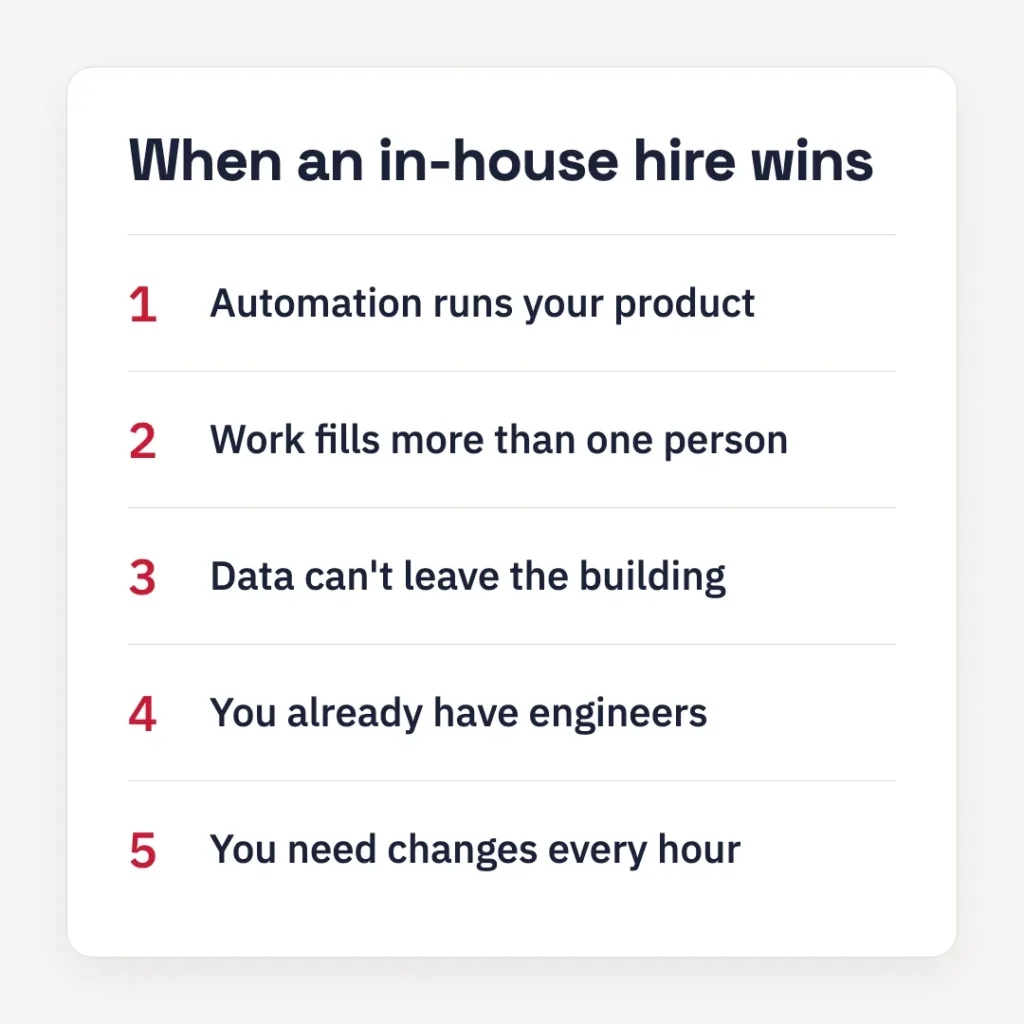
If two or more of these fit, budget for the hire. You can still bring in an outside team for the first 90 days to map the work and write the job spec.
When an outside team wins
An outside team fits better when the work comes in waves, when you can’t wait a quarter to start, or when you need more than one skill at once.
It also fits when you don’t yet know what to automate. A first project often turns up five more. Our no-code AI automation stack shows the kind of workflows owners can run this week, and our advanced n8n guide shows what a bigger build looks like.
When you search for an AI automation agency, you’ll see firms that sell prompts, firms that sell software licences and firms that build and run workflows for you. Ask which one you’re buying before you compare prices.
An outside team often starts with one of these four builds.
- An AI voice agent that answers calls, asks your questions and books the appointment.
- An AI chatbot for your site that captures leads after hours.
- A CRM flow that routes every form lead to the right person and logs the reply.
- A weekly dashboard that pulls sales, ad and operations numbers into one screen.
Mix the two
Many companies don’t pick one side. They hire one person to own automation and bring in an outside team for the builds.
The in-house owner knows the business, sets priorities and checks results each week. The outside team builds the workflows, writes the notes and hands them over. You pay one salary and still get a builder, a data person and a CRM specialist when a project needs them.
This setup also works as a bridge. Start with an outside team while you hire. By the time your new person starts, they inherit working flows and written notes. Keep the outside plan for big builds, or drop it with 30 days’ notice once your hire runs the day-to-day.
Ask these questions before you sign or hire
Run the same checks whichever way you lean.
- Who owns the accounts? The workflow tool, the API keys and the CRM should sit in your company’s name from day one.
- What happens when the person leaves? Ask for written notes on every workflow: what triggers it, what it touches and how to turn it off.
- How do you measure it? Pick one number per workflow, such as hours saved a week or leads routed within an hour, and track it.
- How fast can you get out? Check the notice period in the contract or the offer letter. Month to month with 30 days’ notice keeps your risk small.
- Who reviews the AI output? Every workflow that writes to customers needs a person who checks samples each week.
Run your own numbers this week
Take one hour and build your own version of the table.
- Pull the salary band you’d offer, then multiply by 1.429 for benefits.
- Add a recruiter fee, or $1,200 if you’ll hire without one.
- Add your current workflow tool and AI model bills.
- Compare the total with 12 months of an outside plan from our pricing page.
If the outside team comes in lower and none of the in-house reasons fit, start there. Tell us what you want to automate on our custom software page, and we’ll reply within 24 hours with our questions.
FAQ
How much does an AI automation engineer cost in the US in 2027?
BLS put median software developer pay at $135,980 in May 2025. We grow it at the 3.1% wage rate from the BLS Employment Cost Index to about $144,500 in 2027. Benefits add about 42.9%. With a 20% recruiter fee and basic tools, one hire costs about $239,000 in year one. Engineers with ML skills cost more: Levels.fyi shows a $251,000 median total pay.
Is it cheaper to outsource AI automation or hire in-house?
For most companies with one or two automation projects, an outside team costs less in year one. Our plans run $30,000 to $120,000 for 12 months, against about $239,000 for one in-house hire at the 2027 BLS median estimate. Hiring wins when automation runs your product or the work fills several full-time roles.
How long does it take to hire an AI engineer?
SHRM’s 2026 data shows a median of 39 calendar days to fill a nonexecutive role, from job opening to accepted offer. Add the notice period at the candidate’s current job and time to learn your systems. Plan on most of a quarter before the first workflow ships.
What does an AI automation retainer include?
It depends on the firm. Ask who owns the accounts, how often you get a report, how fast you can cancel and who reviews AI output. Our plans run month to month with 30 days’ notice, a report every Monday and the first 15 days free. You keep every account and all your data.
Do I still pay for tools if I use an outside team?
Yes. Workflow tools such as Zapier or n8n and AI model APIs bill by plan or usage, whoever builds the work. Keep those accounts in your company’s name so you own them if you change teams. Zapier’s Team plan costs $103.50 a month billed monthly.
You're All Set!
We have your request.
Expect a reply from our team within 24 hours. Want to talk sooner? Pick a time below.
Or call us at +1 (914) 297-6638