
You must have seen perplexity.ai popped up once or twice in your referral report and you wondered if it’s worth any real effort. Fair enough. Perplexity doesn’t rank pages like Google does. It answers the question first and then lists a handful of sources as clickable citations. Those citations are where your traffic is coming from. So your real job is to be the source that Perplexity chooses , and the link that people actually want to click . In this guide we will cover the crawler setup, the page structure, the off-site signals, GA4 tracking and a 30 day plan one person can run without a developer.
The Short Answer
For traffic from Perplexity AI to come through, three things must be true. Your pages are going to have to be read by Perplexity. Your pages need to answer a specific question clearly so they can be quoted and the answer needs to make the reader want the whole page.
Inside. It gets you looked at. Citations are structure. You get the visit You get the reason to click.
Most guides stop at the first two which is why plenty of sites get cited and still see almost nothing in GA4.
How Perplexity Sends Traffic in the First Place
Perplexity does a live web search, reads a small set of pages, writes an answer and attaches numbered citations for most questions. Click one and you are taken to the source site, usually with perplexity.ai as a referrer.
Two bots matter here, according to Perplexity’s crawler documentation:
- PerplexityBot indexes pages so they can appear in Perplexity’s answers. Perplexity recommends allowing it in robots.txt and permitting its published IP ranges.
- Perplexity-User fetches a page in real time when a user’s question needs it. Perplexity says it isn’t used for crawling or for training AI models.
The conclusion is simple. When PerplexityBot is blocked, content quality never gets a chance to matter.
One more thing: Perplexity cites passages, not pages. You can still cite a page on page 2 of Google if one section answers the question better than anything else Perplexity pulled.
Is Perplexity Traffic Worth Chasing in 2026?
Honest answer: the volume is small and the intent is high.
Trakkr monitors Perplexity referrals on a panel of 1,429 GA4 properties, and in its mid-2026 Perplexity traffic index Perplexity made up 1.4% of all AI referral traffic . The index was trending down over the last 30 days. That’s not a channel you build your marketing on.
I would still do the work. Everything that gets you a Perplexity citation—clear answers, sourced claims, crawlability, and a strong review footprint—also helps you show up in Google’s AI results and ChatGPT search. You’re not building a Perplexity-only asset. Someone who clicks a citation has already read a summary of the topic, so they tend to arrive further along than a cold search visitor.
That matters, since a growing share of B2B buyers start research in AI tools before they ever open Google. Treat Perplexity as a high-intent side door, not your front door.
Step 1: Make Sure Perplexity Can Actually Read Your Site
This takes 15 to 30 minutes, and plenty of sites fail here.
- Check robots.txt. Open yoursite.com/robots.txt and look for any Disallow rule under
User-agent: PerplexityBot, or a blanketUser-agent: *withDisallow: /. - Add an explicit allow rule so a future edit doesn’t quietly lock it out:
User-agent: PerplexityBot
Allow: /- Check your firewall. Many WordPress security plugins, Cloudflare bot rules, and Sucuri block unknown bots by default. Perplexity’s docs walk through allowlisting its bots on Cloudflare and AWS using its published IP lists.
- View source on your key pages. If the main text is loaded by JavaScript and is not present in the raw HTML, a crawler may see an empty shell. Server-based rendering or pre-rendering solves this.
- Give it a day. Perplexity says changes to robots.txt can take up to 24 hours to reflect on their end.
Step 2: Pick the 15 Questions You Want to Own
Don’t try to optimize “for Perplexity” in general. Pick 10 to 20 questions your buyers actually ask and go after those.
Good places to find them:
- Question-shaped queries in Google Search Console (“how”, “what”, “cost”, “vs”)
- Sales call notes and the objections people raise
- Support tickets and emails
- People Also Ask boxes for your main service keywords
Run every question through Perplexity and log it in a spreadsheet: question, sources cited, are you cited, which URL, notes. Fifteen questions take about an hour.
If you use Search Console already, Google’s newer AI visibility reports help you spot which question queries are worth adding to the list.
Example scenario: a Denver-based residential HVAC company with one marketer and no developer. Some of their list might include “how much does a heat pump install cost in Denver”, “are heat pumps worth it in Colorado winters”, and “how long does a furnace replacement take”. Running those, they might see a local news explainer, a Reddit thread and two cited competitor pages. Now they know exactly what kind of format they’re up against.
Step 3: Write Pages Perplexity Can Quote
Perplexity lifts passages. So write every section so it makes sense on its own, as if someone read only that section and nothing else.
What that looks like in practice:
- Put the direct answer in the first one or two sentences under each H2.
- Phrase H2s the way people phrase the question.
- Keep paragraphs to one idea and two to four sentences.
- Use a table for anything comparative and a numbered list for anything sequential.
- Keep key answers in visible HTML, not inside tabs or accordions that need a click to load.
- Show a “last updated” date, and make the update real.
Here’s the difference in a line. Weak: “Replacing a furnace costs a lot and it is dependent on many factors and no two homes are alike. Quotable: “Most furnace replacements are one day of install work and the price is mostly driven by unit efficiency, ductwork condition and whether a new gas line is needed.” The second one can be dropped into an answer straight away. The first one cannot.
If you want the longer version of this, we broke down how AI answer engines decide what to cite in a separate guide.
Step 4: Give Perplexity Proof It Can Check
Perplexity verifies what it reads , so specific , sourced claims beat vague claims .
There’s science in this. In the original GEO study, Princeton and collaborators tested what improved how often a source appeared in answers from generative engines. Their experiments showed that citations, quotes and statistics increased visibility by as much as 40%. It is a lab result, not a promise, but it fits into a system that has to source every claim.
Practical ways to apply it:
- Swap “most”, “many”, and “significant” for numbers you can source.
- Link the primary source right where the claim sits.
- Name the person and company behind any quote.
- Publish data only you have: job counts, average response times, the prices you actually charge, what customers ask most.
That last one matters most. Original data is the one thing competitors can’t copy.
What I wouldn’t do: invent or round up numbers. A stat nobody else can confirm is more likely to get skipped than quoted. Brands that get this right tend to see the payoff in clicks, which is part of why cited brands pick up more traffic from AI search than brands that are only mentioned.
Step 5: Get Mentioned Where Perplexity Looks
Your own site is only part of the story. Perplexity also pulls from forums, review sites, news coverage, and roundups, and it’s more likely to trust a brand if independent sources agree on it.
Where to focus:
- Reddit and niche forums. Answer real questions in the two or three communities where your buyers hang out. Be useful first and link rarely.
- Review profiles. G2 and Capterra for software, Google and Yelp for local services. Recent, detailed reviews carry more weight than a pile of one-liners.
- Consistent business facts. Name, services, locations, and hours should match everywhere.
- Trade and local press. A short data pitch (“we analyzed 400 service calls and here’s what broke most”) gets picked up far more often than a generic press release.
For local businesses specifically, we covered how plumbing, HVAC, and home service companies get recommended by AI in more depth.
One firm position: skip buying aged Reddit accounts or seeding fake threads. It breaks Reddit’s rules, moderators catch it, and one ban wipes out the whole channel.
Step 6: Give People a Reason to Click
This is the step most guides skip, and it’s why “we get cited but get no traffic” is such a common complaint.
Perplexity’s answer usually answers the question independently. If there’s nothing on your page that isn’t already in the summary, there’s no reason to click. Your page needs something a two-sentence summary just can’t communicate:
- A cost table or price range by scenario
- A calculator or quick estimator
- A checklist, template, or copy-paste prompt
- A worked example with real numbers
- Photos, diagrams, or before-and-after proof
Also match the page to the question. If Perplexity cites you for “cost”, show the cost in the first screen.
Here’s a quick way to diagnose where you’re stuck:
| Symptom | Likely cause | Fix |
|---|---|---|
| Never cited | Bot blocked or content loads via JavaScript | Redo Step 1 |
| Cited for the wrong questions | Vague opening paragraph | Make the first two sentences specific |
| Cited, very few clicks | Summary answers everything | Add a table, tool, or deeper asset |
| Clicks, no leads | Page doesn’t match the question | Align the first screen and the CTA |
| Citations fade after a few weeks | Page went stale | Real update with new data |
How to Track Perplexity Traffic in GA4
Perplexity visits usually show up as referrals from perplexity.ai. Some AI visits arrive without a referrer and get lumped into Direct, which is how GA4 handles any visit with no source attached (Google’s explanation of traffic sources in Analytics covers how that assignment works). So treat your number as a floor, not the full count.
Set it up once:
- Go to Reports > Acquisition > Traffic acquisition, switch the dimension to Session source, and search for “perplexity” to see your baseline.
- In Admin > Data display > Channel groups, create a new group with a channel called “AI Assistants”. Set the rule to Source matches regex:
perplexity|chatgpt\.com|claude\.ai|gemini\.google\.com|copilot\.microsoft\.com - Move that channel above Referral so AI visits get sorted first.
- Build a free-form exploration with Landing page and Session source as dimensions, and Sessions, Engaged sessions, and Key events as metrics.
- Check it weekly for the first month, then monthly.
The landing page view is the useful part, because it shows which pages Perplexity actually cites. We have a longer walkthrough for building an AI assistant channel in GA4 if you want screenshots and edge cases.
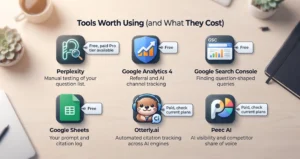
Tools Worth Using (and What They Cost)
| Tool | What it does | Cost |
|---|---|---|
| Perplexity | Manual testing of your question list | Free, paid Pro tier available |
| Google Analytics 4 | Referral and AI channel tracking | Free |
| Google Search Console | Finding question-shaped queries | Free |
| Google Sheets | Your prompt and citation log | Free |
| Otterly.ai | Automated citation tracking across AI engines | Paid, check current plans |
| Peec AI | AI visibility and competitor share of voice | Paid, check current plans |
If you’re tracking fewer than 20 questions, a spreadsheet and 30 minutes a week beats a paid tracker. Pay for automation once you’re past 50 prompts or managing several locations.
A 30-Day Plan for a One-Person Marketing Team
Week 1 (about 3 hours): fix crawl access, set up the GA4 channel group, build your list of 15 questions, and log a baseline of who gets cited today.
Week 2 (4 to 6 hours): pick the three pages closest to your most valuable questions. Rewrite their intros and H2s answer-first, add a table or list, and replace vague claims with sourced numbers.
Week 3 (3 to 4 hours): work off-site. Post five genuinely helpful forum answers, tidy up your review profiles, and send one data pitch to a trade or local outlet.
Week 4 (2 hours): re-run all 15 questions, compare against the baseline, check GA4 for perplexity.ai sessions, and choose the next three pages.
What to expect: citations can shift within days on fresh pages, but timing varies. Traffic will stay modest. Judge the month on citations gained and leads from those visits, not raw session counts.
Mistakes That Kill Perplexity Traffic
- Blocking bots by accident. Security plugins and CDN bot settings are the usual culprits.
- Faking freshness. Changing the date without changing the content fools nobody for long.
- Burying the answer. Three hundred words of setup before the point means a competitor’s direct answer gets quoted instead.
- Hiding content behind clicks. Tabs, accordions, and “read more” toggles that need JavaScript can keep the answer out of view.
- Publishing volume over depth. Five strong pages beat thirty thin ones.
- Only counting citations. A citation that sends no clicks and no leads is a vanity metric.
If you’re not sure which of these apply to you, an SEO, GEO, and AEO audit will flag crawl blocks, rendering issues, and weak answer structure in one pass. For a real example of building visibility in a crowded category, the MessageIQ case study shows how that work played out.
FAQs
Does Perplexity send real referral traffic?
Yeah. Whenever a Perplexity answer has a citation, the visit will usually appear in GA4 with perplexity.ai as the source. Some visits lose the referrer and show up as Direct, so the actual number is usually a bit higher than what you’re seeing.
How long does it take to get cited by Perplexity?
There is no official timeline. Perplexity says changes to robots.txt can take up to 24 hours to reflect on its side. Then, a clear, well-structured page can start appearing in answers in days to weeks, depending on the question and the competition.
Do I need to rank on Google to get cited by Perplexity?
No. But it helps. Perplexity does its own retrieval and will quote passages, so even a page that isn’t in the top 10 results on Google can be cited if it answers the question clearly. The same authority signals Perplexity looks for often appear on the pages that rank well.
Should I allow PerplexityBot in robots.txt?
If you want traffic to Perplexity, yes. Perplexity recommends allowing PerplexityBot and its published IP ranges so your pages can be included in its answers. Blocking it will mostly get you out of the race.
How much traffic can a small business expect from Perplexity?
It’ll be small compared to Google, expect. Perplexity drives 1.4% of all AI referral traffic in mid-2026 on Trakkr’s panel data. Visits are high intent, so judge the channel on calls and leads, not raw sessions.
Is optimizing for Perplexity different from regular SEO?
It’s basically the same base with a sharper edge. Clear answers, sourced claims, fast crawlable pages and strong reviews all help Google and Perplexity. The difference is that Perplexity rewards pages it can quote in a sentence or two, so answer-first writing is more important.
Where to Start Today
Before the week is out, do two things: verify that PerplexityBot can access your site and configure the channel for AI Assistants in GA4. All the rest is built on top of these.
If you’d rather have someone run the full playbook for you, our answer engine optimization services cover the crawl fixes, content rewrites, and citation tracking end to end.