Most carpet cleaning owners think SEO means getting a website that “looks professional” and hoping Google notices. It doesn’t work that way. SEO for carpet cleaning companies is almost entirely a local search game, decided by three things: your Google Business Profile, your reviews, and whether you’ve built pages for the services you already run but never bothered to write about. Get those three right and the rest is maintenance.
Here’s the part most agencies skip: none of it matters if the phone rings while you’re mid-job and nobody picks up. We’ll get to that.
What SEO for carpet cleaning actually means
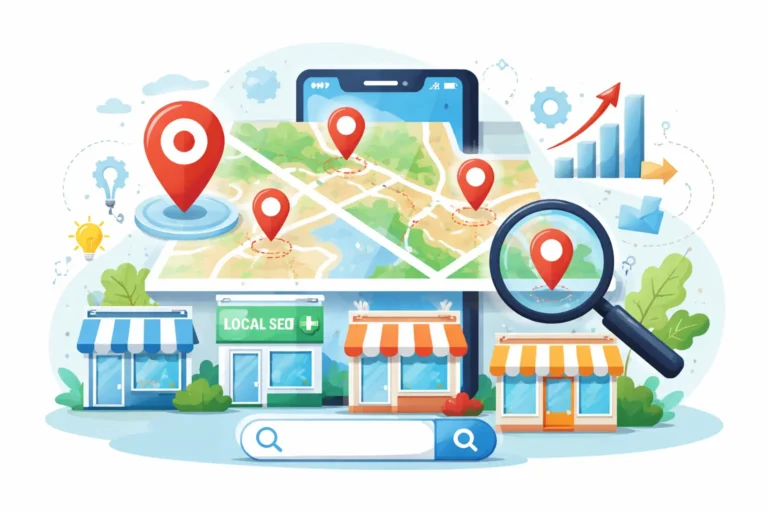
When someone types “carpet cleaning near me,” Google isn’t running a content contest. It’s matching a searcher’s location to a business it trusts is nearby, relevant, and reputable. That’s the whole game, and it’s why a one-page website with a great Google Business Profile can out-rank a competitor’s slick five-page site with a neglected listing.
Three factors decide who shows up: relevance (does your profile and site clearly say “carpet cleaning”), distance (how close you are to the person searching), and prominence (how well-known and trusted you appear based on reviews and links). Google itself describes prominence as being based partly on how many websites link to your business and how many reviews you have, noting that more reviews and positive ratings can help local ranking. You can’t move closer to your customer. You can absolutely improve the other two.
For carpet cleaners specifically, almost every search carries invisible “near me” intent, even when nobody types those words. A search for “pet stain removal” from someone in Tampa is a local search, whether or not the word Tampa shows up anywhere. This is why local SEO looks so different for a service-area business than it does for an ecommerce brand or a national B2B company.
Why this matters more right now than it did two years ago
There are over 39,000 carpet cleaning companies in the US. Most owners in a mid size metro have a dozen or more direct competitors fighting for the same 3 map pack spots. Franchise brands such as Stanley Steemer, Zerorez and Chem-Dry already dominate most cities. An independent operator doesn’t beat them on the word ‘carpet cleaning’ to win. You win on local relevance and review velocity, which are both things a franchise’s corporate marketing team is slower to move on than you are.
It’s not a hypothetical situation for a local service business to go from zero to dominant map pack presence. Autoglass America has gone from zero online presence to 3x lead growth in Florida using the same local-first playbook, and the mechanics translate directly to carpet cleaning.
AI Overviews are also beginning to answer informational questions such as “how to get red wine out of carpet” before anyone clicks on a result. That changes what stuff is worth writing, but doesn’t really touch the money queries. The transactional searches like “carpet cleaning near me” still go to the map pack, not an AI summary box. The businesses falling behind right now are the ones treating their website like a brochure and not a set of pages built around specific searches.
Start with your Google Business Profile, not your website
If you fix one thing this month, fix this. Most booked carpet cleaning jobs come through the three-listing map pack, not organic results below it.
Set your primary category to “Carpet Cleaning Service.” Google says the categories you select directly influence your local ranking by assisting them in matching your business with customers seeking similar products or services. BrightLocal goes further, calling the primary category the single most important local ranking factor in the map pack. A generic label such as “Cleaning Service” silently limits your visibility for the searches that actually convert.
Define your real service area. If you drive a 20 mile radius, set the radius. Listing zip codes you don’t actually serve is picked up through clickstream data (people clicking but not booking) and can suppress your ranking rather than expand it.
Upload real photos, weekly if you can manage it. Your real team, your van, before and after (with permission), real gear. Regularly posting and adding new photos to your profile ranks higher than a profile created once in 2022 and left untouched.
Post updates. Seasonal promotions, a new service, a new job. An active profile shows Google that the business behind it is still open and worth being shown.
The adjacent services you’re already leaving on the table
That’s the biggest missed opportunity in the category. Most carpet cleaners also clean upholstery, rugs, tile and grout and mattresses with the same truck and crew. And on most of their web sites, there is only one page: “Carpet Cleaning.”
Upholstery cleaning alone gets tens of thousands of monthly searches nationwide with next to no competition. Tile and grout cleaning and carpet cleaning are not far behind. These are not separate businesses you would have to start from scratch. They are services you already provide, that don’t have a specific page at the moment, so there is nothing for Google to rank those searches for.
| Service | Relative search demand | Competition level |
|---|---|---|
| Carpet cleaning near me | Very high | Very high |
| Upholstery cleaning | High | Near zero |
| Rug cleaning | High | Low |
| Tile and grout cleaning | Moderate | Very low |
| Mattress cleaning | Moderate | Very low |
Create a page for each one with its own title tag, meta description and content that actually addresses that specific service, not a paragraph bolted onto your homepage. This is realistically a two to three week project for a small team and it is the fastest moving lever you have available to you before you touch a single backlink.
Location pages, if you serve more than one city
You can’t rank one single home page for both “carpet cleaning Round Rock” and “carpet cleaning Georgetown.” Google picks one, the others go unseen.
If you cover multiple cities or suburbs, each one needs its own page with truly unique content: neighborhoods you cover, drive time, any specifics to that area. Google treats a boilerplate “We proudly serve [city]!” paragraph with the city name swapped out as thin, duplicate content and it won’t rank. We’ve got a multi-location SEO guide that covers how to set this up so the pages don’t compete with each other.
Publish your actual prices
Almost every carpet cleaning site avoids publishing pricing, which means almost every carpet cleaning site is invisible for “carpet cleaning cost” and “how much does carpet cleaning cost,” two searches with real commercial intent and close to zero competition. That’s a strange trade to make.
Give real per-room or per-square-foot ranges, and explain what changes the price: pet stains, heavily soiled carpet, move-out jobs, stairs. You don’t need to quote every job exactly. You need enough transparency that a homeowner comparing three companies picks up the phone to yours first, because you already answered the question the other two dodged.
Residential and commercial are two different SEO plays
This is a common and expensive mistake, to treat them as one audience. Residential is volume-driven, phone-led, and review-sensitive. Homeowners searching after a pet accident or before a move-out inspection. Commercial is lower volume but way higher value per contract with facilities managers and property managers as the buyer and a whole different set of proof points. Certifications, insurance, after hours availability, square footage pricing.
One commercial contract can be worth $3,000 to $10,000 or more in annual recurring revenue. Most carpet cleaning sites under build the commercial side as the keyword volume looks small next to carpet cleaning near me. Do the math on one won contract and the volume argument goes away.
Reviews are the fastest lever you’re not pulling hard enough
Prominence is one of the three main local ranking factors that Google directly ties to review volume and rating. Ranking is not the trust signal that a homeowner uses to decide to let a stranger into their house with heavy equipment.
Instead of waiting for clients to remember on their own, create a simple system: text a direct review link an hour after the job, while the clean carpet is still the freshest thing in the room. Answer every review, positive or negative, within 48 hours. A company with 80 recent reviews averaging 4.6 stars will out-rank one sitting on 200 reviews that dried up two years ago. Our guide to getting more five-star Google reviews walks through the exact ask-and-follow-up sequence that gets this moving.
The part nobody selling you SEO wants to talk about
All of the above tactics are designed to get your phone to ring more. This is the uncomfortable math that no one talks about. On average, home service businesses are missing 27% of their inbound calls, according to Invoca’s analysis of home services call data. And that number goes way up for smaller operations where one or two people are running the equipment and answering the phone.
Think about it. You’re halfway through an extraction, your hands are wet, the machine’s running, and your cell buzzes in your pocket. You can’t answer it and by the time you call back that homeowner already booked whoever picked up first. The second that call goes to voicemail, every dollar you spent on SEO to get that call is wasted. A picture-perfect Google Business Profile and a page one ranking don’t mean a single job if no one’s there when the phone actually rings.
This is the gap between SEO advice and revenue. And this is why SEO alone is an incomplete answer for a one truck or two truck operation. Local SEO plus something that catches the calls you can’t structurally answer—like an AI front desk agent that books the appointment while you’re still on your knees dragging a machine across the carpet—closes the loop the SEO work opens. If you want the full scoop on how this works without hiring a full-time receptionist, check out our breakdown of what missed calls really cost service businesses and our practical guide to AI chatbots and virtual assistants for service business owners. You can see what the actual set up looks like for a small operator on our AI automation services page.
Your first 30 days
Week 1: Fix your Google Business Profile category, service area, and photos. Set up a review-request text that goes out automatically after every job. This alone often moves the map pack faster than anything else on this list.
Week 2: Write and publish your adjacent-service pages: upholstery, rug, tile and grout, mattress. Each one gets its own title, description, and real content, not a paragraph tacked onto an existing page.
Week 3: Publish your pricing page with real ranges. If you serve more than one city, ship your first two location pages. Start tracking which of these pages is generating actual calls, not just impressions.
By day 30, you’ve fixed the single biggest lever (your profile), captured demand you were structurally invisible for (adjacent services), and started building the content that compounds over the following months.
Should you do this yourself or hire it out
If you have five to ten hours a week and a market with light competition, doing the Google Business Profile work and adjacent-service pages yourself is genuinely realistic. It’s mechanical work, not creative work.
Where DIY tends to stall is content that needs to keep going: location pages for every city, ongoing reviews management, and the technical maintenance that keeps a site fast and mobile-friendly. If you’re a solo operator without five spare hours a week, or you’re running multiple trucks across a competitive metro, that’s usually the point where bringing in outside help pays for itself faster than grinding through it alone. Our comparison of in-house marketing versus hiring a growth agency walks through the actual cost math both ways, and where the break-even point tends to sit for a business your size.
Mistakes that quietly kill carpet cleaning rankings
- One page for everything. Steam cleaning, dry cleaning, pet stains, commercial, residential, all crammed onto a single “Services” page. It can’t rank well for any of them.
- A miscategorized or half-filled Google Business Profile. No amount of content fixes a listing sitting under “Cleaning Service” instead of “Carpet Cleaning Service.”
- Treating reviews as an afterthought. Sporadic, aging reviews lose to a competitor who systematically asks after every job.
- No location pages, or worse, thin ones. A single homepage trying to rank in six cities at once usually ranks for none of them well.
- Refusing to publish pricing. You’re not protecting yourself from competitors seeing your rates. You’re handing them every “cost” search on a plate.
- Ignoring the commercial side entirely. The volume looks small. The per-contract value usually says otherwise.
FAQs
How long does SEO take to work for a carpet cleaning business?
Local pack movement from Google Business Profile fixes and fresh reviews can show up in 60 to 90 days. Adjacent-service pages and location pages typically build over three to four months. Full competitive rankings for city-level terms usually take six to twelve months.
How much does SEO cost for a carpet cleaning company?
Most operators land somewhere between $600 and $2,000 a month for professional SEO, depending on how many cities they serve and whether commercial work is part of the strategy. DIY is possible for close to zero cash cost, but it requires five to ten consistent hours a week from someone on your team.
What keywords should a carpet cleaning company target first?
Start with your primary service plus your city, then move immediately into the adjacent services you already perform: upholstery cleaning, rug cleaning, tile and grout cleaning, mattress cleaning. These carry meaningful search volume with far less competition than the core “carpet cleaning” terms.
Do I really need a page for every city I serve?
Yes, if you want to rank in more than one of them. A single homepage generally ranks for one location at most, and Google decides which one, not you.
Should I publish my prices online?
Yes, in ranges. The cost-related searches carry real buying intent and almost no competition, because most competitors refuse to publish anything.
Is the local map pack really more important than blog content?
For carpet cleaning, yes. Reviews, your Google Business Profile, and accurate service-area settings drive most of the calls. Content compounds on top of that foundation, but it doesn’t replace it.
Can I do carpet cleaning SEO myself, or do I need to hire someone?
You can handle the Google Business Profile work and adjacent-service pages yourself with a few hours a week. Ongoing location pages, ongoing review management, and ranking in a genuinely competitive metro is where most solo operators find their time runs out before the work does.
If your calls have started increasing and you’re not sure whether your team is actually answering all of them, that’s worth checking before you spend another dollar on rankings. Our SEO, AEO, and GEO audit shows you exactly where the gaps are, on your profile and on the phone.