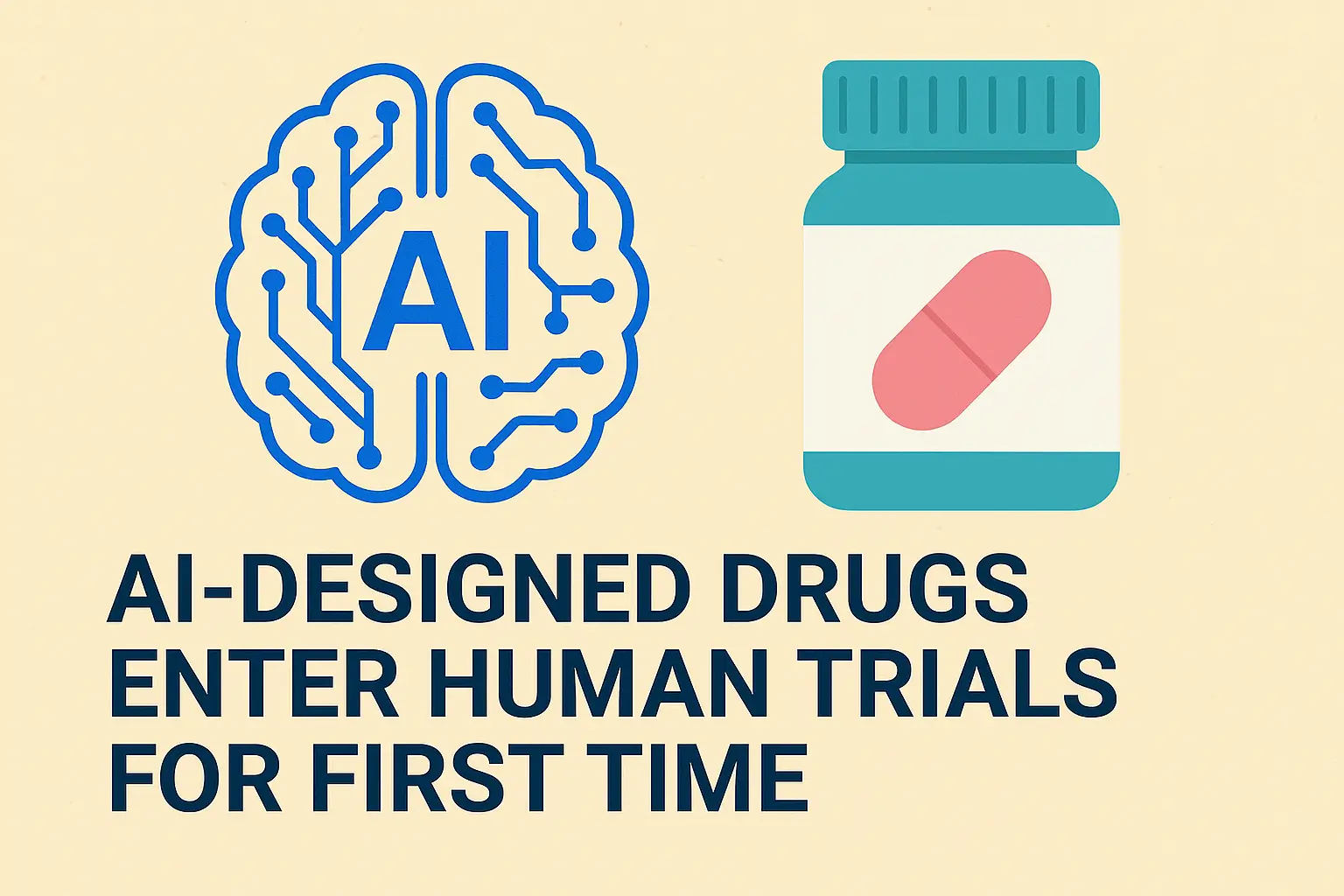
In a groundbreaking moment for both technology and medicine, Google’s Isomorphic Labs is preparing to launch the world’s first human clinical trials for drugs designed entirely by artificial intelligence. This milestone could fundamentally change how we discover and develop life-saving medications.
The Breakthrough Moment
After years of development, Isomorphic Labs—spun out from Google’s DeepMind in 2021—is finally ready to test its AI-created drugs in humans. Colin Murdoch, the company’s president, confirmed that clinical trials will begin very soon, marking a historic first in pharmaceutical development.
“There are people sitting in our office in King’s Cross, London, working and collaborating with AI to design drugs for cancer,” Murdoch told Fortune during a recent interview. “That’s happening right now.”
How AI Is Revolutionizing Drug Discovery
The breakthrough stems from AlphaFold, DeepMind’s Nobel Prize-winning AI system that can predict how proteins fold and interact with other molecules. Think of proteins as complex 3D puzzles—understanding their shape is crucial for designing drugs that can effectively target diseases.
Traditionally, discovering a single new drug takes 10-15 years and costs billions of dollars, with only a 10% success rate once human trials begin. Isomorphic’s AI approach promises to:
• Reduce discovery time from years to months
• Lower development costs dramatically
• Increase success rates significantly
• Target previously “undruggable” diseases
Real-World Impact for Patients
This technology isn’t just theoretical—it’s already attracting major pharmaceutical companies. Isomorphic has secured partnerships worth nearly $3 billion with Eli Lilly and Novartis, two of the world’s largest drug makers.
The company raised $600 million in funding in April 2025, demonstrating investor confidence in AI-driven drug development. The first trials will focus on cancer treatments, with plans to expand into other major disease areas.
“One day we hope to be able to say—well, here’s a disease, and then click a button and out pops the design for a drug to address that disease,” Murdoch explained.
What This Means for Healthcare
For patients and healthcare systems worldwide, this development could be transformative:
Faster Treatment Options: Diseases that currently have no treatments could see new drugs developed in record time.
Lower Drug Costs: More efficient development could eventually lead to more affordable medications.
Personalized Medicine: AI could design drugs tailored to individual patient genetics and specific disease variants.
Rare Disease Hope: Conditions affecting small patient populations—often ignored due to high development costs—could finally get attention.
Industry Transformation Ahead
The success of AI-designed drugs could trigger a massive shift in the pharmaceutical industry. More than 3,000 AI-assisted drugs are currently in development globally, according to market research firm GlobalData, though most are still in early stages.
Major players are taking notice. Novo Nordisk recently invested $2.76 billion in AI drug discovery partnerships, while numerous biotech companies are integrating AI into their research pipelines.
The Road Ahead
While promising, this technology still faces challenges. Human trials are notoriously complex, with high failure rates even for conventionally designed drugs. Regulatory agencies like the FDA must ensure AI-derived drugs meet the same rigorous safety standards as traditional medications.
However, if successful, these trials could mark the beginning of a new era in medicine—one where artificial intelligence helps us solve diseases that have plagued humanity for generations.
What This Means for Your Business
For healthcare companies, this represents both opportunity and disruption. Traditional pharmaceutical development processes may become obsolete, requiring significant strategic shifts.
Investment firms should monitor AI drug discovery companies closely, as successful trials could trigger massive market valuations.
Healthcare providers should prepare for potentially faster introduction of new treatments, requiring updated protocols for evaluating and adopting AI-designed therapies.
The convergence of AI and medicine is no longer science fiction—it’s happening now, and the results could reshape healthcare forever.