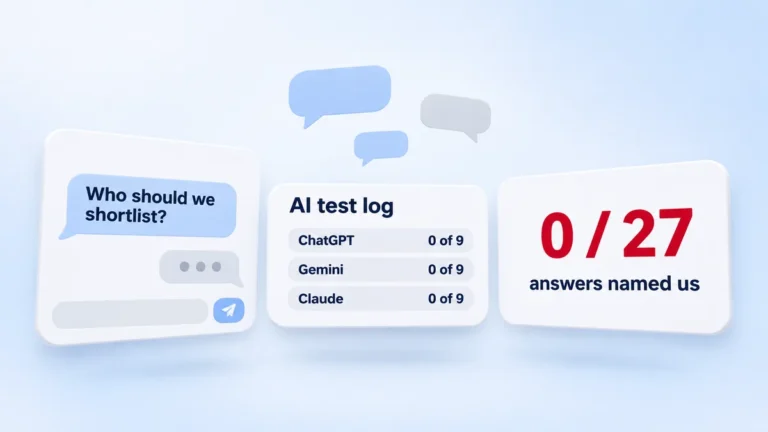

Want results like this for your business?
NuroSparx builds AI-powered growth engines for companies doing $1M to $100M. Let’s talk.
Your B2B company has done SEO the same way for three years. You publish blog posts. You build backlinks. You optimize for keywords. You watch ranking reports every month. Some months you move up and some months you don’t. Meanwhile, your agency hasn’t told you that the whole game is changing.
AI is already part of B2B SEO, and most agencies ignore it because it forces them to rethink their whole playbook. ChatGPT writing your blog posts is the small part. The bigger change is how search works, what B2B buyers want, and how SEO strategy has to change as a result.
An agency still doing manual SEO in 2026 has the basics right, but it’s falling behind.
AI changes three things in B2B SEO: how content gets made, how technical optimization works, and what ranks. Your agency is probably missing all three.
How B2B SEO changed in 2025
Traditional B2B SEO went after high-volume keywords like ‘CRM software’ or ‘marketing automation platform.’ You ranked for the keyword, got traffic and closed deals.
What changed
- AI search: ChatGPT, Perplexity and Google’s new AI-powered search results have changed how buyers search. They type questions instead of keywords.
- Buyer behavior: B2B buyers don’t start with Google. They start with AI assistants, LinkedIn or industry communities.
- Attribution: Traditional SEO metrics (rankings, traffic) don’t track what drives pipeline. Did that blog post create a customer? You don’t know.
- Content volume: Everyone publishes more content now. To rank, you need to publish 10x more, and getting 10x smarter alone won’t do it.
- E-E-A-T counts for more: Google openly puts ‘Experience, Expertise, Authoritativeness, Trustworthiness’ first. You can’t fake it.
What ‘AI-powered SEO’ means, and what it doesn’t
AI won’t write good blog posts for your company. It can write them, but you’ll hate the results. Most AI-generated content is fine for third-party blogs. Your company’s content needs to be better than ‘fine.’
What AI changes
| SEO Activity | Manual Approach | AI-Powered Approach | Impact |
|---|---|---|---|
| Content Strategy | Analyze 20 top-ranking pages | AI analyzes 500 top pages, finds gaps | More accurate strategy |
| Content Creation | Write one 2,000 word post | AI generates 5 to 10 outline variations, team picks the best | 3x content velocity |
| Keyword Research | Tools suggest keywords | AI predicts search volume and intent with 90%+ accuracy | Better keyword targeting |
| Technical SEO | Manual site audits | AI crawls the whole site, flags issues automatically | Find 50+ issues faster |
| Content Optimization | Edit based on ranking pages | AI finds exact content gaps, word count, structure | Better optimization |
| Link Building Strategy | Analyst finds targets by hand | AI finds 100+ link targets, scores them by relevance | More qualified targets |
The three core changes: content, technical, attribution
AI affects three specific areas of B2B SEO. If your agency doesn’t address them, it’s doing outdated work.
1. Content at scale
B2B companies need to publish more because buyers search for more specific things. Volume alone doesn’t impress Google. ‘CRM software’ is too broad. Buyers search ‘CRM software for insurance agencies’ or ‘CRM for nonprofits.’ Those are different searches, and you need content for each of them.
AI makes this possible. Your team creates one template. AI generates 50 variations. Your team reviews, edits and publishes. You now own ‘CRM software for [50 different industries].’ Enterprise competitors can’t keep up because they still publish one post per topic.
2. Programmatic technical SEO
Most companies have SEO issues they don’t know about: duplicate content, missing schema, slow pages, broken internal links. An AI-powered crawler finds all of this automatically and ranks the fixes by impact. An AI audit that costs $500 and updates monthly can replace a $10K technical SEO audit.
3. Answer-ready content (AEO)
AI search reads web pages looking for specific answers. ‘What is a CRM platform?’ ‘How much does a CRM cost?’ ‘What’s the best CRM for small teams?’ Your content needs a structure that lets AI pull answers out of it. Most B2B companies’ content isn’t built this way, and traditional agencies haven’t adapted.
Why B2B SEO is different, and why agencies miss it
B2B buying cycles are long and complex, with several stakeholders. A buyer might search for information, disappear for two months, come back, search again, talk to a competitor and then finally decide. Traditional SEO metrics (traffic, rankings) don’t capture this.
Most agencies report vanity metrics: ‘You ranked for 500 keywords this month’ or ‘Organic traffic is up 25%.’ For B2B, the metric that counts is whether that traffic generated pipeline and revenue. Most agencies don’t know because they can’t track it, so they report what they can measure.
AI-powered B2B SEO takes different thinking. You optimize for qualified leads, pipeline impact and deal size instead of traffic. That needs proper attribution tracking, which most agencies don’t set up.
The AI tools changing B2B SEO
Your agency probably uses Semrush and Ahrefs. Those are fine tools. The advantage comes from how you use them.
| Tool Category | Example | What It Does for B2B | Cost |
|---|---|---|---|
| Content Intelligence | Clearscope, MarketMuse | Analyzes top-ranking content, tells you what’s missing from yours | $500 to $2K/month |
| Technical SEO Automation | Semrush, Screaming Frog AI | Crawls the site, finds issues and ranks them | $300 to $1K/month |
| Programmatic Content | AI templates + generation | Creates 100s of targeted pages automatically | Custom, usually $5K to $20K setup |
| Answer Engine Optimization | Custom AI prompts | Structures content so AI search engines can pull answers | Included in most AI tools |
| Attribution & Tracking | HubSpot, Pipedrive integrations | Tracks which SEO touchpoint drove which deal | $1K to $3K/month for setup |
Real example: how one B2B company doubled pipeline with AI SEO
A SaaS company selling project management software for construction ($8M ARR) didn’t rank for construction-specific keywords. It had generic ‘project management software’ content and couldn’t compete on those terms.
The team built a programmatic SEO strategy: 200 pages, each targeting construction plus a specific use case. ‘Project management software for concrete contractors.’ ‘Project management for structural engineers.’ And so on. AI tools generated 80% of the structure, the team edited 20%, and they published at scale.
Within 12 months: a 340% increase in organic traffic, a 220% increase in qualified leads, and 18 new customers from organic search at an average deal size of $120K. Total investment: $80K in tools and labor. ROI: 27x.
Their old agency couldn’t do this because it took a different way of thinking about SEO. The goal changed from ‘get to page 1 for CRM software’ to ‘own every construction + software combination that exists.’ AI made that possible.
The AI SEO strategy that works for B2B in 2026
The framework B2B companies should use
- Identify your core buyer personas and the specific problems they search for. Be specific: ‘insurance agencies looking to scale their team,’ ‘nonprofits managing donors,’ ‘construction companies coordinating projects,’ rather than ‘people who need CRM software.’
- Map those personas to keywords and content gaps. AI tools help here. Look for high-intent, lower-competition keywords where you can rank.
- Build content systems instead of one-off posts. Create a template, use AI to generate variations, then review and publish. One template becomes 20 to 50 pieces of content.
- Structure content for answer engines. Use schema markup, answer blocks and specific formatting so AI search engines prefer your content.
- Set up proper attribution. Connect SEO touchpoints to CRM data so you know which keywords and content drive pipeline.
- Adjust based on real results instead of vanity metrics. Ask ‘did we get the right traffic, and did it convert?’ rather than ‘did we get traffic?’
Traditional agencies and AI-powered agencies
Ask your current agency about programmatic SEO, AI content tools or answer engine optimization. What do they say? If they haven’t added these, they may still have the SEO fundamentals right, but they’re slow to adapt.
How the two compare
| Approach | Traditional Agency | AI-Powered Agency |
|---|---|---|
| Content Strategy | Publish 1 to 2 posts per month | Publish 10 to 20 posts per month with templates |
| Technical SEO | Annual audit, manual fixes | Monthly automated crawls, ranked by impact |
| Content Optimization | Edit based on ranking pages | AI finds exact gaps and opportunities |
| Attribution | Assume all organic traffic is valuable | Track which keywords drive qualified leads |
| Scalability | Hire more people to do more work | Use AI to multiply output with the same team size |
| Reporting | Rankings and traffic | Qualified leads and pipeline impact |
Frequently Asked Questions
Q: Does AI write our blog posts for us?
A: Not really. AI writes outlines and first drafts that your team reviews. Your content needs real expertise and company knowledge. AI multiplies your team’s output. It doesn’t replace the team.
Q: What’s the difference between AI SEO and traditional SEO?
A: Traditional SEO means publishing more content, building more links and optimizing more keywords. AI SEO automates the low-value work so your team can focus on strategy and quality. The fundamentals stay the same, and the execution gets smarter.
Q: Do we need a new agency or can our current one adapt?
A: Some agencies adapt. Most don’t, because it means rethinking their whole service model. If they don’t already do programmatic SEO or use AI content tools, getting them there will be slow.
Q: How long until we see results with AI-powered B2B SEO?
A: Months 1 to 3: no ranking changes, but you build the content system. Months 4 to 6: rankings start to shift for new content. Months 7 to 12: the results snowball. By month 18, you’ve built established thought leadership.
Q: What’s the single most important change B2B companies should make?
A: Stop optimizing for individual keywords and start optimizing for intent clusters. Build content systems that cover every variation of what your buyers search for.
Next steps
B2B SEO is changing faster than most agencies adapt. The companies winning now moved from ‘do traditional SEO at scale’ to ‘use AI to do smarter SEO at 10x scale.’ If your agency still publishes two blog posts a month and celebrates keyword rankings, you’re falling behind.
Leading B2B companies now work with growth companies that combine AI tools with strategy expertise. That lets them outpace competitors and measure what drives pipeline and revenue.
Last updated: February 2026
Related NuroSparx resources
- Contact NuroSparx | AI-powered Digital Growth
- Fix What’s Blocking Your Visibility Across Search and AI
- Fix What’s Blocking Your Conversions Without Increasing Ad Spend
You're All Set!
We have your request.
Expect a reply from our team within 24 hours. Want to talk sooner? Pick a time below.
Or call us at +1 (914) 297-6638